- Статьи
- World
- The race of accusations: how the Europeans are trying to disrupt the dialogue between Russia and the United States

The race of accusations: how the Europeans are trying to disrupt the dialogue between Russia and the United States

The European "war party" is using the incident with Russian planes over the Baltic Sea to disrupt the settlement in Ukraine, Russian Deputy Foreign Minister Mikhail Galuzin told Izvestia. And according to the Ambassador-at-Large of the Russian Foreign Ministry, Rodion Miroshnik, the cases in Poland and the Baltic States have all the features of provocation. Meanwhile, on September 23, the NATO consultations, organized on the initiative of Estonia, ended. The Secretary General of the alliance, Mark Rutte, said that the bloc would respond decisively to air violations. Polish Prime Minister Donald Tusk has promised to shoot down Russian planes if they violate the border. The Russian Embassy in Warsaw told Izvestia that the Polish authorities have been engaged in the militarization of the region for a long time, and the statements of the leaders of this country are another confirmation of Warsaw's course towards targeted escalation.
Europe is trying to disrupt the Russian-American dialogue
European countries accusing Russia of violating its air borders are trying to disrupt the Russian-American dialogue on resolving the conflict in Ukraine, Russian Deputy Foreign Minister Mikhail Galuzin told Izvestia.
— The European "war party", seeing that its Ukrainian wards are suffering defeat after defeat on the fronts, that there is a Russian-American dialogue at the highest level (first of all, the meeting of the presidents of Russia and the United States in Alaska) about approaches to the political and diplomatic settlement of the conflict [in Ukraine], he is trying to disrupt this positive process and win over the United States, Donald Trump, using such unscrupulous methods as unsubstantiated accusations against Russia of violating airspace or sending drones into the territory of NATO countries," he stressed..

At the same time, according to Galuzin, the accusations of border violations are not supported by any evidence worthy of attention. No factual data has been provided that would confirm a violation of any norms and agreements on the part of the Russian side in either the case of Poland or Estonia, Russian Foreign Ministry Ambassador-at-Large Rodion Miroshnik added.
— To understand that this has all the features of provocation, you don't need to have a lot of brains, especially when a whole choir starts singing immediately on command, without having any reliable data. That is, it's enough just to shout, wave some unsubstantiated pieces of paper, and after that the singing begins," said Miroshnik.
According to him, everything that is being done and announced by the countries of the "coalition of the willing" is subordinated to one goal — to persuade Trump to change his position on the Ukrainian conflict, because without the resources of the American administration, money from the United States and the military-industrial complex of the United States, all plans are doomed.

The hysteria and information background formed in recent years allow European politicians to groundlessly accuse Russia, since the societies of these countries are ready for this, political analyst Denis Denisov said in a conversation with Izvestia. The alleged threat from Moscow provides an opportunity for the leaders of the NATO countries to maintain sanctions and tighten their policies. At the same time, European "hawks" and people affiliated with the military-industrial complex of a number of NATO countries are interested in all such provocations. For them, such situations are new large orders and confirmation of their rhetoric about the threat from the Russian Federation, Denisov concluded.
— Theoretically, all this could be a pre-planned action in order to discredit Russia and create a negative background ahead of the UN General Assembly, where, in particular, talks between Sergey Lavrov and Marco Rubio are scheduled. But provocations are needed, including to get a lot of money from the militarization of NATO's eastern flank. And, of course, in order to somehow put pressure on Trump and force him to protect Europe from an imaginary threat from Russia," Gevorg Mirzayan, associate professor at the Department of Mass Communications and Media Business at the Financial University under the Government of the Russian Federation, said in an interview with Izvestia.

The United States itself has so far reacted very cautiously to what is happening, political analyst Kamran Hasanov told Izvestia. According to him, Trump does not absolve Russia of responsibility for what happened, but at the same time he does not make harsh statements towards Moscow. The US president promised to provide assistance to Poland and the Baltic states in the event of an escalation of relations with Russia. Nevertheless, there was no harsh rhetoric from the White House until a certain point.

However, at the UN General Assembly, Trump nevertheless made a number of harsh statements. In particular, he said that European countries can shoot down Russian military aircraft if they cross the NATO border. However, when asked if the United States would support the allies if the Europeans decided to take such a step, Trump said it all depends on the circumstances.
"Some European leaders, in particular, want Trump to act from a position of strength — not to threaten sanctions, but to impose them,— Gevorg Mirzayan said.
Flight of Russian planes over the Baltic Sea
On September 23, a meeting convened at the initiative of Estonia ended at the NATO headquarters in Brussels. Following the meeting, Alliance Secretary General Mark Rutte issued a statement regarding the flight of three Russian MiG-31s over the Baltic Sea on September 19. The Estonian side provided its data, according to which the Russian planes were in the country's airspace for about 12 minutes. According to Rutte, no immediate threat was identified in this case, so Russian planes allegedly in Estonian airspace were escorted to the country's border by NATO aircraft.

MiG-31
— We will always react with calm determination. Because we have all the necessary defensive systems in place to ensure that we can defend every inch of NATO territory. We have demonstrated this both in the case of Poland and Estonia," the Secretary General said.
At the same time, the decision to open fire on targets in the airspace is made on a case-by-case basis in real time, the Secretary General of the North Atlantic Alliance added.

Russia has previously rejected the accusations of violating Estonia's airspace, calling them false and unsubstantiated. Dmitry Peskov, the press secretary of the President of the Russian Federation, said that the flight was carried out in accordance with international rules without violating borders, which is confirmed by numerous checks.
This week, another incident occurred in Danish airspace, where drones of unknown origin temporarily stopped the operation of Copenhagen Airport. On the evening of September 22 and the night of September 23, two to three large drones were spotted in the Aviagavan area. The airport was suspended for four hours.

Police officers at Copenhagen Airport, where flights were suspended due to reports of drones.
Prime Minister Matt Frederiksen called the incident "the most serious attack on Denmark's critical infrastructure." The Russian embassy in Copenhagen reported that Moscow is not interested in further escalation of tensions in Europe. The diplomatic mission stressed that the incident at the airport is traced to the desire to provoke a clash between NATO countries and Russia.
Rutte, in turn, said that it was too early to talk about the connection between drones in Denmark and the flight of Russian aircraft over the Baltic Sea. At the same time, he stressed: such incidents will not distract NATO from supporting Ukraine, which will continue with even greater energy and determination.
The drone incident in Poland and Romania
During a meeting of the UN Security Council on Monday, September 22, at which the same issue was discussed, Tallinn called the overflight of Russian aircraft "the most serious violation in years." Poland, whose airspace was violated by UAVs on the night of September 10, has also become more active recently — of course, Warsaw blames the Russian Federation for this.
Part of the UAV was shot down by Polish aircraft, and one of the drones allegedly fell on an apartment building. Warsaw immediately blamed Moscow for the destruction on its territory, but later it turned out that the building was damaged as a result of a Polish missile hit. Polish Prime Minister Donald Tusk earlier announced the readiness of the Polish Air Force to shoot down any targets that openly violate the country's airspace. At the same time, in all other cases, Warsaw will avoid steps leading to escalation, the politician added.

The destroyed roof of an apartment building in Poland as a result of a drone attack
The Russian Embassy in Warsaw told Izvestia that Tusk's statements were unjustified and aimed at increasing escalation in relations with Russia.
"The latest statements by Prime Minister Donald Tusk and Foreign Minister Radoslaw Sikorski are yet another confirmation of Warsaw's course towards a targeted escalation in the field of military and political security in Europe," the diplomatic mission said.
In addition, the embassy pointed out that Warsaw has been actively involved in the militarization of the region for at least the last eleven years under the pretext of a far—fetched "Russian threat," and incidents with drones and airplanes over the Baltic are just another reason to justify its confrontational policy.
Russia, for its part, called the accusations politicized, as well as "part of a general escalation" towards the Russian Federation. Russian Permanent Representative Vasily Nebenzia said that the Polish authorities subsequently recognized the absence of a warhead from the detected drones. He also added that some of the drones, according to Polish reports, could have flown from the territory of Ukraine.

The Russian Defense Ministry offered Warsaw to hold joint consultations to find out what kind of drones they were and how they could get there, but the Polish side left the proposal unanswered. In addition, the Russian military department stated that the range of the drones that were used to strike Ukraine that day did not exceed 700 km, which excludes their penetration deep into Polish territory.
Meanwhile, a UAV was also spotted in Romania on the night of September 14 — an unknown drone violated the country's airspace and, according to some reports, stayed in it for up to 50 minutes. Two F-16 aircraft of the Romanian Air Force escorted the target until it returned to the territory of Ukraine.

The alliance used the cases in Poland and Romania as an excuse to strengthen the military mission of the Eastern Sentry. The operation involves the deployment of additional pairs of fighter jets on routes from Poland to the Baltic, as well as the reinforcement of NATO's eastern flank with air defense and electronic warfare systems.
It is obvious that the lobbyists of the so-called drone wall, that is, a continuous contour of anti-drone defense from the Baltic to the Black Sea, have become a direct beneficiary of European provocations. After the UAV flight over Poland, the European Commission and the EU Defense Ministry convened ministers to discuss the financing of the project. On September 23, immediately after the incident over the Baltic Sea, Lithuania proposed to directly integrate Ukraine into the "drone wall" being created, citing its unique combat experience.

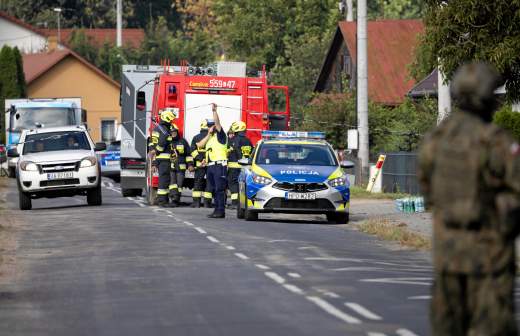
NATO exercises in Poland
Thus, each of the incidents in which European countries wrongly accused Russia led to increased militarization of Eastern European countries. It is difficult for the leaders of the NATO countries to justify the extra costs of the army and sending extra soldiers to the east, if there is no appropriate excuse for this.
For a long time, Europeans have been interested in internal problems more than Ukraine. In this case, even artificially inflating the threat, whether in Poland or the Baltic States, perfectly solves this problem and allows European politicians to get money out of taxpayers' pockets under the plausible pretext of "protecting their own borders."
Переведено сервисом «Яндекс Переводчик»
