
Pressure surge: EU and Ukraine postpone peaceful settlement of crisis

Western countries have chosen the path of aggravation of relations with the Russian Federation. The man-made provocation involving alleged Russian drones and Poland's refusal to contact Moscow on this issue indicate the desire of Kiev and its European allies to escalate, Konstantin Kosachev, Deputy Chairman of the Federation Council, told Izvestia. On September 13, Poland and Romania announced the threat of an invasion of their airspace by UAVs from Ukraine, and on the same day, NATO launched Operation Eastern Guard. At the same time, the EU is trying to persuade the United States to take tougher actions against Russia by joining the sanctions, according to the expert community.
A new round of aggravation of relations between Europe and the Russian Federation
EU countries intend to discuss the response to the drone incident in Polish airspace at a meeting of ministers responsible for European affairs, scheduled for September 16, Polish radio station RMF FM reported. According to media sources, in this context, Warsaw is probably interested in the so-called drone wall, which was previously mentioned by European Commission President Ursula von der Leyen. In addition, Poland intends to raise the issue of drones at the October summit of EU leaders.

The Polish authorities claim that on September 10, 21 Russian drones entered their country's airspace, four of them were shot down. Moscow has denied these accusations. In particular, the Russian Charge d'affaires in Poland, Andrei Ordash, stressed the lack of evidence from the Polish side about the Russian origin of the downed drones. Moscow, in turn, offered to hold consultations on this issue, but there was no reaction from Warsaw to this initiative.
Earlier, during a meeting of the UN Security Council, Warsaw was invited to a dialogue by Russia's permanent representative to the organization Vasily Nebenzya.
"We urge our Polish colleagues to take advantage of this proposal rather than engage in megaphone diplomacy on multilateral platforms. We have repeatedly stated that we are not interested in escalating tensions with Warsaw. We are repeating this now," he said.
However, instead of dialogue, on September 13, Warsaw reiterated the threat of violation of airspace from the territory of Ukraine. In this regard, Polish and NATO fighters took to the skies, and an air raid siren sounded in several areas bordering Ukraine in the Lublin Voivodeship. The authorities of the republic also temporarily stopped accepting and sending flights from Lublin Airport. Later it became known that the military had not confirmed the threat.

On the same day, Romania also noticed the drone in its airspace. Two F-16 fighters were called in at once to neutralize it. The accusations against Russia were immediately made by the Minister of National Defense, Jonuts Mostianu.
"Romania condemns Russia's irresponsible behavior, which threatens stability in the region," he said.
As expected, the head of the European Diplomacy, Kaya Kallas, expressed solidarity with Bucharest, blaming Moscow for the attack.
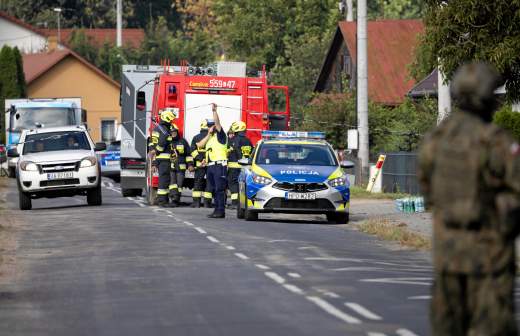
Against this background, "to strengthen the alliance's position on the eastern flank," on September 13, NATO announced the launch of Operation Eastern Guard.
"This is a very serious operation, probably one of the largest in the history of NATO," Polish Defense Minister Wladyslaw Kosiniak-Kamysh said at a press conference.
He noted that planes and helicopters, ground equipment, air defense, ground-based missile defense and anti-drone systems will be involved in the operation. Eight countries have agreed to participate in the operation. It is assumed that the operation will cover the entire eastern flank of the bloc: from the Far North to the Black and Mediterranean Seas. In 2026, NATO has already launched the Baltic Sentinel naval operation.

Meanwhile, the EU is increasing pressure on Russia in other areas. This week, the European Commission plans to introduce the 19th package of anti-Russian sanctions. Earlier, Brussels agreed on a six-month extension of individual restrictions, which were introduced after the start of the free trade. At the same time, it became known about the tightening of the criteria for issuing German visas to Russians. On September 13, the Consulate General of Spain temporarily suspended the acceptance of applications.
Is the dialogue between Moscow and Kiev continuing
Against this background, there were reports that representatives of the Armed Forces of Ukraine will begin to train Polish soldiers in the fight against UAVs. Polish Foreign Minister Radoslaw Sikorski said it was Ukrainians who would teach the West to "stand up to Russia," and Zelensky called on NATO countries to "respond decisively."
Poland's unwillingness to make contact with Moscow indicates the intention of Kiev and its European supporters to continue escalating the conflict with the Russian Federation, said Konstantin Kosachev, Deputy Chairman of the Federation Council.
— Of course, the provocation is man-made. I am sure that Ukrainians and those who support and encourage them in their desire to continue the armed conflict with Russia are behind it. The escalation is visible to the naked eye," he told Izvestia. — The situation itself can be comprehensively resolved through direct consultations between the relevant Polish and Russian agencies without intermediaries. Since everything else is being done, it is clear that the issue is not security concerns, but an effort to continue to push the pedal on the escalation of the conflict in Ukraine.

Russian-Ukrainian negotiations have now been put on pause, Konstantin Kosachev added.
— Kiev is not currently in the negotiation process with the Russian Federation. As far as I understand, even the working-level consultations have now been put on hold, not on our initiative, but before the current provocation (with the UAV in Poland. — Izvestia), — said the senator.
This year, Moscow and Kiev have already held three rounds of negotiations in Istanbul, where the key agreements were humanitarian prisoner exchanges and the return of the bodies of dead fighters. At the last meeting, the Russian delegation came up with a proposal to create working groups on political, humanitarian and military issues, as well as to introduce short-term truces for 24-48 hours for the work of medical teams.
The approval of the next round of negotiations is delayed due to the fact that Ukraine demands an immediate ceasefire and a meeting of the leaders. Russia sees it as important to address the root causes of the conflict and respect the rights of the Russian-speaking population. As for the summit of the heads of state, in early September, Vladimir Putin invited Zelensky to a meeting in Moscow, and the leader of Ukraine refused.

"Kiev's strategy is designed to ensure that the support from the collective West will continue indefinitely," political analyst Denis Denisov explained to Izvestia. — Therefore, Kiev does not consider it possible to compromise on officially declared positions. If the situation on the battlefield changes significantly, we will see progress in the negotiation process. In this context, Kiev's proposals to hold a meeting of the leaders look strange. Such events can be implemented, but only with a number of elaborated nuances and moments, and some decisions should be made based on their results.

The EU is concerned about the US position on the situation with drones
Meanwhile, the EU is concerned about the US attitude to the drone incident. According to European diplomats interviewed by Reuters, Donald Trump's "restrained" reaction calls into question Washington's readiness to defend allies in the event of an attack, as prescribed by the fifth article of the NATO charter on collective security.
Indeed, the day after the incident, the American leader said that the arrival of drones could have been a mistake. Later, Trump added that he was not going to "protect anyone" in this situation. And US Secretary of State Marco Rubio said that Washington wants to get more information before drawing conclusions.

— Europe, as the head of European diplomacy, Kaya Kallas, said, allows the continuation of the war for a couple of years. They vainly believe that Russia will run out of steam by that time, European militarization will gain momentum, and the United States will be disappointed in Moscow. Arms supplies will continue, and their pace depends on Trump's opinion. If he chooses the "Russia is to blame" course, there will be no deterrent mechanisms on the part of Washington in terms of supplying long—range missiles and everything else," Kamran Hasanov, a political scientist and INF expert, said in an interview with Izvestia.
By intensifying anti-Russian rhetoric, Europe is trying to attract the attention of the United States, agrees Tigran Meloyan, an analyst at the HSE Center for Mediterranean Studies. Brussels wants to make Washington think that Moscow continues to pose an immediate threat to Europe's security, the expert believes.
— This "threat" is a good excuse to send additional allied forces to the border with Russia and Belarus and keep them there on a permanent basis. Now the issue of consolidation is acute in NATO, and the Europeans would like to use the incident with drones as an opportunity to restore this consolidation," he explained to Izvestia.
It is possible that the EU will also use the incident to convince Washington to join the new package of anti-Russian restrictions. Earlier, the head of the European Council, Antonio Costa, had already talked about such plans. Trump allowed the imposition of serious sanctions against Moscow — if all NATO countries do the same and stop buying Russian oil.

The US president has made it clear that the United States will not impose sanctions alone. It is important for Washington that the NATO countries do what they are calling on the Americans to do. Such a maneuver would allow the White House to knock Russia out of the market and redirect Europe's demand for its oil and gas. But the Europeans are in no hurry to back up their words with actions, as they do not want to miss the opportunity to purchase cheap Russian energy resources through India and Turkey, and also do not want to spoil relations with China, concluded Tigran Meloyan.
However, there is an opinion that Trump's calls to stop buying Russian energy resources are part of a strategy to delay the introduction of new anti—Russian sanctions, writes The Washington Post. According to the publication, some of the countries of the North Atlantic Alliance will definitely not agree to stop purchases — for example, Slovakia, Hungary and Turkey may be among them.
Переведено сервисом «Яндекс Переводчик»
