
Catching a tick: every third arthropod in Russian forests may be contagious

Despite the abnormal heat in May and early June, which was supposed to reduce the activity of ticks, the number of complaints after their bites in Russia increased by 10%. In some areas, up to 40% of ticks turned out to be carriers of borreliosis. At least 635 people have been diagnosed with the disease since the beginning of the year. Experts attribute this to an increase in the number of parasites and animal migration. Why there are more ticks, where the risk of infection is especially high, and how to protect yourself from dangerous infections — in the Izvestia article.
Where are infected ticks found?
After arthropod bites, infections were confirmed in almost 300 Russians, Izvestia calculated based on data from the regional departments of Rospotrebnadzor. Another 355 people are being examined with suspected tick-borne diseases.

The peak of the appeals occurred in May. As reported to Izvestia in the Hemotest laboratory, 4.5 times more ticks were brought for analysis then than in April, and 35% more than in May last year. In general, the number of arthropods studied during this period was 10% higher than a year earlier.
The most common infection remains Lyme disease, which can affect the skin, nervous system, joints, and heart. Since the beginning of the year, 168 people in 21 regions have been diagnosed with it, and another 146 residents are suspected of having the disease. Most cases were registered in the Sverdlovsk, Tyumen and Kostroma regions.
According to the laboratory, borrelia is found in almost every fifth tick studied. For example, 43% of such arthropods have been identified in Komi, 47% in the Sverdlovsk Region, and 36% in Mari El. Another 3% of ticks carry anaplasmosis, and 1% carry ehrlichiosis.
In addition, 18 Russians were diagnosed with tick—borne typhus, an acute infection that can be fatal in severe cases. Four more people have become infected with rickettsiosis — this disease is accompanied by severe intoxication and can cause damage to internal organs.
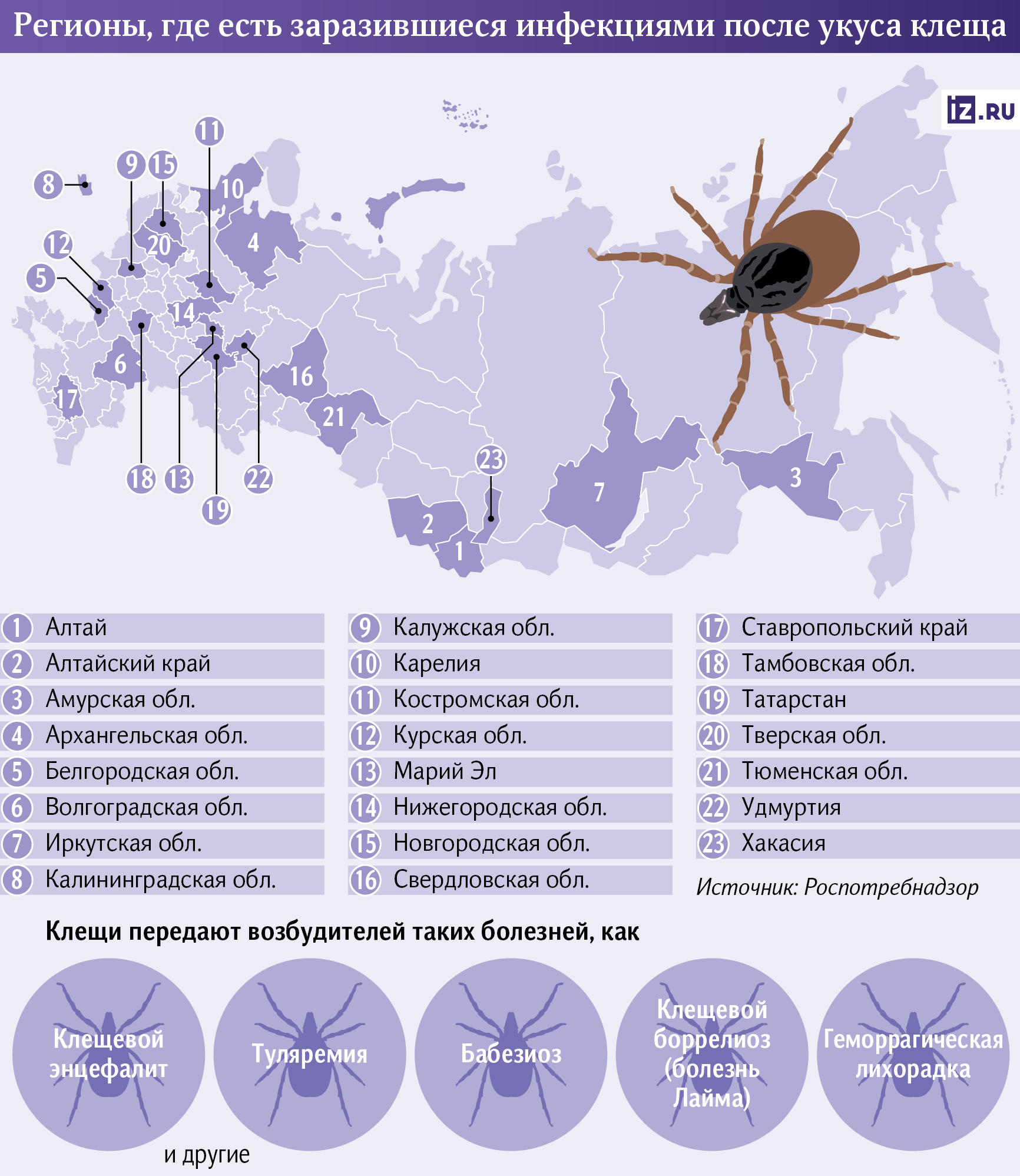
Suspicion of tick-borne typhus was also registered in 137 residents of the Altai Territory. Seven more people from the Stavropol Territory and the Volgograd region were diagnosed with Crimean hemorrhagic fever, which causes high fever and impaired blood clotting, which sometimes leads to internal bleeding.
According to Izvestia, based on data for the 23rd and 24th weeks of 2026, the number of tick bites decreased in 16 regions per week. However, arthropod activity continued to increase in 14 more subjects, despite the hot weather.

Why ticks have become more active
This year, the number of ticks has increased by 10-15%, biologist Dmitry Safonov told Izvestia.
"It's normal in this situation," he explained. — The snowy winter worked as a blanket for the ticks, protecting them from the cold, so almost 100% survived. And the warm spring accelerated their early release and reproduction.
According to him, the ticks have adapted to high temperatures and changed their activity mode: they most often go hunting in the early morning or evening when it gets cooler. Therefore, the heat that was observed in many regions of Russia in May and June did not significantly reduce the number of bites.
"Only a prolonged drought can significantly reduce the activity of ticks," the expert explained.

At the same time, not only their numbers are growing, but also the number of infected individuals. The larger the population, the higher the risk of encountering a dangerous disease vector. The situation is also affected by climate change and animal migration, which help ticks expand their habitat, Dmitry Safonov added.
Every third or fifth tick can be contagious, the biologist believes. However, in Russia, especially this season, emergency prevention is well developed, which makes it possible to prevent infection even with the bite of an infected arthropod.
What are the dangers of bites?
Encephalitis and borreliosis are considered the most severe diseases carried by ticks, Ekaterina Demyanovskaya, an expert doctor at the Hemotest laboratory, told Izvestia. According to her, tick-borne encephalitis is considered a more serious disease because the virus is able to infect the brain and spinal cord.
Borreliosis can also lead to serious consequences.: sometimes the disease affects the joints, nervous system and heart.
— But it is effectively treated with antibiotics, especially if the diagnosis is made at an early stage. But there is no specific treatment for tick—borne encephalitis, so vaccination remains the main method of protection," the expert emphasized.

It's not too late to get vaccinated, although they usually get vaccinated in the fall or winter, said Anastasia Polyakova, a general practitioner at the Sberbank Health medical company. According to her, it is enough to get vaccinated at the first opportunity, and then follow the standard revaccination schedule — once every three years.

It is useless to vaccinate a person who has recently been bitten, since immunity is formed only after a few weeks, the expert noted.
After a tick bite, it should be removed as soon as possible and tested. Even in the absence of symptoms, doctors recommend that you closely monitor your well-being for several weeks, Ekaterina Demyanovskaya added.
Переведено сервисом «Яндекс Переводчик»
