- Статьи
- Science and technology
- Special bite: four exotic viruses dangerous for humans found in Russian ticks

Special bite: four exotic viruses dangerous for humans found in Russian ticks

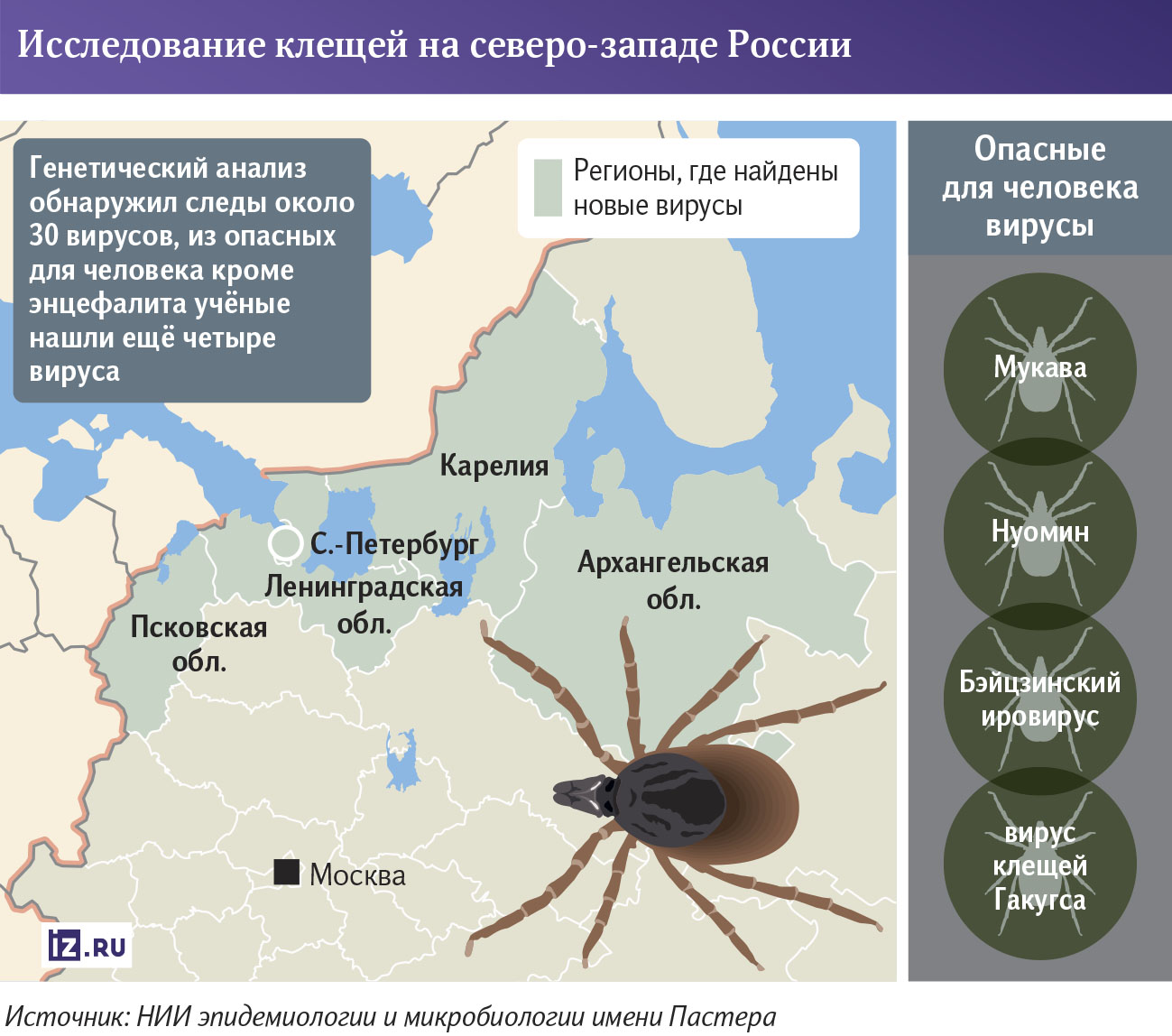
Scientists have discovered the genetic traces of almost 30 viruses in ticks in northwestern Russia. According to the researchers, in addition to tick-borne encephalitis, at least four of them can pose a potential danger to humans: Mukawa, Nuomin, Gakugsa and the Beijing virus. When infected, patients may develop fever, and some of the identified pathogens can lead to severe complications and even death. Experts note that ticks act as a kind of reservoir for a variety of infections, some of which can potentially lead to a pandemic. Rospotrebnadzor emphasized that such studies are necessary to assess the danger of tick-borne infections, however, additional experimental data are required to accurately determine their pathogenicity.
Asian viruses in Europe
Specialists from the St. Petersburg Pasteur Research Institute of Epidemiology and Microbiology conducted a large-scale study of viruses found in ticks in the northwestern regions of Russia. In the course of the work, scientists have identified the genetic traces of almost three dozen microorganisms. According to the researchers, encephalitis virus, Mukawa, Nuoming, Beijing nairovirus and Gakugsa virus may pose a potential danger to humans. At the same time, the pathogenicity of many other identified microorganisms remains insufficiently studied. In addition, the genetic sequences of four previously unknown viruses have been discovered.

Scientists note that the exchange of genome fragments between viruses is possible in the body of ticks, which theoretically can contribute to the emergence of new infectious forms with varying degrees of contagion and severity. The results of the study are published in the journal Scientific Reports.
"Our results represent the first high-precision image of a tick virus in northwestern Russia. They emphasize the importance of continuing virological surveillance in underrepresented biogeographic areas. These data contribute to the growing global viroma map and may contribute to the development of regional measures to combat vector—borne diseases," the authors of the article wrote.

The study included samples of 42 ticks of the two most common species — taiga and European. They are considered carriers of dangerous infections. The samples were collected in 2021-2023 in the Arkhangelsk, Leningrad and Pskov regions, Karelia and St. Petersburg. The scientists sequenced the genetic data and found traces of viruses from seven different families. According to them, such a variety can be called unexpected. Interestingly, encephalitis found in the west of the Russian Federation does not belong to the European, but to the Siberian variant, which is considered more severe.
According to biologist Dmitry Safonov, the detection of viruses more typical of Asia is quite unusual in European Russia. Such strains are more common in the Khabarovsk Territory, the Volga region, as well as in the Kemerovo and Chelyabinsk regions. At the same time, according to him, they are now gradually spreading to other regions.

According to him, the most dangerous of those found is the Beijing nairovirus, as it can cause severe fever with high fever, confusion, and in some cases, coma and even death. Nuomin also causes fever and headache, but no deaths have been reported yet. Mukawa and Gakugsa are still considered potentially dangerous: their ability to infect human cells has already been confirmed, but their pathogenicity requires additional study. Transmission of these viruses is possible only through a tick bite, while the infection does not spread from person to person.
— The existing system for monitoring and diagnosing tick-borne infections is too narrow and needs to be expanded. Standard tests for encephalitis and borreliosis do not detect exotic viruses of Asian origin. If these infections enter the body during a bite, but the system does not identify them, then the pathogens will spread in the population (ticks). The only test developed in Russia is for Nuomin. For all other pathogens, diagnosis is possible only within the framework of scientific research," said Dmitry Safonov.
He noted that it is necessary to develop new laboratory tests to detect all detected viruses in tick populations. In the meantime, the main protection remains preventive: it is important to avoid bites and carefully monitor your condition after possible contact with these arthropods. If a tick is found on oneself, it is recommended to seek medical help in a timely manner, the expert emphasized.
Such studies are of great importance for assessing the risk of human infection with viruses carried by these arthropods, the press service of Rospotrebnadzor told Izvestia.

"This study is based on the study of RNA viruses, that is, the virus itself has not been isolated into culture and its biological properties have not been studied. The assumption of pathogenicity is based on the fact that in other countries these viruses were isolated from the blood sera of people who showed signs of infection. It can be said that in the northwest, in addition to tick-borne encephalitis, viruses such as the Beijing nairovirus and Mukawa virus have been identified, which were previously isolated from human blood sera in China and Japan. The Lesnoye virus, which was also found in ticks in the northwest, does not have a clear taxonomic position and is similar to Naomin, whose pathogenic strains are described in the literature," the agency explained.
The Siberian genotype
The study by the Pasteur Institute, according to immunologist Mikhail Bolkov, casts doubt on the widespread idea that the more "mild" European genotype of the tick-borne encephalitis virus prevails in the western part of Russia.

— The discovery of the Siberian genotype in the western regions refutes the popular notion that tick bites are safer here than in the east, due to the prevalence of the more "mild" European encephalitis genotype. The spread of more aggressive eastern strains is facilitated by both birds and wild animals, which more often carry these variants," he said.
The specialist also stressed that there are many previously unknown microorganisms among the identified viruses, and additional research is needed to assess their danger, including cultivation and study of properties. At the same time, the presence of confirmed pathogens indicates a potential risk of infection for the population of western regions.

The authors of the article note that ticks are not only carriers of infections, but can also serve as reservoirs for the emergence of new diseases.
"The combined circulation of 'known pathogens' and 'potentially pathogenic' viruses in populations also poses a hidden threat to both public health and veterinary medicine, especially in regions with high levels of human-tick interaction," the researchers emphasize.
Scientists note that gene reassortment can occur between tick—borne viruses - the exchange of genetic material that can change their properties.
"This potential not only stimulates viral diversity, but can also contribute to changes in virulence, host range, or transmission dynamics. These factors are key considerations for emerging zoonotic threats," the article says.
Virus reassortment is one of the mechanisms of mutation of infectious agents. Each such stable and pathogenic human change can theoretically become the basis for the emergence of a new "pandemic X," said Sergey Voznesensky, Associate Professor of the Department of Infectious Diseases at RUDN University.
— Tick-borne infections are potentially dangerous from this point of view. However, a set of preventive measures is already being applied. First of all, analytical studies are needed: it is important to map the distribution and variability of populations. Based on the data obtained, it is possible to plan sanitary measures, including disinfection of forest park areas where the presence of people is possible," the specialist said.
It will be possible to say for sure whether the identified viruses are pathogenic or not only after isolating them into culture and conducting additional research, the press service of Rospotrebnadzor emphasized. To reduce the risk of infection with tick-borne viruses, it is necessary to continue such studies in order to assess the range of potentially pathogenic strains and their prevalence in the regions of Russia.
Переведено сервисом «Яндекс Переводчик»
