
Bite served: how temperature records affect tick activity

The diagnoses of "borreliosis", "typhoid" and "encephalitis" have currently been given to at least 34 Russians bitten by ticks, Izvestia calculated based on reports from the regional departments of Rospotrebnadzor. Since the beginning of the year, according to the agency, 25 thousand arthropod bites have been recorded, of which 7 thousand were in the last week. Among the regions with the highest tick activity are the Moscow Region and the Altai Republic, where temperatures exceeding the climatic norm have been recorded in recent days. The information about which other regions are affected by the invasion of ticks and how the weather affects their activity can be found in the Izvestia article.
Where did the heat come from
Warm weather has arrived in the Moscow region — the air temperature in the capital and the region is five to six degrees above the climatic norm, Tatyana Pozdnyakova, a leading specialist at the Meteonosti news agency, told Izvestia. This weather will continue until Thursday, May 7.

— Daytime temperature will be in the range of + 22... + 25 degrees. But this surge will not last long. Already on Friday, May 8, the weather will begin to change, cooler air will come to the region. First of all, this will affect the daytime temperature: in the period from May 8 to 11, it will be in the range of +7... +12 degrees in the capital," the expert emphasized.
According to her, this will mean a return to the climatic norm. The weather will be similar throughout Central Russia, but in its western regions the temperature will drop a day earlier than in Moscow.
Warm weather — up to +26 degrees — was also established in Primorye, according to the Hydrometeorological Center. However, in the coming days, rains are expected in the region, the wind will increase, and the daytime temperature will drop to +12... +18 degrees. It can be up to +20 degrees in the south-west of Yakutia.

However, such warm weather is far from all over the country. In some areas of Yakutia, the temperature will drop even to -6 degrees. Rains with snow and increased winds are expected in the coming days in the Magadan region. In Kamchatka, according to the Hydrometeorological Center, there are already gale-force winds, heavy rains and snow, as of May 5, up to 16 mm of precipitation fell. And in the Kuril Islands, this figure was 44 mm.
Where the ticks have become active
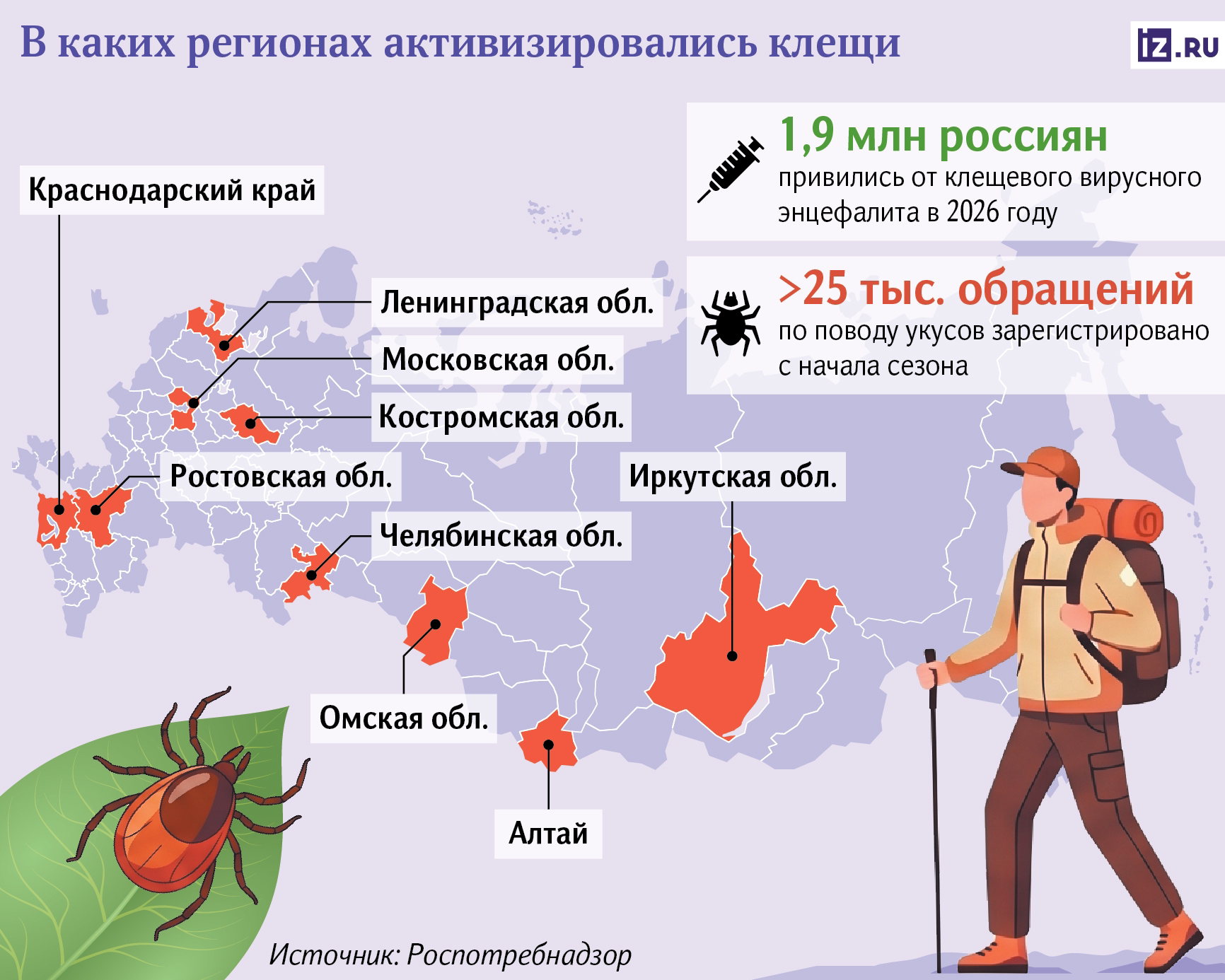
The warming that has come to many regions has provoked the activity of ticks. At the end of April, Rospotrebnadzor reported 18,000 requests for medical help due to tick bites since the beginning of the year, but over the past week this figure has increased by 7,000 at once. Most of the bites, according to the agency, were recorded in nine regions: Chelyabinsk, Irkutsk, Kostroma, Leningrad, Moscow, Omsk, Rostov regions, the Altai Republic and the Krasnodar Territory.

At least 34 Russians have been diagnosed with tick-borne diseases since the beginning of 2026, Izvestia calculated, based on data from the regional departments of Rospotrebnadzor. In addition, 27 more were hospitalized with suspected infection.

Residents of the Sverdlovsk region are most often confronted with infections. There, tick-borne viral encephalitis (acute inflammation of the brain substance) is suspected in 10 people, and tick—borne borreliosis (affects the cardiovascular system) in 13. There are many cases in the Altai Republic: one case of encephalitis and seven cases of tick-borne typhus (an acute infectious disease that in rare cases causes death) were registered in the region.
In Khakassia, borreliosis was found in three of the bitten, typhus was found in two, and encephalitis is suspected in three more.
"Since the beginning of the year, seven cases of ixodes tick—borne borreliosis have been registered in the Republic of Crimea and the city of Sevastopol," the local Rospotrebnadzor reported.
Four people were diagnosed with borreliosis in the Kaluga Region, and two in the Belgorod Region. Infections were also encountered in the Tyumen, Irkutsk, Tver regions, Stavropol Territory, St. Petersburg and Leningrad Region.

However, not all those bitten by infected ticks were infected. In the Kaluga Region, for example, tick-borne borreliosis was found in eight out of 47 ticks, but only four residents became infected. The territorial bodies of Rospotrebnadzor noted that most of the victims received anti-tick immunoglobulin. Also, according to Rospotrebnadzor, about 2 million Russians have been vaccinated or revaccinated this year.
In what weather are ticks active?
The ticks have already fully woken up and are highly active throughout the country, biologist Dmitry Safonov confirmed to Izvestia.
— Their range has been constantly expanding in recent decades. There was no such mass invasion of ticks in the Arkhangelsk region until the 90s of the last century," he said.
According to him, the risk of being bitten is highest in Siberia, the Urals and the Far East.
— The activity of ticks directly depends on the temperature. As soon as the air warms up to +8... +10 degrees and above, they instantly come out of their stupor and begin actively searching for a victim. And the sudden warming, as it is now, serves as a powerful wake—up call for them," the biologist added.

Traditionally, the peak of tick activity falls at the end of April and the first half of May, Dmitry Safonov emphasized. With changeable weather — sometimes cold, sometimes hot — arthropods become aggressive.
—Ticks are cold—blooded organisms," he said. At low temperatures, their metabolism slows down dramatically, but does not stop completely. Accordingly, they do not feed during the cold snap, as they are physically unable to move and search for prey. But on all cold days, their body continues to spend energy on basic needs, as a result of which the ticks experience a state of energy deficiency. After a cold snap, they come out exhausted, but extremely active and hungry. Such ticks are more likely to attack than well-fed ones from regions where there has been no cold snap.

Despite the fact that ticks become numb during cold weather, they can still bite if there is a person or animal nearby, Dmitry Safonov emphasized.
How to protect yourself from ticks
A tick becomes encephalitic when it feeds on the blood of infected mammals or birds, Anatoly Altstein, chief scientific virologist at the Gamaleya Research Institute of Epidemiology and Microbiology, told Izvestia.
— Occasionally, you can get infected with the raw milk of cows or goats, whose blood is fed by infected ticks, — he explained.

He added that the ticks hatch and mature in April, their diseases appear in May and can last through the summer, which is why the disease is called spring-summer tick-borne encephalitis.
— The first symptoms after an encephalitic tick bite appear only after 7-21 days. The disease is accompanied by high fever, severe headache, muscle pain, nausea, vomiting, and in some cases, paralysis is possible," the doctor said.
Variants of the tick-borne encephalitis virus vary in the degree of danger in different regions. Thus, in the Far East and Siberia, the disease is more likely to occur in a more severe form than in the European part of Russia.
—The disease can sometimes turn into a chronic form, which often leads to severe disability and even death," the expert noted. — There is no recognized drug-specific treatment for tick-borne encephalitis yet, but there is a vaccine.

According to him, in areas where this disease is often detected, it is necessary to vaccinate people whose professional activities are related to nature. Two doses of the vaccine must be administered before the onset of the dangerous period, and then revaccinated every 3-5 years.
When planning a trip to areas endemic for tick-borne encephalitis, people should receive two doses of the vaccine with an interval of 14 days two to three weeks before arrival, the expert added. And when in contact with any wildlife, it is better to wear closed light clothing and use insect repellent, the doctor said. The ticks found on the body must be transferred to the virology laboratory.
Переведено сервисом «Яндекс Переводчик»
