- Статьи
- World
- Railway logistics: goods transportation will be simplified along the North–South MTK route

Railway logistics: goods transportation will be simplified along the North–South MTK route

They want to make freight transportation via the North–South Transport Corridor cheaper and faster. To do this, the Russian Federation is negotiating, which should result in the signing of memoranda of understanding in the field of transport and transit with Afghanistan, India, Qatar, Kenya, the United Arab Emirates, Oman, Pakistan and Saudi Arabia, the head of the Ministry of Transport Andrey Nikitin told Izvestia. In the future, the agreements will help assemble the route into a single commercial system and make it more convenient for carriers, which will increase business confidence in it, experts say. In the context of the conflict in the Middle East and the blockade of the Strait of Hormuz, the attractiveness of alternative routes is actively growing.
How is it planned to improve the operation of the North–South corridor
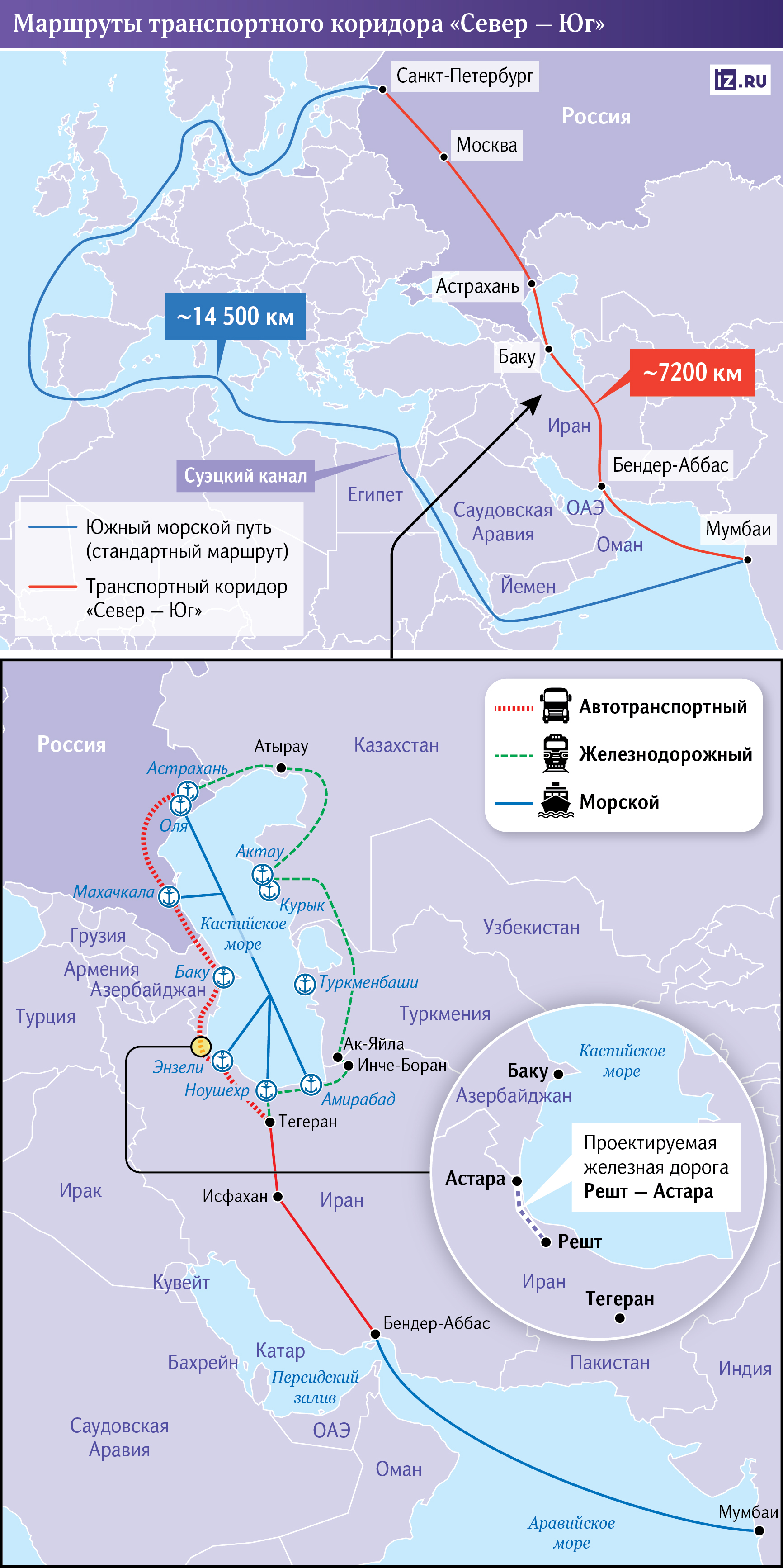
The war between Iran and the United States, as well as the subsequent blockade of the Strait of Hormuz, finally consolidated a new trend: the Eurasian land corridors are turning from alternative routes into the main ones. Business is increasingly attracted by the North–South international transport corridor, which in recent years has been able to impose serious competition on its rival in the face of the Suez Canal, the main route from Europe to India.

Having originated as a project of Russia, India and Iran, North–South soon attracted the attention of the CIS countries and the Persian Gulf. Today, the Russian Federation is negotiating with a number of states to simplify the transportation of goods: to save time and the cost of their delivery. To do this, Moscow is discussing the possibility of signing relevant memoranda, Andrei Nikitin, the head of the Ministry of Transport, told Izvestia.
— An interdepartmental memorandum of understanding in the field of transport and transit was signed with the Iranian and Bahraini sides. The signing of similar documents with India, Oman, Qatar, Kenya, the United Arab Emirates, Saudi Arabia, Pakistan and Afghanistan is being discussed," the minister said.

The signing of the memoranda will make it possible in the future to assemble the route into a single commercial system, Vladislav Airapetov, President and Chairman of the Management Board of the MRT group of companies, explained to Izvestia. Firstly, it will simplify and save money: to ship a container from Mumbai to St. Petersburg, the carrier will not need to pay separately for each country, he will be able to buy one "ticket" for the entire journey. Secondly, it will shorten the delivery time so that wagons and containers do not stand on the borders of countries due to different laws or document requirements.
— Not only roads and ports are important for the carrier, but also predictable tariffs, agreed procedures, clear transit dates, insurance and uniform rules for working at junctions. Therefore, such agreements can reduce transaction costs and increase confidence in the route," said Hayrapetov.

In order for the system to work, after signing the memoranda, it will be necessary to agree on the creation of end-to-end logistics services between the states that will ensure uninterrupted delivery of goods.
— Work is underway to create end—to—end logistics services and reach agreements with the Republic of Azerbaijan and the Islamic Republic of Iran, both in bilateral and trilateral formats, - said Andrey Nikitin.
Despite the fact that due to the war in the Middle East, supplies along the North-South route have significantly decreased, this is unlikely to affect the timing of the signing of the memoranda, experts say. Moreover, it is the crisis around Suez and Hormuz, as well as other maritime risks that make overland and multimodal routes more in demand, Vladislav Airapetov noted. According to him, participation in the North–South Trade Cooperation Center is beneficial for the Persian Gulf countries: it is the diversification of trade, access to Russia, the Caspian Sea, the Caucasus and the EAEU markets, as well as reducing dependence on maritime logistics alone. Nevertheless, this corridor will not be able to completely replace the Suez Canal, the expert said.

Prospects and problems of development of MTK North–South
The popularity of the route was growing rapidly even before the outbreak of the great war in the Middle East. The problems of its competitor, the Suez Canal, are related to the situation in the Red Sea, where the Yemeni Houthis have made passage unsafe for most Western container ships. By the beginning of 2025, Egypt's revenue from the canal had fallen by more than 50-60%, and rates for container shipments from Asia to Europe had roughly tripled compared to the level of 2023.

Compared to the Suez Canal, transportation along the North–South route is almost twice as fast: this period is reduced from 35-45 to 15-20 days. In 2025, about 21.5 million tons of cargo were transported along it, and the growth in five years was 39%, the Minister of Transport of the Russian Federation specified. However, due to the conflict between the United States and Iran, the volume of supplies decreased last year: in 2024 it amounted to 26.9 million tons, according to data from the Institute for the Study of World Markets (IIMR).
The western route of the MTK, skirting the Caspian Sea, is particularly important today. Starting from 2022, the capacity of checkpoints on the border with Azerbaijan has been increased fivefold — from 400 to 1,9 thousand cargo vehicles per day, Andrey Nikitin said.
"Issues of reducing congestion at automobile checkpoints, redistributing part of the cargo flow to rail transport, joint implementation of infrastructure projects, speeding up customs control and optimizing procedures are being worked out, in particular, the Green Corridor and Simplified Customs Corridor projects," the minister explained.

There were huge queues of trucks at the borders with Azerbaijan and Iran. Now it is planned to expand the border posts so that instead of conditionally two windows, ten work, and make sure that cars do not stand for days. Finally, we need to use the railway, as one train replaces about 100-150 trucks. For this purpose, Russia and Iran have agreed to build the Rasht–Astara branch.

The work was supposed to start on April 1, but it was postponed due to the war between Iran and the United States. It is planned to return to this before the end of 2026, said Iranian Ambassador Kazem Jalali. According to preliminary estimates, the construction will take at least five years. If the funds are provided by the end of 2026, the completion of the project can be expected no earlier than 2031.
The Rasht–Astara line, 162 km long, should provide continuous rail transit from Ust-Luga to Bandar Abbas and provide a transportation volume of at least 15 million tons per year along the western route, Artem Valeev, CEO of the FCS-Service group of companies, told Izvestia.
"If this section is completed, then not just another railway will open, but a different class of transportation: heavier and more massive shipments, better control over deadlines and less dependence on seasonal or political risks," the expert believes.

Railways are much more efficient and cheaper for transporting large volumes of goods over long distances compared to motor transport, agreed Sergey Tolkachev, professor at the Financial University under the Government of the Russian Federation. In fact, the Rasht–Astara section will transform the North–South route from a set of routes into a full-fledged transport framework, which will dramatically increase the volume of traffic.
Переведено сервисом «Яндекс Переводчик»
