- Статьи
- Economy
- Prisoner of the autobahn: overland corridors accepted only 10-15% of cargo from Hormuz

Prisoner of the autobahn: overland corridors accepted only 10-15% of cargo from Hormuz

After the escalation of the Middle East conflict, only 10-15% of cargo was transferred from the Strait of Hormuz to overland routes, Izvestia found out. We are talking about supplies to Russia and the CIS countries. The main routes pass through Turkey, the Caucasus and Central Asia. But it will not be possible to completely replace maritime logistics: the infrastructure cannot cope with the increased workload. Freight rates increased to $15-16 thousand per container, the cost of transportation also jumped, and delivery time increased by two weeks. How the business adapts and the price of which imported goods continues to rise — in the Izvestia article.
How the closure of the Strait of Hormuz changed logistics
As of April 15, logistics through the Strait of Hormuz seemed to have begun to recover: according to media reports, some vessels are passing through, but with risks and restrictions. The United States insists that after the blockade was imposed on April 13, not a single vessel broke through it on the first day, and six ships turned around. CNN explained this discrepancy on the 15th: the United States is blocking Iranian ports, not the Strait of Hormuz, so reports of tankers passing through it cannot be considered a violation of the blockade. Moreover, at about 15:00 Moscow time, Donald Trump announced on his Truth Social account that he was "forever" opening the Strait of Hormuz.

After the escalation of the conflict in the Middle East, only 10-15% of all cargo to Russia and the CIS countries was quickly redirected to overland routes, said Vadim Filatov, co-owner and deputy director of the PEC company.
The financial advisor, the founder of Rodin, agreed with this.Capital Alexey Rodin. Natalia Milchakova, a leading analyst at Freedom Finance Global, gave a similar assessment. According to her, due to political and military risks, it can be said that export activity in the Middle East is now in deep stagnation. Of the cargoes around the world that passed through the Strait of Hormuz, it is still difficult to calculate how much was redirected along land routes. But it does not exceed 5%, the expert believes.

Which corridors have become an alternative to Hormuz
The main flow from the Persian Gulf countries to Russia is now going through Turkey, followed by road delivery through Georgia and Azerbaijan, Vadim Filatov said.

The eastern branch of the North–South corridor (through Turkmenistan, Uzbekistan and Kazakhstan) is used less frequently because it passes through several countries and requires coordination of railway schedules, which increases delivery time, the expert added. In addition, when transiting through Kazakhstan, companies face delays in paperwork and inspections, which can take up to two weeks, he explained.
In practice, the Western branch through Azerbaijan with access to the Caspian Sea is more often used, Oleg Shevtsov, Deputy General Director of Project No. 7, confirmed. He explained that the eastern route through Kazakhstan is chosen less often due to the high load on the infrastructure, and the Trans-Caspian route is limited by instability and the need for several transshipment points.
An alternative route for shipments from the Persian Gulf states is through the ports of Oman and Saudi Arabia, then through the Red and Mediterranean Seas to Turkey and further to Russia, said Serdar Dzhumaev, founder of Prime Shipping Agency. If delivery to several countries is required at once, more complex schemes are used with transshipment to vehicles and transit through the Caucasus and Central Asia, he said.
The risk of restricted shipping has forced the market to rethink the sustainability of the southern direction, but it is premature to talk about a complete reversal, Oleg Shevtsov believes. Currently, businesses are in no hurry to leave the sea routes through the UAE and Iran en masse, as they still remain the most predictable in terms of timing and cost.

Companies only partially reorient supplies and use this scheme as a hedging tool, that is, they use different options to reduce risks. The new routes did not replace basic logistics, he added.
Alexey Rodin agreed with this. The business is now actively reviewing its logistics strategies, implementing several routes in parallel to distribute supplies between different modes of transport in order to reduce the threat of downtime. This is becoming one of the key risk reduction tools.
There is no full-fledged alternative to the Strait of Hormuz today, Irina Sozdatel, Vice-President of the Association of Exporters and Importers, agreed. In her opinion, overland corridors are able to take on only a limited share of flows due to infrastructural constraints.
Why can't land routes replace the sea
The market is currently operating in an adaptation mode: overloads are occurring somewhere, the delivery time is increasing somewhere, and the cost is increasing somewhere, Irina Sitel explained.

The reorientation of cargo runs into several systemic problems, said Igor Rastorguev, a leading analyst at AMarkets. In particular, there is a lack of electrification on the eastern branch of the North–South railway, limited railway capacity, insufficient transshipment routes and platforms for container transshipment. In addition, overland routes require more time and resources compared to sea transit through the strait, and passing through several countries complicates cargo clearance, he added.
The demand for transportation along the North–South railway and the Eastern Landfill has increased significantly over the past two weeks. However, this is an increase in interest, not the actual volume, Oleg Shevtsov noted. The number of requests for logistics calculations and bookings has increased by 20-30%, but this rarely translates into real shipments. Freight rates have already increased by 15-25% in key areas, especially where complex schemes are involved. The workload of the infrastructure is growing, but it is limited by physical limitations, so the effect is expressed not so much in increasing turnover as in lengthening deadlines and increasing costs, the expert explained.
Alternative ports were not ready to accept such a volume of cargo: they raise prices and delay deadlines, Alexey Rodin noted. For rail transportation from China, there was also an increase in the cost of containers and deadlines by an average of 30%, he added. Air transportation is expensive, and major Middle Eastern airlines — Qatar Airways, Emirates and Etihad — have partially frozen their operations, the expert explained.

How has the shipping cost changed?
Compared to the situation before the conflict (until February 28, 2026), the cost of shipping by sea from the Middle East to Russia has increased by more than one and a half times, to $15-16 thousand per 40—foot container, Serdar Dzhumaev said. The operators ship cargo through the ports of the Red Sea and the Cape of Good Hope.

The economic feasibility of reorientation in some cases remains questionable, Oleg Shevtsov believes. Shipping a container from the UAE to Moscow via land corridors costs one and a half to two times more expensive than the sea route, and in some cases the difference is even higher due to downtime and additional operations.
For a significant part of importers, especially those with low margins, this model is unprofitable. Some companies consider a temporary pause in supplies as a more rational solution than switching to expensive and unstable logistics, the expert added.
Irina Sozdatel says that the business is not ready to freeze supplies completely: companies need to ensure turnover, fulfill contracts, and maintain a market presence. Therefore, even with the increasing cost of logistics, they will look for solutions within new routes, rather than going on hiatus.
Not all goods can be adapted to overland routes, Oleg Shevtsov continued. Perishable products are time-critical and temperature-critical. Dangerous goods are limited by regulations and require special permits. Bulky and heavy—weight - they run into the limitations of the railway infrastructure. Electronics are sensitive to deadlines and insurance conditions — as logistics lengthens, the cost of risk increases dramatically.

These difficulties are already reflected in the cost of imported goods, Alexey Rodin believes. High-tech components such as lithium-ion batteries and semiconductor components have increased in price by more than 10%. And the cost of auto parts (components from Southeast Asia and Europe) increased by 7.8-9.2%, Izvestia reported earlier.
In case of prolonged disruptions, the most vulnerable categories may face local shortages, we are talking about segments with high turnover, Oleg Shevtsov admitted. At the same time, the risks of total shortages are minimal, especially in sensitive segments such as food, where Russia retains a high degree of domestic security, Irina Sozdatel believes.

What will happen to logistics next
The market is no longer waiting for a return to previous conditions, says the vice president of the Association of Exporters and Importers. Businesses will have to combine several routes at the same time to minimize risks, Alexey Rodin believes. Even after the possible opening of the strait, companies will continue to use land corridors for insurance, Vadim Filatov agreed. The experience gained during the lockdown period will force the business to diversify logistics on an ongoing basis, he added.
In the near future, we can expect active infrastructure improvements for overland routes (to make them more convenient and profitable for businesses) and more visible business involvement in alternative supply chains.

But there are no expectations that these corridors will completely replace the Southern Sea route in the short term, Oleg Shevtsov said. Even with increased investments, their throughput and manageability are still insufficient.
However, companies are preparing to work in conditions of increased uncertainty, increasing logistics budgets. The basic scenario is based on partial adaptation and continued dependence on maritime transportation.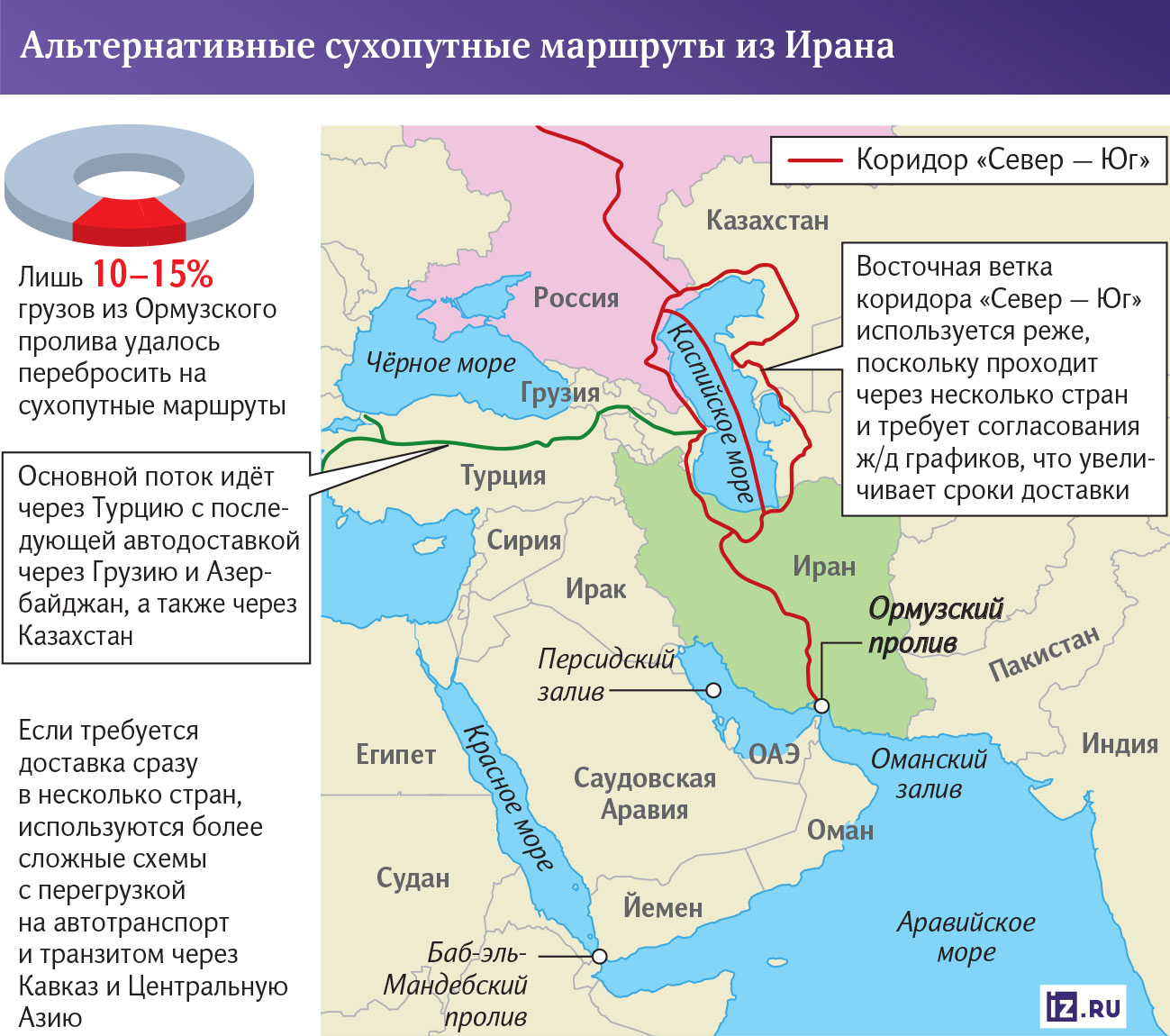
Turkey and Oman may become long-term transit hubs for Russian imports, Serdar Dzhumaev noted. Even if shipping through Hormuz recovers, some cargo flows will remain on alternative routes, as businesses will appreciate the benefits of diversification, he explained.
Переведено сервисом «Яндекс Переводчик»
