- Статьи
- World
- Beyond the Arctic circle: Russia has allowed cooperation with Western countries along the Northern Sea Route

Beyond the Arctic circle: Russia has allowed cooperation with Western countries along the Northern Sea Route

Russia is ready to discuss cooperation with Western Arctic countries in the operation of the Northern Sea Route, Vladislav Maslennikov, director of the Department of European Affairs at the Russian Foreign Ministry, told Izvestia. Amid the crisis over the Strait of Hormuz, global interest in the NSR as a safer and shorter route is growing. Currently, China and India remain Russia's main partners in the development of Arctic logistics, but experts admit that Norway and Finland may join the project in the future. The question of whether the Northern Sea Route can become a full—fledged trade route and what is needed for this is in the Izvestia article.
Russia is ready to allow Western countries to enter the Northern Sea Route
The crisis over the Strait of Hormuz has called into question the reliability of the usual sea routes. In these circumstances, many countries have begun to actively look for alternative ways to deliver goods. The advantages of the Northern Sea Route in a situation of geopolitical turbulence are becoming more and more obvious — these are safety, shorter logistical leverage, and high environmental friendliness, Vladislav Maslennikov, director of the Department of European Problems at the Russian Foreign Ministry and senior Russian official at the Arctic Council, told Izvestia.
— Russia is open to a comprehensive dialogue with all those who are ready for constructive and mutually beneficial cooperation. Now it is primarily developing with non-regional countries, primarily with China and India. If the Western Arctic countries show interest, we will consider possible options for cooperation with their participation," he said.

For part of the transportation between the Russian Arctic and Asia, the Northern Sea Route really saves time compared to the southern routes. For example, for Arctic LNG, the journey to Asia takes about 20 days in summer, while it takes about 30 days via Suez and about 37 days via the Cape of Good Hope.
Transit cargo transportation is also growing along the NSR — in 2025, this figure amounted to 3.2 million tons. On April 2, the head of Rosatom, Alexei Likhachev, said that in 2026 cargo traffic is 15% higher than last year's level.

However, we should not expect that the Northern Sea Route will replace the southern trade corridors yet, says Boris Martsinkevich, editor of the Geoenergetics Internet portal.
— Now the NSR works mainly for the export of oil, LNG and ensuring the northern supply. In order for it to truly become a major international corridor, we need not only icebreakers, but also developed ports, year-round service infrastructure, emergency rescue and medical services, repair facilities and an emergency fleet of enhanced ice class," he stressed.

In addition, the route should be integrated into a broader logistics system with constant loading and transshipment of goods, as it happens on traditional southern routes. So far, there is no such model on the NSR: some of the Arctic ports are poorly equipped, and the former system of linking the sea route with the northern rivers was lost after the collapse of the USSR.
If it is possible to restore it and fill the route with not only raw materials, but also other cargoes, the NSR will have a chance to go beyond the niche format, Martsinkevich emphasized.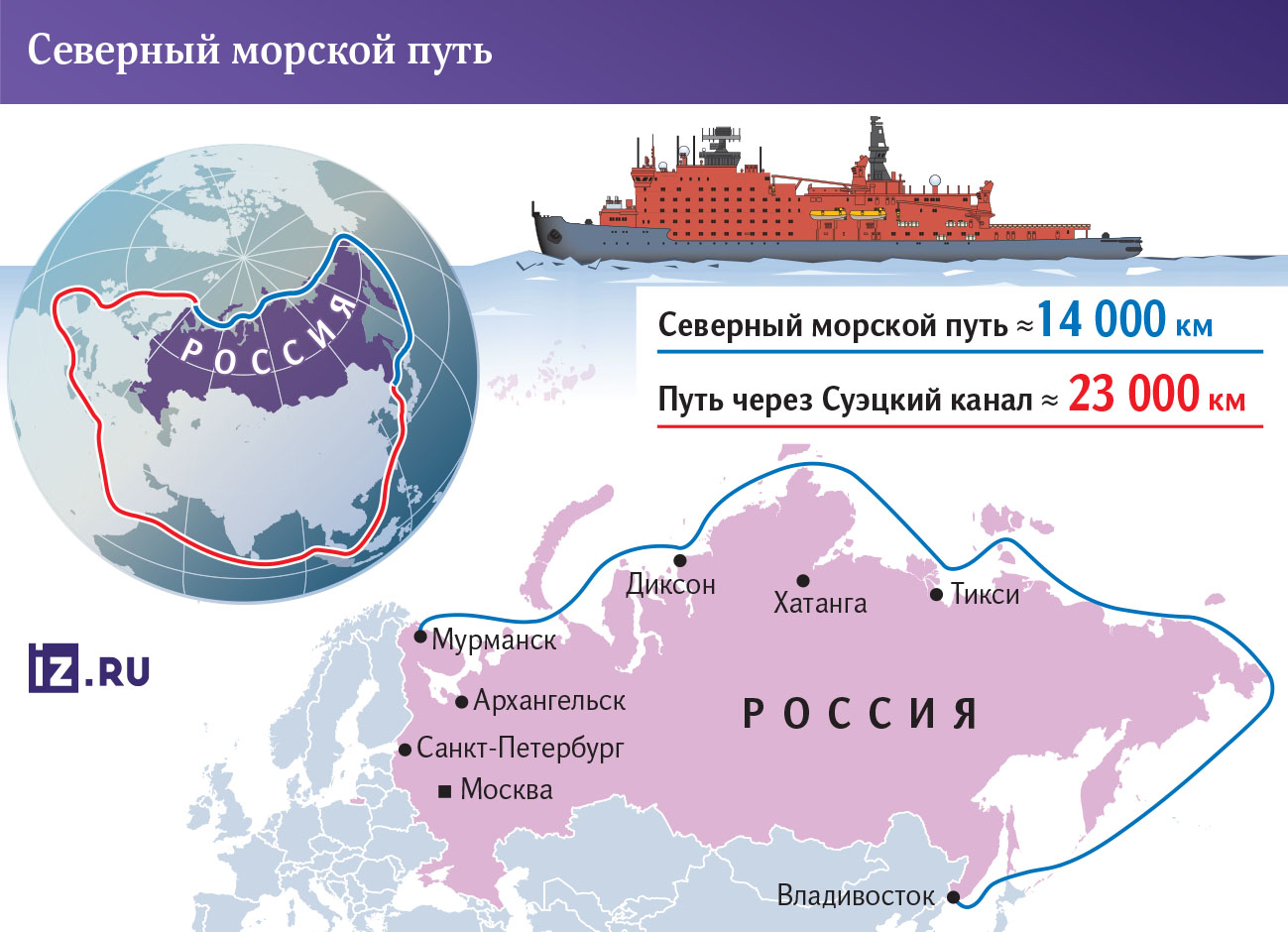
In the meantime, Moscow can strengthen the position of the NSR as an additional international route. And in the future, Russia could expand its range of partners not only at the expense of China and India, but also at the expense of the Western Arctic countries.
Who could use the NSR
In addition to Russia, the Arctic states include Denmark, Iceland, Canada, Norway, the USA, Finland, and Sweden. Until 2022, their cooperation with Moscow largely went through the Arctic Council, an intergovernmental forum where issues of ecology, sustainable development, science, safety of navigation, as well as search and rescue are discussed.

Arctic Council Ministerial Meeting at Lappi Arena, Finland, May 7, 2019
After the outbreak of the conflict in Ukraine, the work of the council with the participation of Russia was actually frozen, but the format itself did not collapse, and the Russian Federation was not excluded from its membership. Later, some of the working mechanisms gradually began to function.
According to Maslennikov, the activities of working and expert groups with the participation of Russian specialists have been restored. In addition, the possibility of face-to-face meetings is being discussed. At the same time, the topic of navigation, especially in the context of the safety of navigation along the NSR, has never been raised within the council, he noted.
"We see that the current Danish presidency of the Arctic Council, like the previous Norwegian one, is making efforts to further unfreeze the council and is conducting a close dialogue on this issue with all member countries, including Russia," Maslennikov added.

Putting aside the political component, Finland and Norway remain the most obvious partners for possible cooperation in the Arctic, Marcinkevich believes.
— Finland is traditionally strong in shipbuilding and has a serious school in this field: since Soviet times, it has been involved in the production of hulls for domestic nuclear reactors. Norway itself is interested in the Arctic because of projects related to the development of high latitudes and because of its proximity to Russia," he said.

Svalbard Archipelago
At the same time, cooperation with Norway continues even now. In December 2025, Moscow and Oslo agreed on a fishing agreement for 2026. In addition, the parties agreed on a joint scientific program. The Norwegian authorities explicitly acknowledged that the negotiations were not easy and took place under the conditions of anti-Russian sanctions, but they still managed to reach an agreement.
The countries are also cooperating in their work on the Svalbard archipelago. The islands are under Norwegian sovereignty, but this regime also enshrines the equal rights of the participating States to conduct certain types of economic activities there without discrimination based on nationality. Russia maintains its presence in the archipelago, primarily in Barentsburg.
However, as has been repeatedly stated in Western countries, partial restoration of ties with Russia is possible only after the end of the conflict in Ukraine. For example, the President of Finland, Alexander Stubb, spoke about this. According to him, the Europeans need to "mentally prepare" for the restoration of relations with the Russian Federation after the end of the conflict.
Nevertheless, while the conflict is in an acute phase, all formats of cooperation, including within the framework of the Arctic Council and the NSR, will remain frozen.
Переведено сервисом «Яндекс Переводчик»
