- Статьи
- World
- Agrochemistry between us: EU leaders to discuss reduction of duties on Russian fertilizers

Agrochemistry between us: EU leaders to discuss reduction of duties on Russian fertilizers

On March 20, European leaders will discuss the issue of revising duties on Russian and Belarusian fertilizers, the European Commission told Izvestia. So far, only Hungary has applied to Brussels with a request to temporarily cancel tariffs, the EC clarified. Budapest has warned of the risk of a food crisis due to the war in the Middle East and soaring global prices for agricultural chemicals. At the same time, experts emphasize that Brussels is trapped in its own rhetoric and is unlikely to abandon its anti-Russian course.
Hungary has asked the EU to temporarily cancel tariffs
With the escalating situation in the Middle East and growing tensions on world markets, the topic of European duties on Russian and Belarusian products has returned to the political agenda. Although Brussels has not officially announced a revision of the tariff policy, the issue has already been included in the program of the next meeting of the heads of state and government of the EU countries, which will be held on March 19-20 in Brussels.
— The Commission is closely monitoring the situation. The situation with fertilizers will be discussed by EU leaders on Thursday, the European Commission told Izvestia.
At the same time, as it was clarified in Brussels, so far only Hungary has applied to the EC with a request to temporarily ease tariffs on Russian and Belarusian fertilizers. The country's Minister of Agriculture, Istvan Nagy, warned in an official letter: restricting access to affordable fertilizers will inevitably lead to lower yields and provoke a jump in food prices within the union.

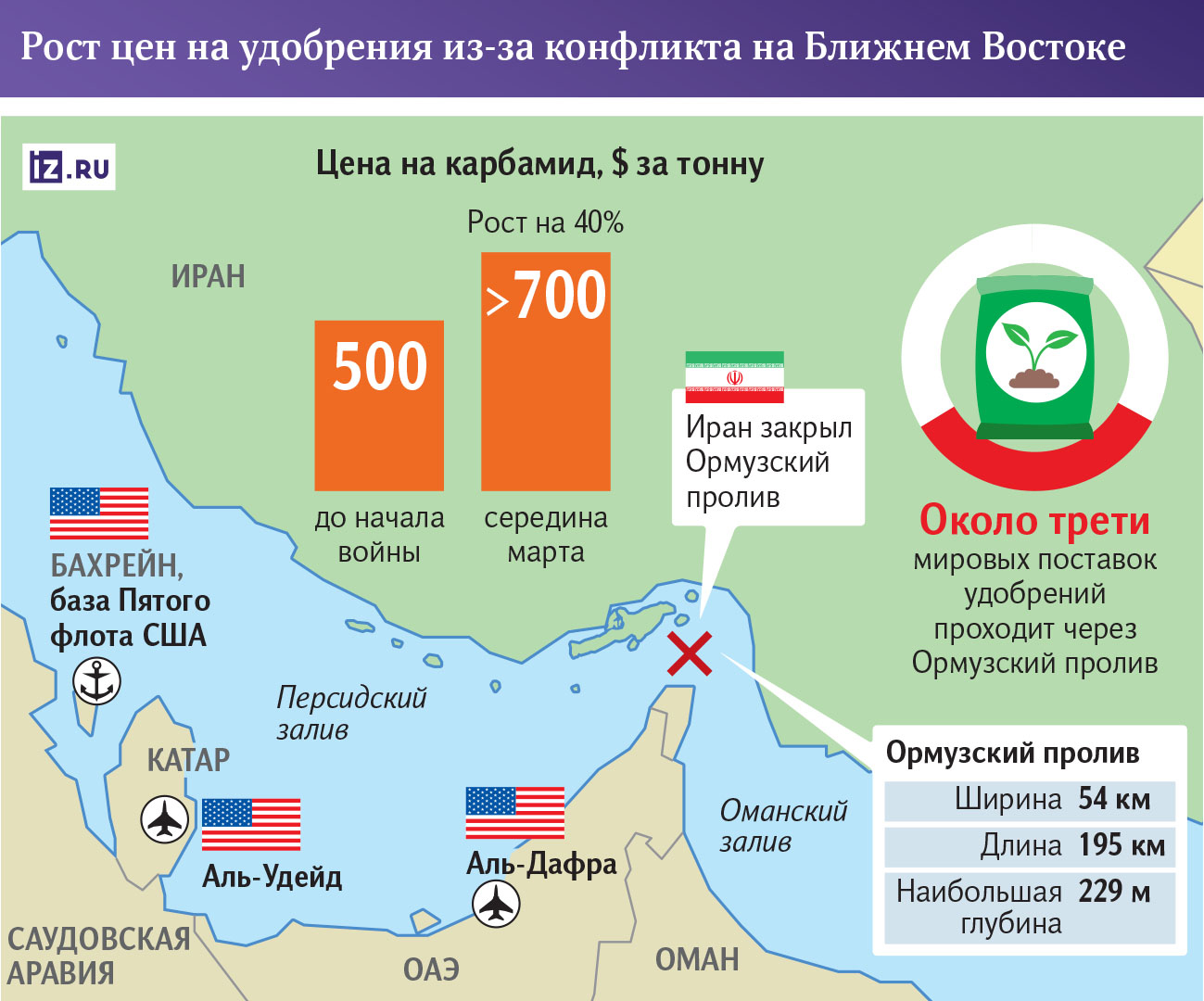
The conflict over Iran has already hit global trade in agrochemicals: about a third of global supplies pass through the Strait of Hormuz, and logistical disruptions and production shutdowns have pushed up prices for key nitrogen fertilizers. According to media reports, urea prices in the Middle East have increased by about 40%, and in the event of a prolonged crisis, they may rise even higher.
Alternative EU suppliers have also faced difficulties. Egypt, one of the largest players in the nitrogen fertilizer market, is directly dependent on Israeli gas, a key raw material for the production of carbamide. Due to the reduction in supplies from Israel, Egyptian factories were forced to suspend operations, which further squeezed the supply on the market.

As a result, Europe found itself under double pressure: an increase in the costs of farmers was added to the shortage of resources. According to Eurostat, in the fourth quarter of 2025, fertilizer prices in the EU were already 7.9% higher than last year's figures. At that time, European farmers and traders warned of further cost increases, as urea prices in July 2025 were already about 26.5% higher than in May.
Nevertheless, experts urge not to wait for the restrictions to be lifted soon. In a conversation with Izvestia, Egor Sergeev, senior researcher at the MGIMO Institute of International Studies at the Ministry of Foreign Affairs of the Russian Federation, noted that the EU's political ambitions have so far blocked any attempts to soften the trade regime with the Russian Federation. A number of senior officials in Brussels and representatives of individual capitals insist on increasing sanctions pressure rather than easing it.

Thus, Italian Prime Minister Giorgia Meloni, speaking to parliament, confirmed her commitment to the tough course of the European Union, without hinting at a revision of positions even in the face of the impending energy crisis provoked by events in the Middle East.
— So far, there are no prospects that this rhetoric and the approaches of key EU countries will change. The blame for everything is political factors and the high reputational cost of abandoning anti—Russian rhetoric," Sergeyev said.

It should be recalled that Brussels justified the introduction of duties by seeking to limit the export revenues of Moscow and Minsk. A tariff of 6.5% was set for a number of items with an additional fee of €40-45 per 1 ton for the transition period of 2025-2026, and by 2028 this level should rise to €430.
Despite these barriers, Russia remained the largest supplier of fertilizers to the EU by the end of 2025. According to Eurostat statistics, the share of the Russian Federation in the union's imports by the end of last year decreased to 16% (against 28% at the beginning of 2021), however, the key European economies - Germany, Spain, Poland, Romania and France — continue to purchase Russian products, which remain competitive even taking into account the tax burden.

In which areas do Moscow and Brussels still trade
Under these conditions, the meeting of the leaders of the European Union countries in Brussels will take place. The escalation in the Middle East is on the agenda of the countries, including the consequences for the EU in the form of rising energy prices and risks to energy security, as well as issues of defense, competitiveness, the budget of unification and migration. Separately, the leaders will discuss Ukraine and increasing pressure on Russia.
The 20th package of EU sanctions against Russia has not yet been approved: in February, the union countries could not approve it due to disagreements, primarily because of Hungary's position. Budapest linked the approval of the new restrictions to the resumption of oil supplies via the Druzhba pipeline, which ceased to function due to Kiev's sabotage.

Among the possible restrictions are new barriers against Russian oil and gas exports: a broader ban on services that help export oil and gas, including transportation, transshipment, insurance and port maintenance of ships. In parallel, additional restrictions on chemical products and metals are also being discussed. These are precisely the positions that still remain in trade between Russia and the European Union. Moscow still sells iron, steel and nickel to Brussels, as well as pipeline gas and LNG.
According to Sergeev, the EU is less dependent on the Strait of Hormuz than East Asian countries, but the current situation is complicated by low reserves in European underground gas storage facilities amid growing dependence on imported LNG.
— The general trend of rising energy prices will also not be ignored by the association. It will be followed by an increase in prices for other goods," the expert emphasized.

Another area of critical importance for Europe is nuclear energy. 19 Russian-designed VVER reactors are still in operation in the EU (in Bulgaria, the Czech Republic, Finland, Hungary and Slovakia). Finding alternative fuels for them is a long process that requires complex licensing. According to the European Commission, although four of the five countries have already signed contracts with new suppliers, the real abandonment of Russian assemblies will take years.

According to the latest verified data for 2024, the EU spent about €1 billion on purchases of Russian nuclear fuel. Seven countries of the union continued to import enriched uranium or use specialized services of the Russian Federation, the volume of supplies then exceeded 2.8 thousand tons. Full data for 2025 are not yet publicly available.

However, here, too, Brussels is set for a long-term break: the REPowerEU strategy provides for the phasing out of nuclear materials and services from Russia. The EU countries were supposed to submit national plans to get out of this dependence by the end of 2025, but there is no noticeable news about breakthroughs in this area yet.
At the same time, a complete rupture of economic relations between Russia and the European Union is not expected in the foreseeable future. By the end of 2025, Russia's share in EU exports dropped to 1.2%, and in imports to 1.0%. It is noteworthy that the European Union has maintained a positive trade balance with Russia for three consecutive quarters. The main product that Europe supplies to the Russian market remains pharmaceuticals: in 2025, the volume of these supplies amounted to €9.747 billion.
Переведено сервисом «Яндекс Переводчик»
