
There is no agreement: why NATO will not join the attacks on Iran

The North Atlantic Alliance will not be able to enter into conflict with Iran on the side of the United States due to internal disagreements, experts say. At least five NATO countries have officially condemned the American and Israeli strikes. Only Poland, the Baltic states and the Czech Republic unconditionally supported Washington. Britain has been extremely reluctant to help, while France and Italy have focused on protecting Cyprus and the Gulf states. However, the main thing that the United States needs is missiles for air defense systems and ammunition in general. The urgent search for additional resources shows that Washington did not expect such prolonged resistance from Tehran.
Will NATO join the strikes on Iran
The US Central Command has requested additional military intelligence personnel from the Pentagon to support operations against Iran for at least 100 days, and probably until September, Politico reported. The urgent increase in resources indicates that Washington initially did not expect such a lengthy operation.
Therefore, the White House is beginning to consider the scenario of the entire NATO bloc joining the conflict. Alliance Secretary General Mark Rutte said that the alliance is ready for the possible application of the article on collective defense in the US operation against Iran. However, he did not specify exact dates.
"We keep this uncertainty because we don't want our enemies, our opponents, to know more about it," he explained.

NATO Secretary General Mark Rutte during a press conference at the headquarters in Brussels
We are talking about the application of Article 5 of the North Atlantic Treaty, which states that an attack on one or more member states of the treaty means an attack on all. In this case, NATO members should use military force to defend the alliance. However, there is an important limitation: the attack must take place on the territory of a member country in Europe, North America or Turkey.

Therefore, the only legitimate way to use this article in the conflict with Iran is to protect the territory of Turkey. Recall that on March 4, the Ministry of Defense of this country reported that a ballistic missile, presumably launched from Iran, was shot down in its airspace. The General Staff of the Armed Forces of the Islamic Republic denies launching towards Turkey. The NATO Secretary General said that the alliance would not invoke the fifth article in this regard.

Debris from a suspected Iranian ballistic missile shot down in Turkish airspace on March 4, 2026
Russia also sees how the North Atlantic Alliance is being drawn into an operation against Iran, said Foreign Minister Sergei Lavrov. He stressed that the conflict could provoke a nuclear arms race and lead to catastrophic consequences. The Russian Federation supports a moratorium on strikes on civilian infrastructure and intends to prepare a draft resolution of the UN Security Council.
Political analyst Denis Denisov told Izvestia that the most likely scenario for NATO's participation is the creation of an informal coalition around the United States and Israel. The official participation of the alliance is highly unlikely, as it will require the consent of all members of the association.
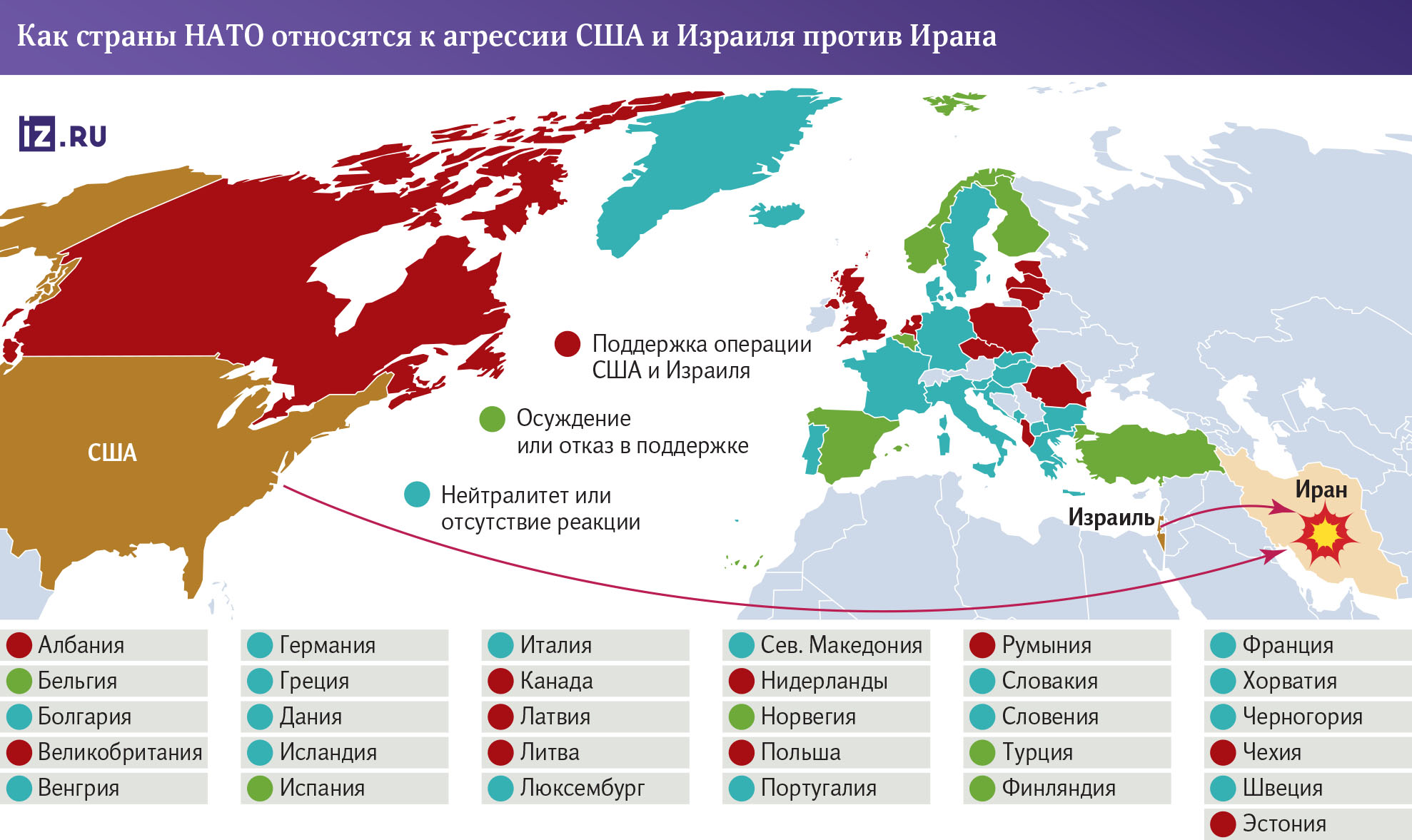
However, there was a deep split within the alliance itself on the issue of participation in the operation. The bloc can be roughly divided into three groups: full support for the actions of the United States and Israel, condemnation of this operation, and restrained neutrality.

The split in NATO over Iran
Washington's actions are supported by countries that have no special interests in the Middle East, but want to show solidarity with the Trump administration. These include Poland, the Baltic States and the Czech Republic. Warsaw is concerned that the White House's attention is now focused on the Middle East, and supplies to Ukraine may be delayed.
Canada expressed "deep concern" about the escalation, but did not officially condemn the US actions, taking a position of cautious support. Moreover, Canadian Prime Minister Mark Carney did not rule out the participation of the Canadian armed forces in military operations against Iran.

A US Air Force transport aircraft at the British Akrotiri Air Base in Cyprus
London holds a similar position: British Prime Minister Keir Starmer said that British troops are not involved in US strikes on Iran, but have provided their bases to the Americans, share intelligence and participate in "defensive" actions. At the same time, Donald Trump openly criticizes the British leader for not initially wanting to provide these bases.
— It took us three to four days to figure out where we could land there. We are very surprised. We are not dealing with Winston Churchill," he said, referring to Cyrus Starmer.
France has officially declared that it is not taking part in the offensive operation of the United States and Israel. At the same time, Macron blamed Iran for the aggravation of the situation. According to him, Tehran was developing a dangerous nuclear program, as well as arming and financing terrorist groups in neighboring countries. According to some reports, France has temporarily allowed American aircraft to use its military bases in the Middle East. In addition, the Fifth Republic has sent six Rafale fighter jets to the UAE to ensure the country's security.

French Rafale fighter jets in flight
However, Paris, as well as Italy and Greece, are focusing on defending Cyprus, which is under attack due to the presence of British bases there. For example, Rome is not going to enter into the Middle East conflict, but intends to help ensure the air defense of the Persian Gulf countries and Cyprus. Spain sent its frigate to the shores of the island. By the way, there are demands in Cyprus itself to return sovereignty over the British bases.
The camp of those who opposed the operation or simply chose to refrain from participating is extremely diverse. Turkey has confirmed that it will not allow the use of its airspace, as well as land or sea elements for operational purposes in favor of either side of the conflict.

A big surprise was the position of Spain, which condemned the operation of the United States and Israel, and also opposed the use of bases located on its territory for these purposes. In response, the United States intends to sever all trade relations with Spain, with the official reason being Spain's refusal to increase defense spending.
The Belgian and Finnish authorities also condemned the strikes, while in Norway they questioned the thesis that they were preemptive.

The United States may need the help of its allies
The discussion of the possible activation of the fifth article of the NATO Charter in the context of the confrontation between the United States and Iran looks more like a strategic preparation "ahead of schedule" rather than an immediate legal inevitability, military expert Dmitry Kornev believes. However, several critical factors can already be identified that explain the Pentagon's logic.
— If the conflict in the Persian Gulf drags on, the United States may require additional assistance, primarily resource assistance. We are probably talking about replenishing ammunition for Patriot anti-aircraft missile systems. It is known that this particular segment of air defense is used to repel Iranian launches, and their consumption during intense combat operations is extremely high — there are often about four interceptor missiles per target. There are examples when 12 missiles were fired to destroy one missile," he told Izvestia.

Patriot anti-aircraft missile system of the Saudi Armed Forces
According to expert estimates, the United States has a stockpile of 20,000 to 25,000 Patriot missiles of various modifications. Even with the upper limit of 25,000, with an average consumption of four missiles per ballistic target, the real interception potential is about 6,000 targets. If we assume that 20-30 launches of Iranian missiles and drones are carried out daily, then the consumption of anti-missiles can reach 120 units per day. In this mode, the existing American reserves will last for about 6-8 months of combat operations, the expert believes.
— That is why Washington's attention is focused on the arsenals of the allies, primarily Poland, Romania and Germany, where NATO warehouses with ammunition for air defense systems are concentrated. Logistics from Europe simplifies the supply of the Middle East theater, and therefore the discussion of the fifth article may have not so much military as coordinating and political significance as a tool to legitimize the attraction of alliance resources," Dmitry Kornev explained.

Patriot anti-aircraft missile system of the Japan Self-Defense Forces
Of particular interest is Japan, which has significant reserves for Patriot, but is not a member of NATO. Washington will have to negotiate with Tokyo within the framework of bilateral agreements. And such preparation of the legal framework for the use of the alliance's resources indicates that Washington does not rule out a scenario in which the fighting will drag on for months.
Other NATO members have few opportunities to directly participate in the US and Israeli operations against Iran. Britain has already provided its aircraft and bases, but its fleet is in an extremely difficult position — only half of the ships are combat-ready, most of them are in ports. The rest of the countries can at most provide their territory, ammunition, or provide diplomatic support. Participation in a ground operation would be political suicide for virtually any government of the NATO countries, since a ground invasion would hit the ratings of the ruling forces.
Переведено сервисом «Яндекс Переводчик»
