Nose by Vertov: museum retrospective showed the relevance of the documentary filmmaker
- Статьи
- Culture
- Nose by Vertov: museum retrospective showed the relevance of the documentary filmmaker


From the first Soviet film experts to modern rils. From the technical know-how of a century ago to the synthesis of the arts. The exhibition "Dziga Vertov. Kinoglaz", which opened at the Zotov Center to mark the 130th anniversary of the birth of the great documentary filmmaker, is actually broader than just a monographic project. It is a hymn to innovation and an attempt to visually explain the very nature of the visual image. And at the same time, the dream of awakening an experimental director in every viewer. Izvestia was among the first to see this.
About a man with a movie camera
For the film world, Dziga Vertov's name has long been in the pantheon of major geniuses. His "Man with a Movie Camera" is regularly recognized as the best documentary of all time and is shown with enviable regularity, the sound tape "Enthusiasm. The Symphony of Donbass is being analyzed as a musical score, and early films that were considered lost are being restored and successfully released (Izvestia wrote about two such examples; I would like to believe that there will be even more).
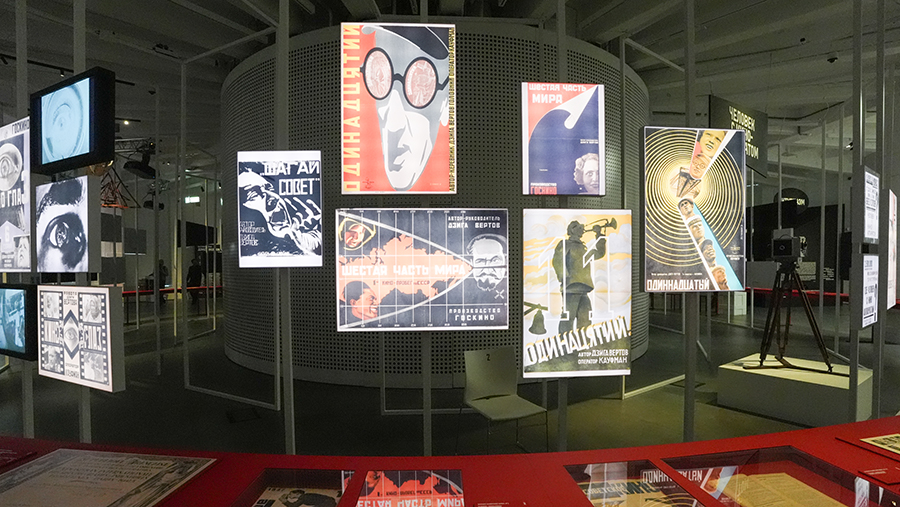
It would seem, well, what can I say here that is new? However, there are still many surprises lurking in the film material itself, as shown by the same restorations by Nikolai Izvolov, and the paper archives are replete with unpublished materials, as evidenced by the books by Kirill Goryachka (both researchers, by the way, acted as scientific consultants for this project). As it turns out, there was no exhibition about Vertov in Russia at all, and only one abroad, and that was in the 1970s. Although, for example, expositions around the world are devoted endlessly to his contemporary and rival Sergei Eisenstein. The Zotov Center corrected the omission.
Screen space
The first thing that strikes you when you find yourself in the exhibition space is the abundance of screens. On the one hand, this is logical, because the main character is a film director. On the other hand, the displays here are not just a way to show fragments (and even full versions) of films, but also a metaphor for the world seen by the director and cameraman through the "cinema eye" and enclosed in a rectangular frame format.
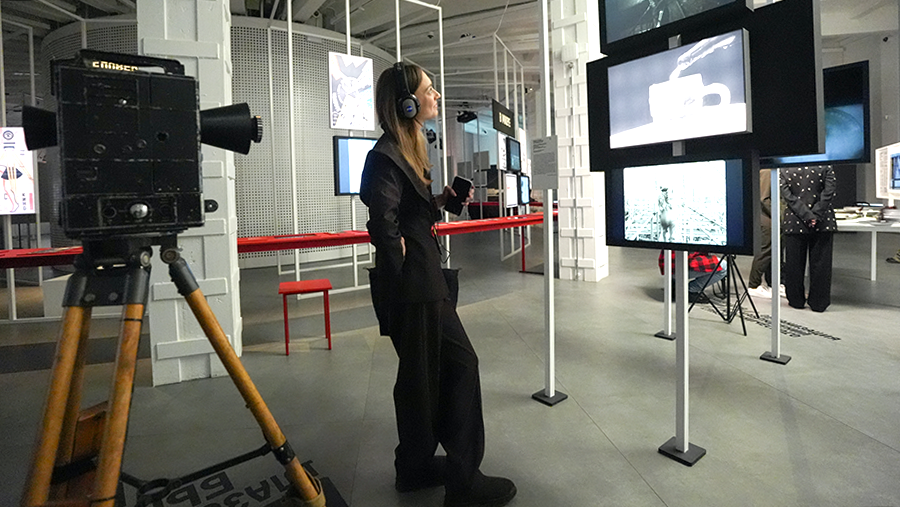
But the most interesting thing is that these screens are not the same. We are not looking at monotonous LCD TVs (by the way, they are not here at all - probably so as not to destroy the spirit of the times), but projections in dark cubes and lightboxes of various formats that preserve the analog retrowire. With the help of stands combining several lightboxes at once, where dynamic fragments and freeze frames are broadcast, the curators create mosaic panels, collage structures that turn temporary art into spatial art.
There are also real cinema halls here: the "Man with a movie camera" in the new, restored version of Nikolai Izvolov can be viewed in its entirety, with seating in front of the screen. And immediately we see a mock-up of the cinema, referring to the beginning of the film, where the audience is shown gathering for a screening. Inside the structure, of course, they also show the famous ribbon.

Credits of the avant-garde
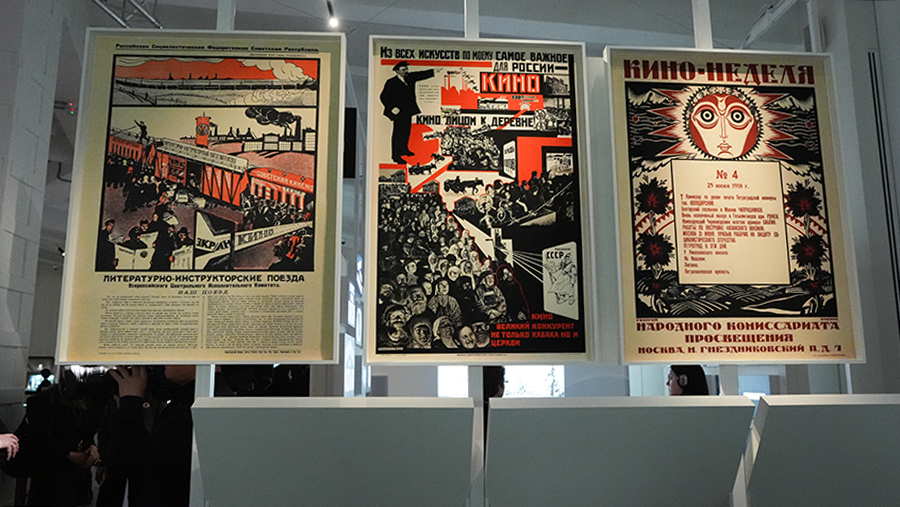
The exhibition demonstrates exceptional ingenuity in working with the material. What's left of Vertov? Films and manuscripts. They show us posters, printed publications, cameras (including the one in "The Man with the Movie Camera" — visitors can even turn the handle on it), and under the glass you can see a bulky experimental sound recording device used on the set of "Enthusiasm"...
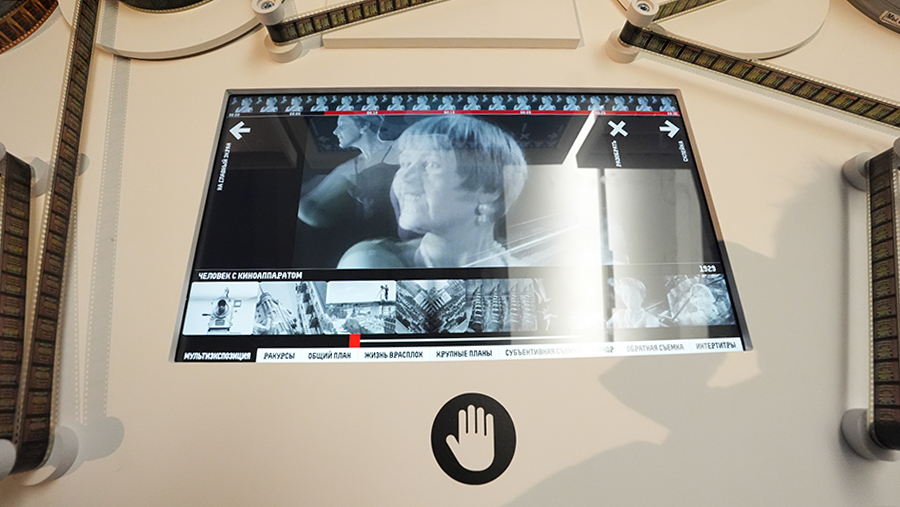
But the project is still thought of more as artistic than historical. Hence the main difficulty of the topic itself: the inability to highlight what museum exhibitions usually focus on: paintings and sculptures. The solution is creative work with the film frame as an object of fine art. Plus— there is an extraordinary audio accompaniment: at the entrance, the audience is given headphones in which the works of Oleg Karavaichuk (another eccentric experimenter who was ahead of his time) and quotes from Vertov himself are played.
But still, it was absolutely impossible to do without painting and graphics. And the examples that are involved here become real discoveries for the public.
Here, for example, is an ink sketch of the intertitles for Vertovsky's "Kino-Pravda" in 1922. The author is Alexander Rodchenko! The final version is also presented here in the form of a cut from the film. And it is noticeably different. It would seem a small detail. But this is eloquent evidence of how unconventionally, experimentally Vertov and his comrades approached every element of film work.
Rodchenko even invented dynamic three-dimensional intertitles: viewers can see not only the result, but also the reconstruction of this structure made of wood and paper. And here the parallel with the painting of the great avant-garde artist is more than appropriate: the "Construction on a yellow background (No. 89)" with a spiral staircase going up in this context reminds us of the film.

The Giant and the Storyteller
A few more remarkable artifacts, hardly seen even by film experts, are Boris Eliseev's sketches for Vertov's unrealized film The Tale of the Giant, a late idea that was supposed to be the documentary filmmaker's debut in children's feature films. The work went on for a year and a half, several art councils were held to discuss the script, and it was planned to involve Aram Khachaturian in writing the music (his prior consent was obtained). But the project was never given the green light.
Zotov did not limit itself to original drawings from the Russian State Archive of Literature and Art, offering to watch a cartoon based on a storyboard animated by modern technology. And this is symbolic in its own way: the failed film was nevertheless embodied in a film form (by the way, Vertov himself planned to use animation in The Tale of the Giant, along with feature and documentary films).
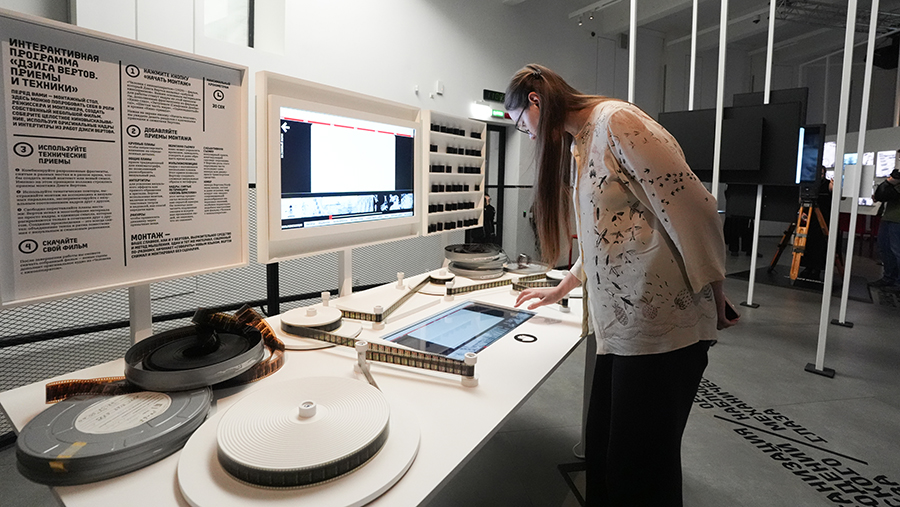
The exposition is arranged chronologically — from the debut "Anniversary of the Revolution", the formation of the kinok group (combining the words "cinema" and "eye"), the series of "Cinema-Truth" and up to the latest projects and ideas, mostly unrealized. Putting a stand at the end listing Vertov's rejected applications is a simple but eloquent and very powerful decision. An outstanding visionary, a dreamer, he has surpassed his era.
However, it is still impossible to call the ending of the narrative tragic. Having been rejected and forgotten during his lifetime, Vertov became incredibly influential after his death, and the exhibition convincingly recalls this.
In the "postscript" of the narrative, there are fragments from films of the French new wave, video art by Olga Chernysheva and Dmitry Venkov, a timeline with a list of directors (up to Christopher Nolan) who somehow took advantage of Vertov's findings, and even realizations from ordinary viewers — anyone can participate here by sending their editing in the spirit of kinokov for selection. After all, the "movie eye" is in everyone's pocket today. Wasn't this what Dziga Vertov himself dreamed of 100 years ago?
Переведено сервисом «Яндекс Переводчик»
