Exchangeable paintings: which masterpieces the State Museum of Fine Arts gave to the Tretyakov Gallery for Chagall
- Статьи
- Culture
- Exchangeable paintings: which masterpieces the State Museum of Fine Arts gave to the Tretyakov Gallery for Chagall


The Tretyakov Gallery has been replenished: the Pushkin Museum (GMII) has donated 15 works for a permanent exhibition on 20th—century art. Among the paintings are "Girl on a balloon", "Moroccan triptych", "Red Fish" and other masterpieces. The idea of integrating paintings by foreigners into the story of Russian painting only seems strange at first glance. The new project "Matisse and Picasso. Color and Form" clearly shows how the French avant-garde influenced Russian art. Izvestia was one of the first to visit the updated exposition.
The answer is in French
Since February 17, the New Tretyakov Gallery has been showing nine paintings by Henri Matisse (including the Moroccan Triptych, Red Fish and a cycle from the artist's studio) and six canvases by Pablo Picasso (Girl on a Balloon, Portrait of Ambroise Vollard, Violin and three Cubist works from 1909).
The usual place of paintings is the Gallery of Art from Europe and America of the XIX—XX centuries of the State Museum of Fine Arts on Volkhonka. And usually the museum does not part with such masterpieces. After all, it is to them that the public comes to the permanent exhibition.
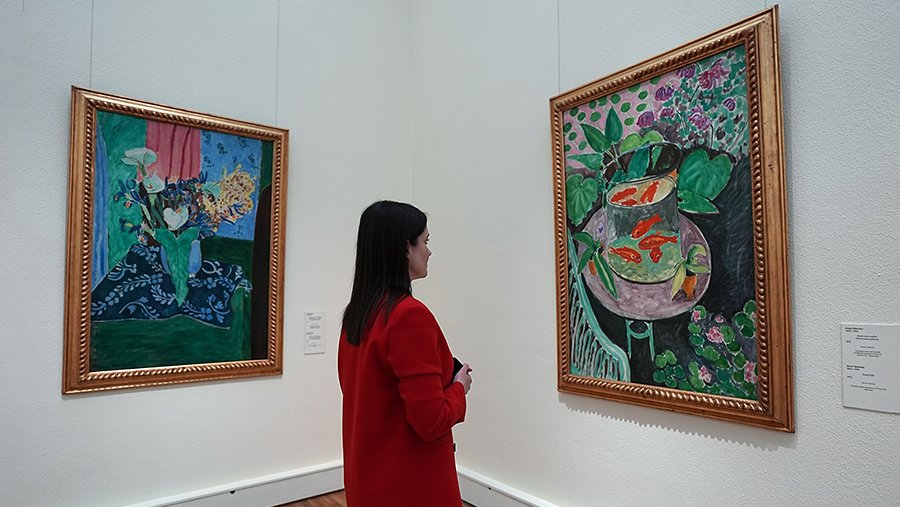
But here is a special case. For the exhibition "Marc Chagall. The Joy of Gravity" Tretyakov Gallery gave the State Museum of Fine Arts almost the entire contents of the Vitebsk artist's hall in the 20th century art exhibition: not only the famous painting "Over the City", but also huge panels for the Jewish Chamber Theater. Of course, such decisions are made only on a mutually beneficial basis.
One can argue whether the exchange turned out to be equivalent. After all, everyone knows "The Girl on the Balloon" and "Red Fish", and only connoisseurs know the theatrical panels. On the other hand, the Tretyakov Gallery could have done without the French, whereas the Pushkin exhibition was going on without things (tickets for it were completely sold out from the very first days) it wouldn't have worked out in principle.

It seems that this is the case when everyone wins. It's clear from the State Museum of Fine Arts; the Tretyakov Gallery has got big names on the poster and iconic things that may never have been in these walls.
Guests and hosts
The "guests" were predictably placed in the Chagall hall (also partly French, considering the period of his emigration). It would probably be more interesting to spread them out across all the halls of the Russian avant-garde, so that viewers could see with concrete examples how Picasso influenced Lyubov Popova and Matisse influenced Ilya Mashkov.
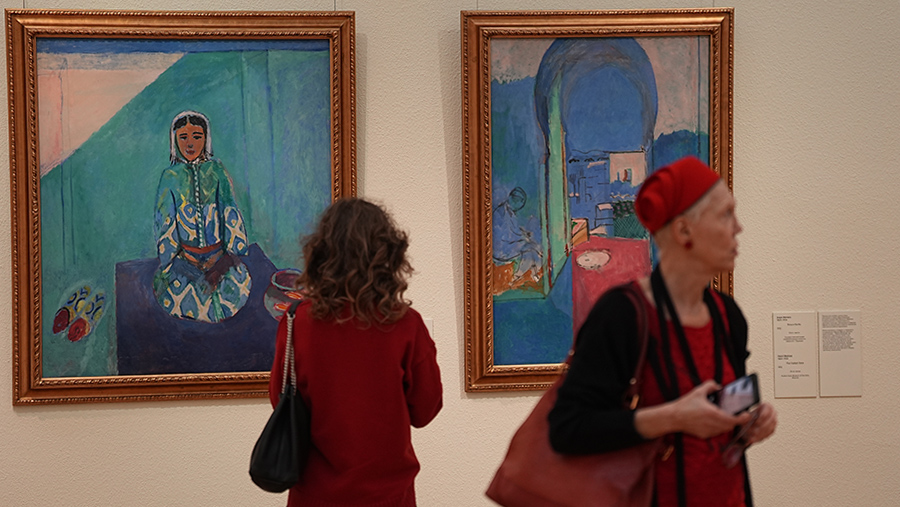
But then it would be necessary to interfere too radically with the existing exposition. The Tretyakov Gallery decided to follow a simpler path, hoping that all artistic and historical parallels would be read by the public anyway. In principle, with good reason.
In the previous hall there are paintings by Aristarchus Lentulov and Alexandra Exter, and a little further away there is a hall dedicated to the collection of George Costaki. And this neighborhood immediately creates the necessary context.
Looking at the colorful mosaic city views of Lentulov, led by the famous "Basil the Blessed" and "Venice" by Exter, you catch yourself thinking that this is something like a synthesis of Picasso's Cubist ideas and Matisse's coloristic expression. Admiring Kostaki's collecting sense, one involuntarily compares his intuition with Sergei Shchukin and Ivan Morozov, thanks to whom the exemplary works of Picasso and Matisse appeared in Russia.
The houses of the two merchants were a real Mecca for Russian avant-garde artists. It was in Moscow that many of them saw advanced French painting for the first time. And then we adopted the innovations of foreigners and moved on.
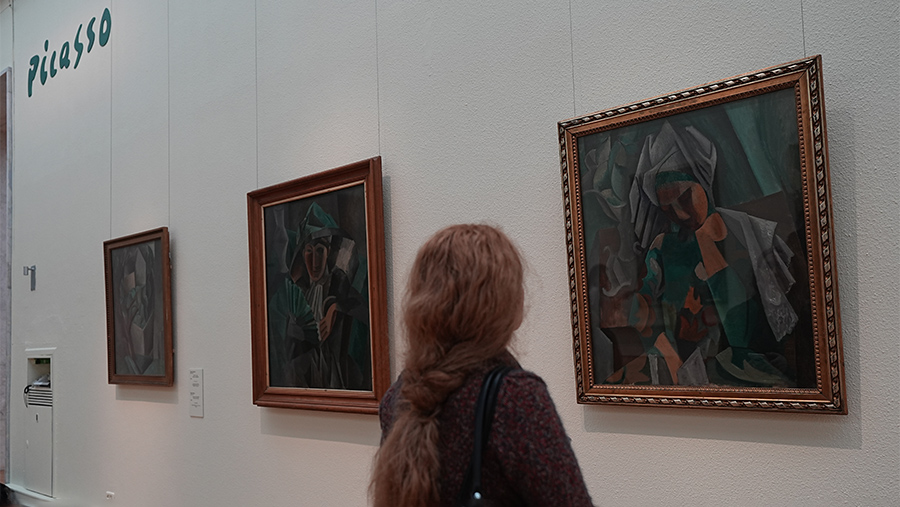
It is interesting, for example, to compare Picasso's "Portrait of Ambroise Vollard" with Kazimir Malevich's "Portrait of Mikhail Matyushin" in the Kostaki Hall. These things are separated by only three years; both are Cubism (more precisely, in the case of Malevich, cubofuturism). But the work of the future author of the "Black Square" is much more radical — there is already a complete rejection of portrait similarity and anthropomorphism as such.
If the figures of the Russian avant—garde became familiar with the latest techniques thanks to Shchukin and Morozov, then the artists of the second avant—garde, the Soviet nonconformists, sought to visit Kostaki for the same purpose. Yes, yes, to see what Malevich, Popova, Exter, and so on had done (since all this was forbidden in the USSR and was in closed funds). Here's another parallel.
And although the works of the sixties are ahead, at the very end of the exhibition, the new focus exhibition makes you think about the "relay race" of the eras. And at the same time — about the very importance of the figures of Picasso and Matisse for our country.
More than art
The main picture of the new project is "The Girl on the Balloon", a decision that seems obvious only to the Russian audience. This work is important, but not the key to Picasso. From the point of view of the universal history of art, the "Avignon maidens" are considered more significant.
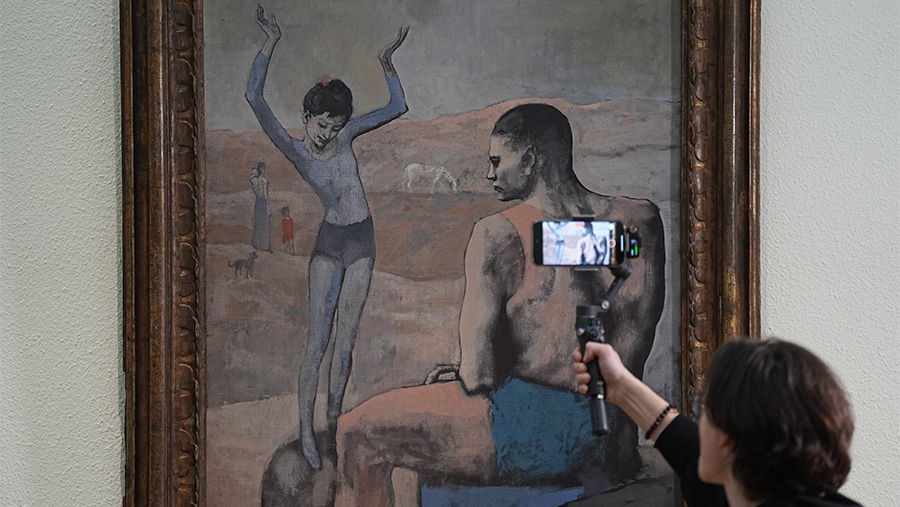
But in the USSR, "The Girl on the Balloon" became — largely thanks to the sensational thaw retrospective of the artist in 1956 — a real symbol of everything advanced. In a way familiar to everyone.
Another landmark moment of Soviet culture is the Moscow—Paris exhibition, a harbinger of perestroika. Matisse's "Dance" was already displayed there (a photo of Brezhnev and his comrades against the background of a seditious canvas could not but shock the public).

And this story can also be remembered today. However, the great canvas itself is not shown in the Tretyakov Gallery — it is in the Hermitage. But the painting "Nasturtiums. The panel "Dance" — the artist depicted it on the wall of his studio.
It is symbolic that Matisse was not allowed to visit the Tretyakov Gallery twice. Shchukin wanted to leave his collection to this museum, but Ilya Ostroukhov, the gallery's trustee, was categorically against "Dance" and "Music," and Shchukin agreed to delete them from his will. And during the preparation of the Moscow–Paris exhibition, the then director of the gallery, according to the legendary Irina Antonova, said at a meeting at the ministry that this project would get to the Tretyakov Gallery only over his dead body.
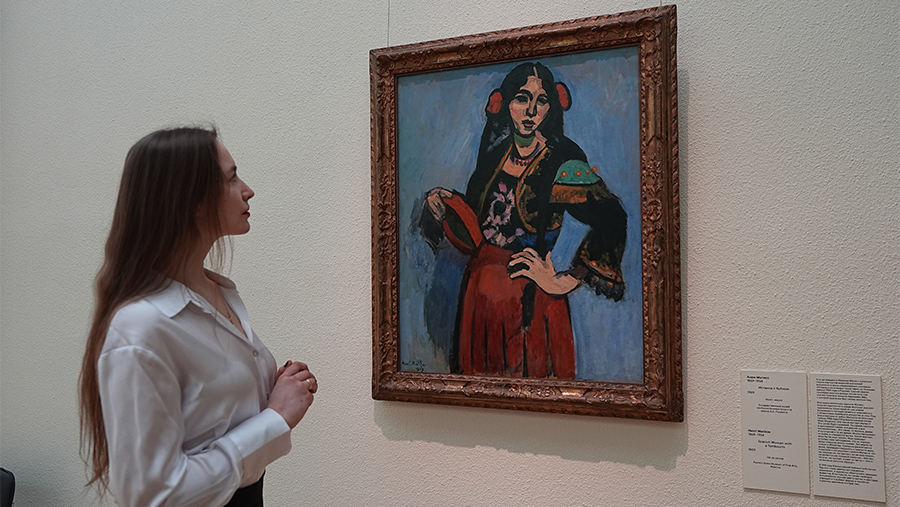
The current head of the Tretyakov Gallery, Olga Galaktionova (along with her predecessor, Elena Pronicheva), in a sense, eliminates historical injustice. A special grace to this fact is given by the fact that Galaktionova agreed on the exchange "on the other side" — while still in the status of head of the Pushkin Museum.
And already this year, the gallery received not only paintings from the State Museum of Fine Arts, but also the director. Which, of course, is a coincidence, but only partially: the Chagall exhibition, an ambitious homage to Antonova, clearly contributed to Olga Nikolaevna's career successes.
Now it remains to make a new "Moscow–Paris". However, this requires something more than 15 canvases (albeit masterpieces). Let's say it's a start.
Переведено сервисом «Яндекс Переводчик»
