
There is a loan: the share of companies with overdue loans reached a record quarter

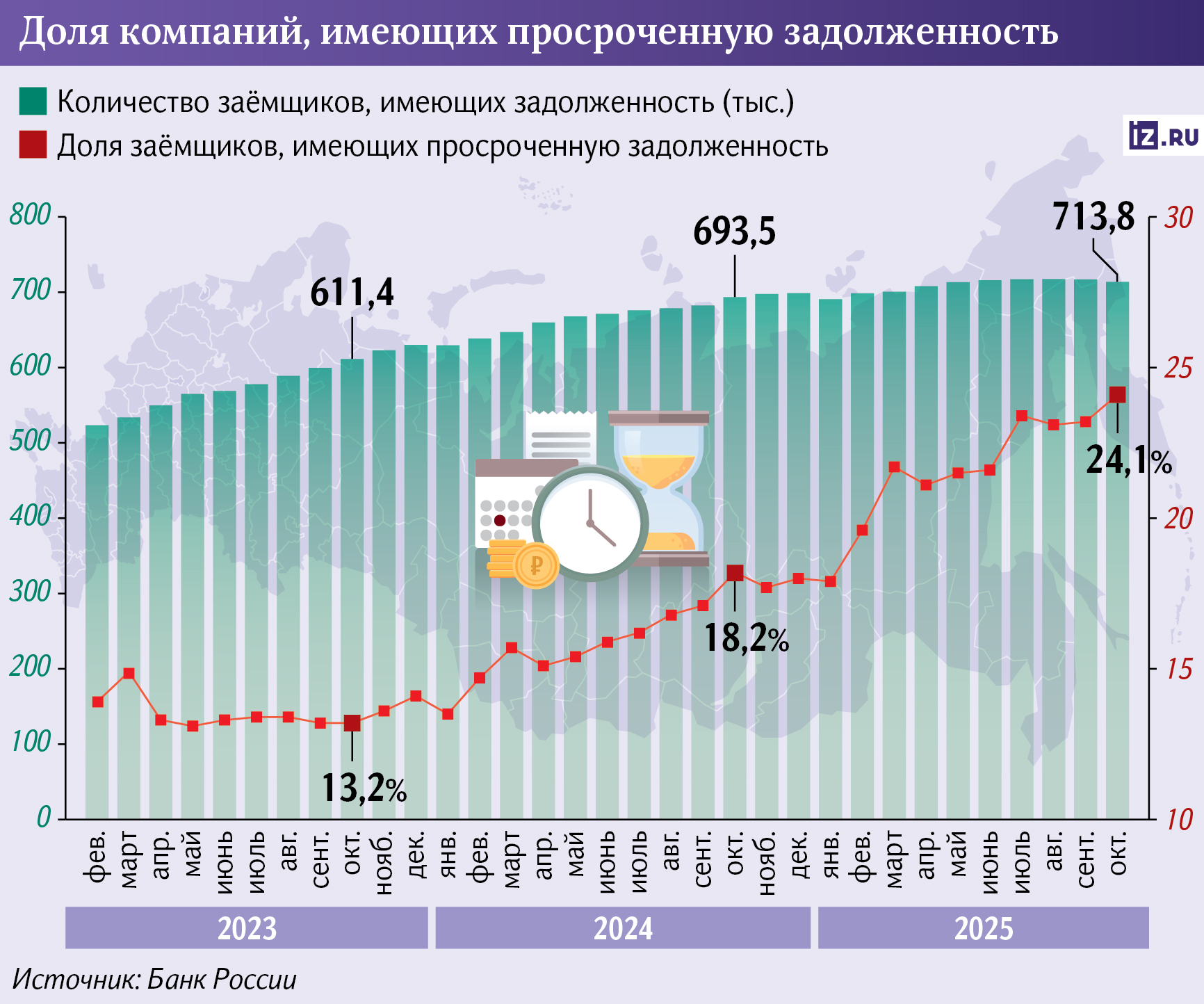
The share of companies with overdue loans has reached a record quarter — it has increased by 6 percentage points over the year, and since 2023 it has doubled, according to data from the Central Bank (Izvestia analyzed them). At the same time, the volume of delays has almost reached 3 trillion rubles. The reasons are a high debt burden, falling profits due to lower demand, and rising costs for servicing old loans. This situation doubles the risk of defaults and further company bankruptcies, experts believe. Which regions have the weakest payment discipline and what will help businesses stay afloat — in the Izvestia article.
Why is a business delaying loan payments?
As of October, there were almost 714,000 legal entities and individual entrepreneurs (sole proprietors) with outstanding loans in Russia. Of these, 24% (approximately 171 thousand) were overdue payments. This share has become a record for at least 2.5 years (no earlier figures are given). At the same time, in 12 months this indicator has grown by 6 percentage points at once, and since the beginning of 2023 it has almost doubled, according to the November statistics of the Central Bank.
At the same time, the volume of delays increased by 7.2% compared to 2024, to almost 3 trillion rubles. This increase was the highest since the fall of 2023. At the same time, the loan debt itself increased by almost 10% over the year — by the end of the third quarter it exceeded 80 trillion.
In recent years, banks have been increasing lending to companies — from the beginning of the year to October 1, the corporate loan portfolio increased by 6.2% (an increase of 9.5% in 12 months), the press service of the Central Bank told Izvestia. As the size of the loan portfolio increases, the amount of overdue debt increases proportionally.
At the same time, its share remains stable over time: for loans in rubles, it has increased since the beginning of the year from 3.6% to 3.8% as of October 1, and for loans in foreign currency it has decreased from 1.5% to 1.4% over the same period, the regulator said.

The main reason is the high key one, which has been at a record high of 21% per annum for six months (and only in June it began to be gradually lowered to 16.5% by November). This made money an expensive resource, and companies with a high debt burden were under serious pressure, explained Valery Tumin, a member of the expert council on the development of the digital economy under the State Duma Committee on Economic Policy. According to him, for businesses whose profitability rarely exceeds 10-15%, this situation is especially painful. It has most significantly affected small and medium-sized enterprises that do not have access to cheap financing and are forced to borrow at market rates.

As the key rate increases, the cost of loans increases, so the monthly payment increases, independent expert Andrey Barkhota added. At the time of taking out loans, companies expected that the period of high rates would not last long — a maximum of three to four months.
At the same time, many enterprises borrow not for development, but to cover old debts and maintain liquidity. As Izvestia reported earlier, by the end of September, companies were spending more than 36% of their profits on loan servicing, which is a historical maximum. The increase in delays, in turn, is related to the difficulties of refinancing: banks are tightening requirements, and companies do not have enough available funds for timely payments.

In addition, debt pressure has increased due to lower profits. For example, in the eight months of 2025, companies earned 17.6 trillion against 20 trillion in the same period of 2024. According to Rosstat, the balance of income and losses also decreased by 8.3%. The drop in profits is due to lower consumer demand amid high interest rates, rising costs due to staff shortages, tax changes, increased interest costs, as well as higher prices for imports of equipment and raw materials due to sanctions and logistics.
In which regions and areas do companies have the highest loan delinquencies?
As of October, the companies' loan debt was unevenly distributed across the regions. The largest annual increases were recorded in the North Caucasus, Southern and Ural Federal Districts - by 29%, 21% and 13%, respectively. At the same time, businesses in Siberia have accumulated debts by almost 3% less, according to the regulator.

At the same time, enterprises in the Southern and Volga districts became leaders in delays, where they grew by a quarter or more. Siberia was also included in the anti-rating, where, despite a decrease in debt, the volume of loan defaults increased by 19%.
In October, most of the debts were in manufacturing, the financial sector, as well as professional, scientific and technical services — together they accounted for 56% of the total amount of liabilities.

What should a business do because of delays
Delay in loan repayment is primarily a commercial risk for the debtor company itself, Maxim Barashev, managing partner of BBNP and a member of Delovaya Rossiya, emphasized. According to him, the main thing in this case is to prevent the application of penalties and changes in the terms of the contract, for example, an increase in the interest rate. If difficulties arise, it is worthwhile to contact the bank and negotiate debt restructuring — to extend the loan term by reducing the monthly payment.
To limit the potential risks associated with the growing debt burden on large companies, the Bank of Russia has set a 20% credit requirement surcharge since April 1 this year, the Central Bank's press service said. Financial institutions will reserve more capital when issuing loans or purchasing bonds of large enterprises with increased debt burden. In addition, starting from December 1, 2025, the surcharge will increase from 20 to 40%, which will further limit the risks, the press service added.

Companies currently do not have enough money to service their debts, independent expert Andrey Barkhota believes. Due to the high key rate, businesses are closing and jobs are being vacated. According to expert estimates, the number of defaults may increase by two to three times. Izvestia sent a request to the Ministry of Energy.
A further increase in debt pressure may lead to a wave of bankruptcies in the private sector, as well as restrain economic growth, according to private investor Fyodor Sidorov. According to the Expert RA agency, in January – October 2025, at least 26 companies committed a technical default, compared to 11 for the whole of 2024.

If problems arise for large backbone enterprises (for example, in the manufacturing industry), the government is likely to support them through additional capitalization, says Natalia Milchakova, a leading analyst at Freedom Finance Global. However, such expenses have the potential to accelerate inflation.
Valery Tumin from the expert council of the State Duma Committee, in turn, believes that the growth of high debt burden is inherent mainly in small companies, so bankruptcy is not possible in all areas. Large and medium-sized businesses that have access to preferential loans and government support are mostly doing well. In addition, Russian enterprises have an important advantage — a high savings rate and accumulated profits in recent years, the specialist added.

At the same time, Valery Tumin continued, default risks are most likely in sectors with low margins and high debt exposure — development, trade, and individual industries. However, further dynamics will depend on how quickly the economy adjusts to the new conditions and how effectively support measures will work. The situation may stabilize when the Central Bank starts to reduce the key rate more actively — next year it is expected to reach 13-15%.
Переведено сервисом «Яндекс Переводчик»
