
Renaissance Decadence: support for Macron and Bayrou has dropped to a minimum
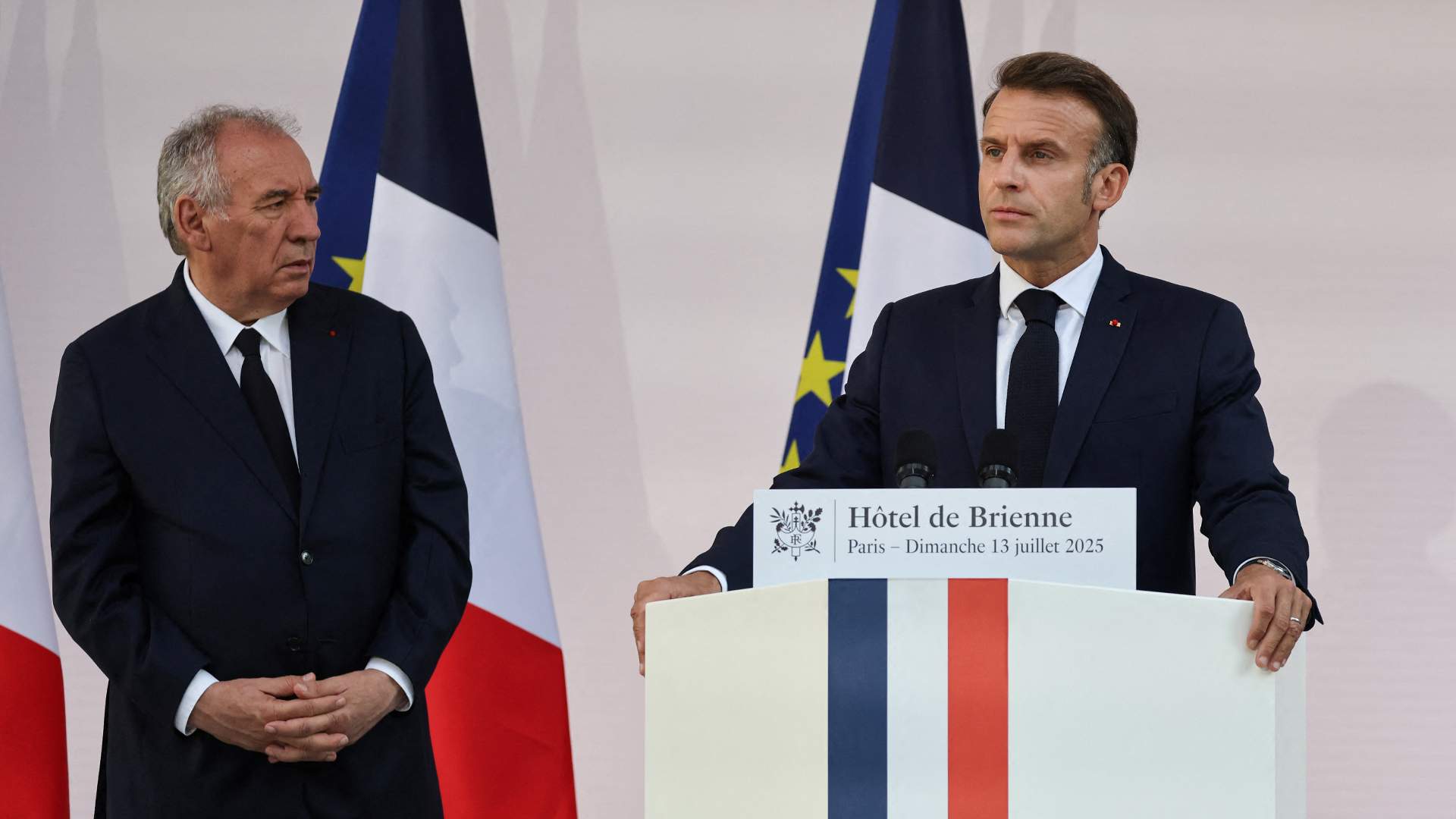
The French electorate is less and less supportive of its president and his next prime minister. An IFOP poll conducted for the Journal du Dimanche showed that Emmanuel Macron and Francois Bayrou occupy the first places from the end of the rating of political leaders with 19 and 18% approval, second only to the former head of the Fifth Republic Francois Hollande. Why the lack of support is becoming a harbinger for parliamentary upheaval and why the "revivalists" are not going to do anything about it — in the Izvestia article.
Napoleon is missing
"The most unpopular pair of leaders in the history of the Fifth Republic," is how the press described the government duo of Emmanuel Macron and Francois Bayrou based on IFOP/JDD barometer data. The French president received 19% support, while his prime minister received 18%.

Former French President Francois Hollande
So far, Macron has not reached the absolute anti-record of his predecessor Francois Hollande, whose electoral rating was 13% in the fall of 2014, but there is an obvious negative trend in the attitude of the French towards their president. The situation was not changed by the regular change of government that took place in December last year. In this sense, Macron is even worse than Hollande, who managed to improve his position due to the appointment of Manuel Valls as Prime Minister. 11 years ago, the latter's fairly successful work at the head of the Cabinet of Ministers earned the support of 38% of French citizens. Polls show that the current Prime Minister, Francois Bayrou, looks even worse in the eyes of his compatriots than his boss.

The Journal du Dimanche emphasizes that Macron's rating did not fall to such a level even during the period of the social crisis associated with the mass protests of the "yellow vests" movement.
Rejecting outcasts
Natalia Eremina, Doctor of Political Sciences, professor at St. Petersburg State University, told Izvestia that the rating is steadily declining with each new French government, and the endless change of prime ministers does not help, since there are no examples of a "rollback" - only some stabilization, and then a further decline.
"The legal decisions that were taken under President Macron have directly and very seriously affected the social sphere, unemployment, subsidies, tuition fees, payments and labor law," Natalia Eremina said, adding that France has been experiencing a deterioration in the quality of work since the coronavirus pandemic.

The expert added that the French are also tired of the ongoing climate agenda, not to mention the failures on the external circuit.
"Macron is trying to use the Ukrainian case to show how successful he is in foreign policy: he manages security issues, concludes relevant agreements, but in fact this is more a sign of failure than success, because in reality he does not influence the resolution of any of the crises anywhere in the world," explained Natalia Yeremina..
On July 15, France announced its readiness to consider compensation for crimes in the colonies of Niger, as reported by The Guardian newspaper. Paris has not yet acknowledged responsibility, but it is possible that four communities from Niger, representing the descendants of the victims of the 1899 colonial expedition, will push through the French government. There have been precedents, for example, the recognition of France's responsibility for the genocide in Rwanda by Emmanuel Macron in 2021.
Yeremina stressed that over the past couple of years, France has weakened its neocolonial positions in some countries, especially in Africa, from which France was largely forced to retreat. Today, the same uranium mining in Niger is accompanied by severe restrictions compared to the previous, almost unlimited freedom of action.

According to the expert, Macron's policy, which manifests itself mainly "for democracy all over the world" and "for democratic values," is forced to become at the top of the agenda, including the French-Ukrainian one, because the French president simply has no other options. Moreover, the budget improvement initiated by Bayrou, which provides for serious cuts in the social sphere, will primarily affect ordinary people.

Experts also call the solution found by Macron in relation to New Caledonia, which saw mass riots for several months last year, equally ambiguous. The acquisition by the overseas Territory of the actual status of a limited independent State has met with mixed reactions. The largest pro-independence party in New Caledonia, the Caledonian Union, opposed the initiative.
Pavel Timofeev, Head of the Regional Problems and Conflicts Sector at the E.M. Primakov IMEMO, told Izvestia that the formula for mitigating the situation after the pogroms of 2024 could both satisfy the people and, conversely, "open Pandora's box." Granting broad autonomy to the French overseas Territory could potentially calm the situation, or, conversely, provoke an even broader conflict with new goals.

View of Noumea, the capital of New Caledonia
"Not everyone welcomed the decision, although it has not yet been approved," Timofeev stressed, adding that the combination of two events could well affect the ratings of Macron and Bayrou.
Russian interference in the budget
Against the background of failures on the external circuit, the Elysee Palace redirects money into weapons "against Russia" and "from Russia." During a speech at the Ministry of Defense, Macron said that France would double the military budget by 2027, and not by 2030, as originally planned. It is assumed that in two years the budget of the armed forces will grow to €64 billion, and additional funding will be provided — in the amount of €3.5 billion for 2026 and another €3 billion for the next.
Natalia Eremina notes that further failures will be correlated with an even greater Russophobic narrative, because Macron has no other arguments in his hands.
At the same time, Eremina noted that most French people do not care what happens in Ukraine — some people believe that their country is taking the right position without understanding the issue, while others do not like the price of supporting Ukraine. According to the expert, the citizens of the Fifth Republic may not be satisfied with the very fact of accepting Ukrainian refugees, because a lot of money has been spent on this — more than 12 billion.

"We don't really understand the percentage of French people who strongly oppose participation, but we can suspect that a quarter of them, or maybe even half, believe that the support is excessive," Eremina said.

As a result, France has to some extent become an example of how a government can become more anti-Russian than pro-French, Eremina notes. According to her, anti-Russian means anti-French, anti-Italian, anti-German and further down the list.
— They are trapped, which they cannot get out of themselves, because they have been pursuing this policy for a long time and cannot now say that they were wrong. They thought that it would be possible to conclude an "equal" agreement with Russia and profit from what they planned to compensate for their expenses. It didn't work out and it won't work out, but they certainly won't be able to admit it," the expert points out.
The victim of the figure
France has had five prime ministers in the last three years. This is happening against the background of an emergency situation in the national economy, requiring urgent budget cuts, which are the highest in relative terms among the developed economies of the world.
"We can no longer afford everything as before. France will have to make a choice," said Francois Villeroy de Galo, head of the Bank of France.
Budget cuts for 2026 amounted to €43.8 billion, while departmental expenditures will remain at the current level. According to Villeroy de Galo, Paris is hindered from taking decisive steps in this direction by the large public debt, amounting to a record €3.345 trillion, or 114% of the country's GDP. According to the head of the Bank of France, the stabilization of the national debt is a priority task of the government, the solution of which will make it possible not to shift "an increasingly heavy burden" to future generations.

Meanwhile, only defense items remained unaffected by the budget sequester. Moreover, in March, the state investment bank Bpifrance, at the suggestion of the Ministry of Finance, announced the creation of special deposits for citizens who want to invest their savings in financing the defense industry. Thus, the government plans to attract €5 billion in additional investments.
Bloomberg notes that Francois Bayrou will not be able to solve the problems that caused his predecessor Michel Barnier to leave his post last December, even if all the planned budget cuts are implemented. Among them, for example, there are plans to abandon the indexation of pensions and social benefits.
However, Bayrou proposed even less popular measures, for example, to make traditional holidays — Easter Monday and May 8 — working days. Politico called these initiatives a death sentence for the French prime minister's political career. Nevertheless, as Pavel Timofeev notes, it is premature to make predictions about when the government in France will change again.

French Prime Minister Francois Bayrou
— It is difficult to guarantee anything here, because Bayrou may well make it to the end of Macron's second term. A lot will depend on whether the opposition in France, the far right and the far left, can unite together to overthrow him, as was the case with Barnier that year. Here, as they say, mathematics decides everything," the expert believes.

He notes that if Bayrou resigns, it will be much more difficult for Emmanuel Macron to reach an agreement with the opposition again. The unpopular prime minister has a chance to repeat the fate of his predecessors and become an electoral lightning rod for the president, but this time the centrist coalition, which is already going through hard times, will take the blow.
— Macron's rating will fall, and indeed he can, roughly speaking, put everything on Bayrou and dismiss him. But if he does this, he will shoot himself in the foot, because the group of "Macronists" in parliament is not monolithic," Timofeev explained.

French President Emmanuel Macron
According to him, much for Macron will depend on the economic situation, as well as on whether the "wings" of French politics can agree and coordinate efforts. The French political scene is very fragmented, and the more candidates there are in the current split, the more confusing the situation will become.
— In general, if fragmentation persists, the Macronists have a chance to continue to unite the moderate center around themselves, playing on fears of extreme forces coming to power. Another thing is that the economic situation, general splits and general unpopularity of Macron may go sideways to his "heirs". Roughly speaking, the voter will "ride" his successor. In this case, the question is: "And then who will be chosen? Will these representatives of the extreme forces represent the Republican party or the moderate left?", Pavel Timofeev emphasized.
Переведено сервисом «Яндекс Переводчик»
