- Статьи
- Culture
- Living as a single human dormitory: the truth about the most famous communal apartment in Soviet cinema

Living as a single human dormitory: the truth about the most famous communal apartment in Soviet cinema

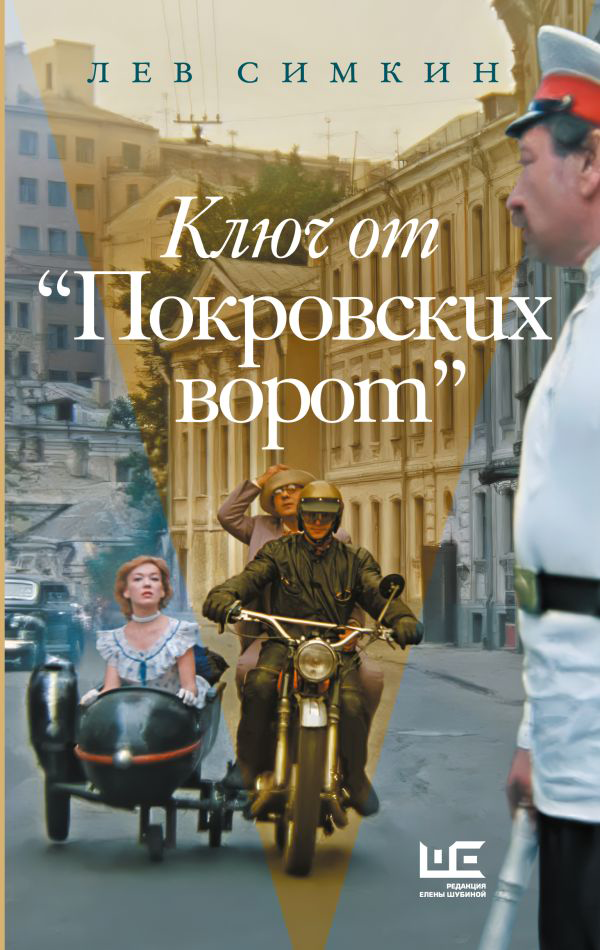
Lev Simkin's book is devoted to the socio-cultural analysis of Mikhail Kozakov's most popular TV movie "Pokrovsky Gate". One of the goals is to explain the details of Moscow life in the 1950s, which are obscure to most viewers born after 1982, when the film was released. But Simkin's more global task is to formulate the secret of the success of Pokrovsky Gate, which at first did not attract much attention (the premiere at the Cinema House did not make a splash), but over the years began to gain momentum and become more attractive to new generations. Critic Lidia Maslova presents the book of the week specifically for Izvestia.
Lev Simkin
"The key to the Pokrovsky Gate"
Moscow: AST Publishing House: Edited by Elena Shubina, 2026. 249 p.
It is important for the researcher to identify parallels between the film's hero, Kostya Romin, played by Oleg Menshikov, and the creator of this literary character, Leonid Zorin. His autobiographical Kostya is an end—to-end character in many works, appearing not only in the 1974 play that formed the basis of the film, but also in various prose writings. More often than others, in order to highlight the character and fate of Kostya, Simkin quotes the story "Khokhlovsky Lane", and also cites the confession of Zorin himself, whose youth was spent in the late 1940s in a communal apartment on Petrovsky Boulevard: "There is no gap between me and Kostya."
Mikhail Kozakov, who made his theatrical directorial debut with Pokrovsky Gate eight years before the film, was no less closely identified with Kostya.: "In his fifties, he mercilessly drilled 22-year-old Oleg Menshikov to make him look as much like himself as possible in his youth. And he didn't spare everyone else, perceiving the Zorinsky script as a story about his life." Thus, both Zorin and Kozakov merged into a certain whole in the image of Kostya, and this "chemistry" between the playwright and the director can probably serve as a lock pick, the key to the long—lasting popularity of the film - Simkin writes about this in one of the final paragraphs of his book: "That's why the creation of two artists, frankly speaking Those who disliked the USSR turned into a poetic hymn to a bygone time. Hints and allusions are no longer readable, irony and sarcasm, losing touch with the era that gave rise to them, turn into a nostalgic utopia over the years. Actually, this book was written for the reader to hear the real echoes of that life."

There are indeed plenty of purely factual real echoes of Moscow life in the 1950s in Simkin's book, who managed to see the "thaw" of Moscow with his own eyes, starting with the information about eggs, one of which is accidentally broken at the beginning of the film by the clumsy Khobotov (used to Lend-Lease egg powder during the war, Muscovites in the mid-1950s in general they were afraid of eggs returning to the shelves because of dangerous bacteria and harmful fats) and ending with an explanation for the youngest ones - why the characters of the film communicate on a regular basis using telegrams (and also why Velurov's love telegram sent to swimmer Svetlana — "I'm going crazy" — lacks an excuse).

A shot from the movie "Love and doves"
In addition to everyday details, the book also contains general cultural considerations, as well as film analogies, for example, between "Pokrovsky Gate" and Vladimir Menshov's folk comedy "Love and Pigeons" released two years later. According to Simkin, both films are a rare example of the coincidence of the tastes of the "deep people" and the "more educated strata of Soviet society." The similarity also lies in the fact that "Pokrovsky Gate" is a kind of myth about the intelligentsia, which in the eyes of the people (represented by the brutal metal artist Savva Ignatievich) looks "helpless and ridiculous, unable to do anything with their own hands, and earn money," while "Love and pigeons" — a somewhat bogus myth about "ordinary people" seen through the eyes of the creative intelligentsia.

But the funniest cinematic parallel arises in the chapter, which tells about Kozakov's little trick, trying to distract the attention of censorship and secure an erotic scene in which the loving Kostya is visited by "all such sudden and contradictory" blonde Anna Adamovna. Following the example of many of his colleagues who have repeatedly used this technique, Kozakov tried to insert into this episode some obviously "impenetrable" minor vulgarity that would anger the censors, but the rest would go unnoticed. As such an irritant, the director came up with a globe that rhythmically sways on the closet while Kostya and Anna Adamovna retire to his room. The plan worked, and censorship really pounced on the obscene globe.

An image from the film "Pokrovsky Gate", Margarita Pavlovna
Simkin's book sheds light on some of the prototypes of Zorin's characters, for example, on the famous French translator Nadezhda Zharkova, whose features were inherited by Margarita Pavlovna, and who, among other things, translated the very Emile Zola, who, according to Kostya, was burned out because the burner was not turned off. However, a woman of considerable merit, Margarita Pavlovna, has a much more weighty symbolic meaning, which is revealed in the pre-final scene, where Kostya, who is too young, but already very perceptive, pronounces the key phrase of the play and the film.: "Believe the historian, you can't make people happy against your will." It is clear that in this episode Margarita Pavlovna symbolizes nothing less than the Soviet government itself, persistently or even forcibly offering citizens security and stability in exchange for freedom to control their own destiny. The transparency of this metaphor led to the fact that the film, although not for long, still lay on the shelf, because the chairman of Gosteleradio, Sergei Lapin, "saw this fig in his pocket — likening Margarita Pavlovna to the party and the state."

Reflecting on the intelligentsia's desire for freedom as such ("Actually, Khobotov was sent to the hospital for wanting to be free, at least in his personal life"), in the finale of the book, Simkin logically moves from cinema and literature to real life. And in it, the problem of freedom is not solved as easily and cheerfully as in the cheerful Kostya with his farcical disguises. Simkin reflects on this, as if summing up the lives of Mikhail Kozakov and Leonid Zorin. The first, having made an attempt to leave for Israel in the 1990s, but soon running back, "like Khobotov from Margarita Pavlovna," discovered that freedom seemed to be an absolute good, only until it was gone: "But it turned out to cause a lot of problems, and, most importantly, there was a lot of unfreedom inside it." The same philosophical view of freedom as a rather elusive value is reflected in Leonid Zorin's stoic poem concluding Simkin's book: "It serves me right. / He did without freedom; / He spent all his released years / Living at a desk."
Переведено сервисом «Яндекс Переводчик»
