- Статьи
- Culture
- Ice under the paws of Cthulhu: how one of the main myths of twentieth-century science fiction was created

Ice under the paws of Cthulhu: how one of the main myths of twentieth-century science fiction was created

The creepy deity Cthulhu, invented a hundred years ago by the American science fiction writer H. F. Lovecraft, has firmly entered the set of memes of the Internet era, and the plots of his dark fantasies have been used by cinematographers around the world for many years. A lot has been written about Lovecraft's work, but it seems that this is the first time his mythology has been analyzed in such detail in Russian. Critic Lidia Maslova presents the book of the week, especially for Izvestia.
Artyom Shirkunov
"The mythology of Lovecraft. From Cthulhu and cosmic horror to the Necronomicon and forbidden cults"
Moscow: MIF, 2026. — 208 p.
In the preface to Artyom Shirkunov's book about one of the most original American visionary writers, Howard Phillips Lovecraft, scientific editor Dmitry Danilov cites the criteria and characteristic features of Lovecraft's mythology, calling one of the most fundamental "the fact that it describes human contacts with supernatural entities of enormous and even omnipotent power." At the same time, Danilov considers it appropriate to apply the dictum of science fiction writer Arthur C. Clarke to Lovecraft's work: "Any sufficiently developed science is indistinguishable from magic." According to the editor, in Lovecraft's universe, supplemented and developed by his numerous followers (and known as the "Cthulhu Myths"), despite all the fantasticism of what is happening, magic "is more a form of highly developed sciences — biology, chemistry, physics, non—Euclidean geometry, philosophy - than it really is a supernatural force."
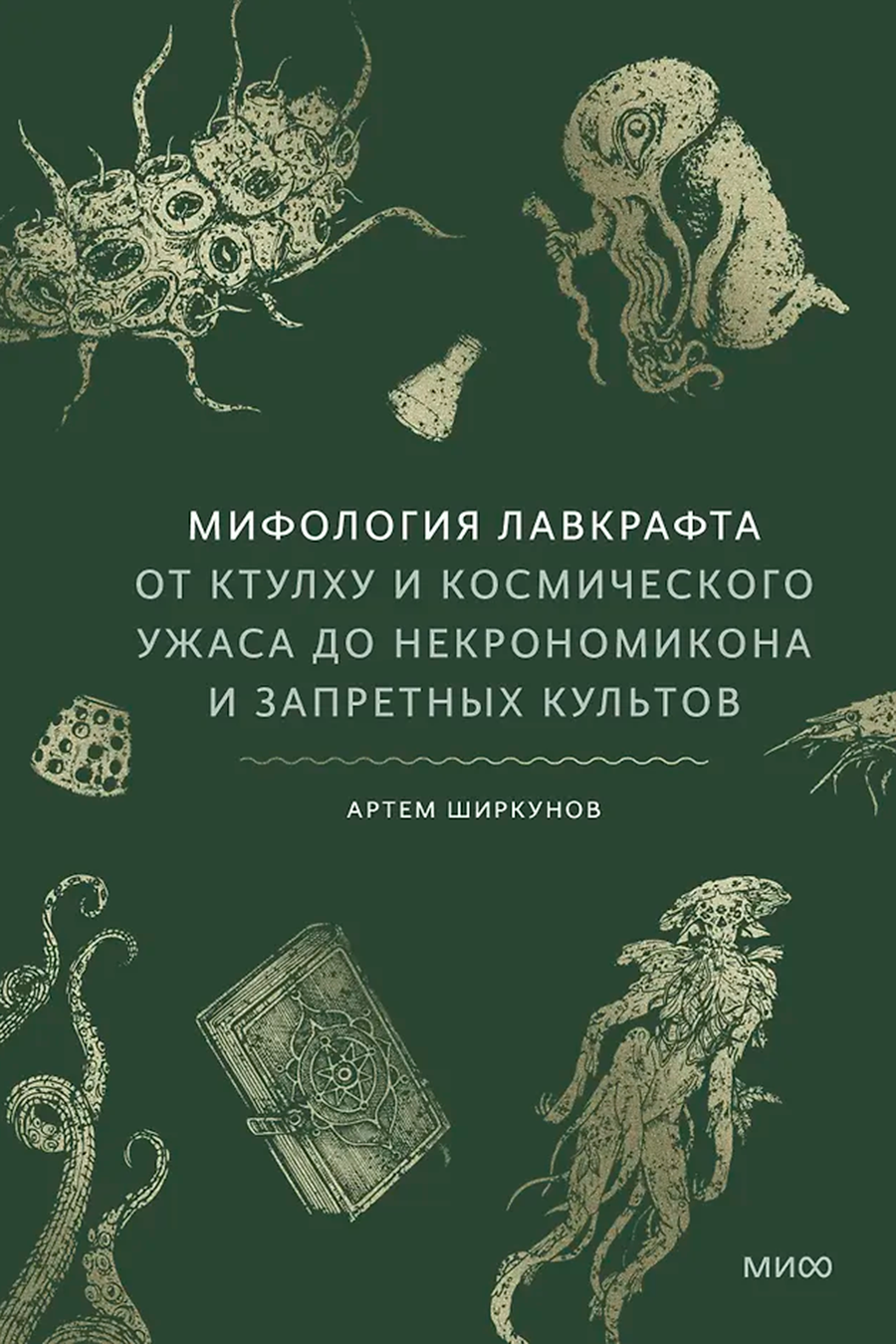
Shirkunov picks up the theme of the balance between science fiction and dark poetry, complaining that our translators, with all due respect to their titanic work, do not always manage to maintain this balance, and therefore Lovecraft often turns out to be difficult to perceive in Russian: "... sometimes we have something truly indescribable from huge verbal constructions, more reminiscent of a scientific study, rather than a cheerful action thriller or horror." Nevertheless, in the guide to Lovecraft's mythology, the researcher manages to systematize the bizarre world created by the writer's imagination and sort out its main components. Shirkunov starts from such an important location as Lovecraft's hometown, Providence in New England. The fourth chapter, "Fear and Loathing in Providence," inspiringly describes the gloomy "Lovecraft's cradle," located like Rome on seven hills and "preserving the colorful atmosphere of old-world New England with intricate streets and majestic architecture of the XVIII century. It was here that the best years of the writer passed, here he drew inspiration, the city became the epicenter of many of his works."

But in Providence, the future creator of the great and terrible Cthulhu also suffered the most serious childhood injuries, losing his father early, who ended his days in a psychiatric clinic (as did Howard's mother later). Shirkunov dwells in detail on the influence of his grandfather, Whipple Van Buren Phillips, from whom Lovecraft inherited the main range of his literary interests: "His grandfather's library became for Lovecraft an abode of knowledge and fantasy, where he first encountered the motives of antiquity, the unknown and mysticism, later embodied in his mythology. <...> The absence of his father, strict and nervous his mother, the influence of his grandfather with his passion for antiquity and mysticism — all these factors shaped the inner world of the writer, where reality was intertwined with ancient fears and fictions."

Mentioning "The Call of Cthulhu", "The Case of Charles Dexter Ward", "The Dunwich Horror", "The Somnambulistic Search for Unknown Kadath" and others as the key and most influential Lovecraftian texts, Shirkunov defines their philosophy as "cosmic horror", where the most powerful source of fear is not monsters and ghosts, but the consciousness of the insignificance of a tiny a little man in the face of the boundless unfathomable cosmos: "Lovecraft saw the universe as an indifferent, cold chaos, where man is just a speck of dust lost among countless stars." This worldview was formed under the influence of scientific discoveries at the beginning of the twentieth century, which destroyed traditional religious and anthropocentric ideas: "Lovecraft believed that beyond human experience lurked forces indifferent to our sufferings and aspirations."
Lovecraft's rejection of anthropocentrism as the cornerstone of his philosophy runs through the entire book and is somehow highlighted in the story of almost any of Lovecraft's writings and characters who have become archetypal for popular culture, including the most significant gods who embody "not only ancient forces, but also the fundamental principles of the cosmos, violating the usual laws." reality and causing mortals to feel a sense of hopeless horror": The Great Cthulhu, Nyarlathotep, Yog-Sothoth, Shub-Niggurat and the Mad Azathoth. They are completely indifferent to people, Shirkunov emphasizes Lovecraft's anti-anthropocentric attitude, and "perceive humanity only as a fleeting phenomenon, unable to comprehend their true essence, despite the existence of numerous cults and sects worshipping them around the world." The only one of the ancient gods who can sometimes condescend to communicate with people is the trickster Nyarlathotep, who, as a tool of higher powers, enters into deceptive and destructive games with the minds and destinies of mortals, passing on some knowledge to them: "Many great minds, according to rumors, gained their insights and inspiration under the influence of an unknown force, which can be associated with Nyarlathotep."

However, the possession of forbidden knowledge does not bode well for a person who stubbornly strives for forbidden knowledge — this is one of Lovecraft's favorite ideas, which concentrated the bulk of this knowledge in the famous Necronomicon, a folio so impressive that some almost still consider it a real grimoire. It is discussed in the third chapter of the Lovecraft Mythology— "Forbidden Books and Sources of Knowledge." Shirkunov then proceeds to analyze Lovecraft's geography as an important tool for inciting horror.

In addition to using the already mentioned Providence, the only real location in Lovecraft's work, the writer invented many even more mysterious towns in his image and likeness, which he essentially acts as living beings influencing the psyche of the characters.: "Lovecraft's geography is based on a deep respect for the existing landscapes of New England, his native land. Dark forests, swampy lowlands, ancient houses with tiled roofs, quiet port towns — all this is more than just scenery. The cities of Arkham, Dunwich, Innsmouth, and Kingsport are fictional, but closely related to the real geography of Massachusetts and Rhode Island." According to Shirkunov, this geography is also closely connected with Lovecraft's favorite theme of human insignificance and helplessness: "The places of action in his stories are not just landscapes, but "emotional landscapes" reflecting the inner world of the characters.: fear, uncertainty, a sense of losing control and facing madness."

But paradoxically, for all the insignificance of man, he is sometimes the most terrifying creature, surpassing any monster in his disgust. This is indicated by the epigraph of the chapter "Creatures beyond understanding", taken from the story "Horror in the Museum": "A human being in his depravity is always scarier than any non-human." This chapter describes the most bizarre creations of Lovecraft's fantasy, for example, the amorphous multicellular shoggots from the novel "The Ridges of Madness", which look like huge clusters of viscous gelatinous mass dotted with a multitude of moving eyes, mouths and pseudopods.
All Lovecraft's monsters, according to the author of the book, actually embody some specific human fear or several fears at once. That is why Lovecraft's mythology enjoys unfading popularity in popular culture: "It allows us to look into the abyss without risking death, and to feel solidarity in our small and vulnerable human existence in the face of eternal space. Lovecraft's myths teach us not so much to be afraid of the dark as to understand that sometimes we find ourselves in the abyss."
Переведено сервисом «Яндекс Переводчик»
