
Typhon flew: Japan and the United States began military exercises using missiles

On Thursday, September 11, the two-week joint military exercises of the United States and Japan called Resolute Dragon ("Resolute Dragon") started off the islands of Okinawa, Kyushu and Hokkaido. For the first time, the Americans delivered the Typhon medium-range missile system and the NMESIS sea-based missile system, which is designed to attack ships. Previously, the deployment of such complexes was prohibited under the treaty with Russia (INF), but six years ago Washington withdrew from the agreement. Since then, the American authorities have begun to install similar systems in different countries of Europe and the Asia-Pacific region (APR). In this case, they can reach the territory of Russia and China. Details can be found in the Izvestia article.
US and Japanese military exercises Resolute Dragon: where are they held, which missiles
The Japanese Self-Defense Forces and the US Armed Forces have launched joint Resolute Dragon military maneuvers, which will last until September 25. During the two weeks of the exercises, in particular, the deployment of Typhon medium-range missile systems will be practiced, the Japanese Defense Ministry said.

The exercises are taking place at the US Marine Corps Iwakuni base in Yamaguchi Prefecture. They are planned to involve 12,000 military personnel from the Japanese ground forces and about 1,9 thousand American troops. The parties are going to conduct live firing using rocket systems. In particular, it is planned to use the latest NMESIS mobile coastal missile systems with a range of 185 km at the Ishigaki Island test site in the immediate vicinity of Taiwan.
According to Japanese media, the weapons will be temporarily deployed, but it is possible that the missiles may linger on Japanese territory. The newspapers emphasize that Tokyo and Washington are strengthening their means to contain China.

The deployment of ground-based intermediate-range and shorter-range missiles (INF) was prohibited under an agreement signed between Russia and the United States in 1987. In 2019, Washington withdrew from the agreement. Moscow has stated its readiness not to produce or deploy missiles until Washington deploys these systems in any region of the world.
However, it later became known that from 2026, the United States plans to deploy intermediate-range and shorter-range ground-based missiles in Germany. In addition, a Typhon-like installation has already been brought to Denmark twice for exercises.

The current deployment of systems in Asia is the second since the US withdrawal from the INF Treaty. Last year, they appeared in the Philippines: in April last year, the Salaknib 24 joint military exercises were also held there, and after the maneuvers, the installations remained on the islands.
Moscow warned
The stated purpose of the event is to prepare for a possible attack on Japan due to rising tensions in East Asia. However, the deployment of these weapons could threaten not only China, but also Russia.
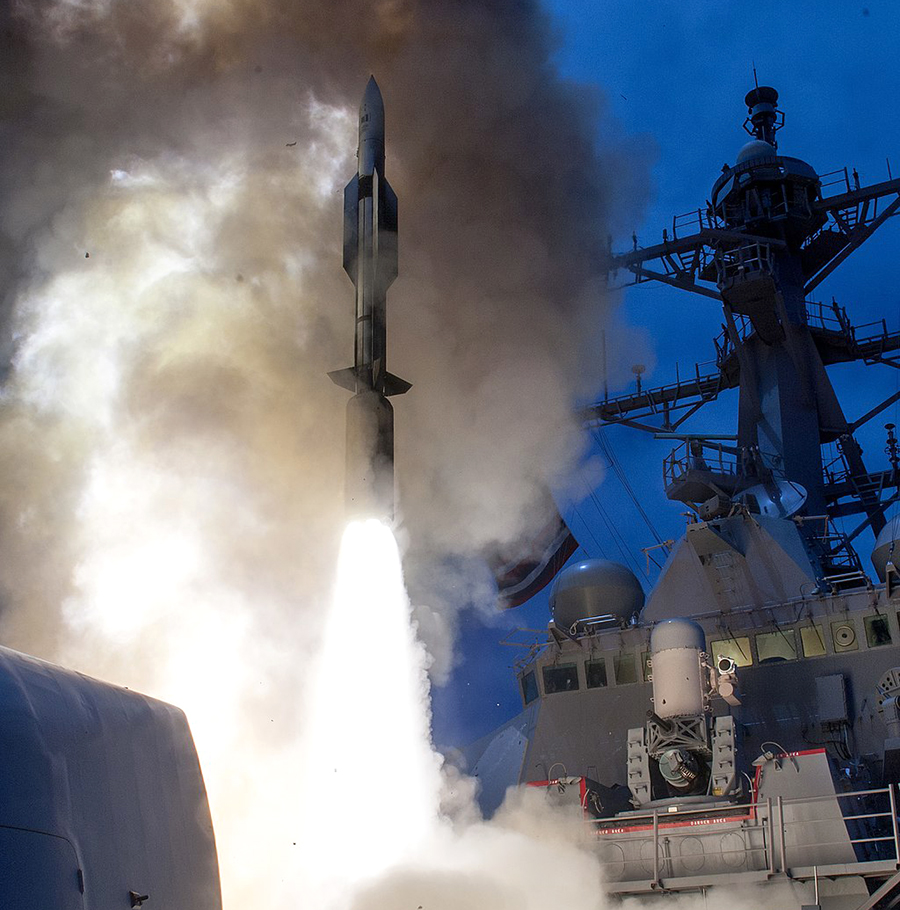
Typhon can be used to launch multifunctional SM-6 missiles and Tomahawk cruise missiles, whose range reaches 2,000 km. According to Japanese media, this complex is designed to deter Beijing.
On August 4, the Russian authorities announced that Moscow no longer feels bound by self-restrictions on the deployment of intermediate-range and shorter-range missiles, since the conditions for maintaining this moratorium have disappeared.
As the Russian Foreign Ministry recalled, Russia called on NATO countries to declare a reciprocal moratorium on the deployment of weapons systems previously banned under the INF Treaty, and on US allies in Asia to support efforts to prevent such an arms race in it. However, the initiatives of the Russian Federation did not meet with understanding and reciprocity, the ministry explained.
The official representative of the Russian Foreign Ministry, Maria Zakharova, appealed to the Japanese authorities, urging them not to deploy Typhon ground-based batteries. The diplomat noted that they pose a threat to the Russian borders in the Far East.
"Otherwise, we will proceed from the fact that all responsibility for the further degradation of the situation in the region lies with the Japanese side," Zakharova stressed.

The diplomat added that Moscow characterizes Tokyo's actions as "deliberately hostile and ignoring national interests."
The Chinese authorities also criticized the use of Typhon in Japanese-American exercises.
"China has always been resolutely opposed to the American Typhon medium-range missile systems in Asian countries. The deployment of such systems in Japan harms the legitimate interests of other countries and poses a significant threat to regional strategic security," warned Chinese Foreign Ministry spokesman Guo Jiakun.

Tomahawk cruise missile launch from MRC Typhon complex
He called on Tokyo and Washington to take into account the interests of other countries and "take practical actions to play a positive role in ensuring regional peace and stability."
What do the experts think
The United States uses Japan as a "stable aircraft carrier" in the Asia-Pacific region in attempts to put pressure on Russia, China and North Korea, Denis Denisov, an expert at the Financial University under the Government of the Russian Federation, told Izvestia.
— In this way, Washington intends to ensure its global dominance and advantage in the military-strategic situation. Obviously, the United States has set itself the task of creating military-political blocs in East Asia and will increase its presence in the Asia—Pacific region, the expert believes.
In his opinion, it is highly likely that Tokyo will not refuse the offer of a Western partner.
—There are American military bases in Japan and there is no formal army," the specialist explained.

The MRC Typhon missile system during unloading from a transport aircraft
Vasily Kashin, director of the Center for Comprehensive European and International Studies at the Higher School of Economics, noted in an interview with Izvestia that the United States had not made any statements that Typhon systems would be deployed in Japan on a permanent basis.
— But, indeed, it became known that such an installation is temporarily deployed at the American Marine Corps base Iwakuni in Yamaguchi Prefecture. The base is located quite far from the southern Kuriles, somewhere at a distance of 1200-1300 km, but Vladivostok is 850-900 km away, so theoretically this could pose some threat to Russia," the political scientist explained.
He added that Japan has a contract with the United States for the purchase of 400 Tomahawk missiles.
— Typhon is a ground—based missile system that fires two types of missiles. One of them is the Tomahawk naval cruise missile, the range of which, depending on the modification, can range from 1,600 to 2,500 km, and so far it exists only in a non—nuclear version," the specialist said.

The second, the SM-6, is actually an anti—aircraft missile used to shoot at ground targets. Its range is within 1 thousand km, the expert specified.
—That is, theoretically, it can be used to launch attacks on Russian territory: from this Japanese area, for example, in the Primorsky Territory," Kashin believes.

The Sinologist stressed that in practice, Japan has already started mass production of Type-12 cruise missiles with a range of over 1-1.5 thousand kilometers. km depends on the modification.
— The Japanese are starting mass production of hypersonic gliding warhead missiles. And then, in the future, they want to launch cruise hypersonic missiles with a ramjet engine. That is, they have a lot of potential," Kashin believes.
The expert is confident that the Americans are setting a precedent with the deployment of a small number of cruise missiles on Japanese territory in order to accustom the Japanese public to this and create the prerequisites for the permanent presence of installations.
— Initially, they will be in a non-nuclear version, but it cannot be ruled out that nuclear ones will appear in the future. This is a sensitive issue in Japan, and the population is usually nervous about such initiatives, so gradualism is very important here. So by themselves, these missiles don't change much, taking into account Japan's own potential, but they set an important precedent," the expert believes. The political scientist is sure that Russia should take this into account.
Переведено сервисом «Яндекс Переводчик»
