
Storm in the corridor: Americans break into the struggle for the South Caucasus
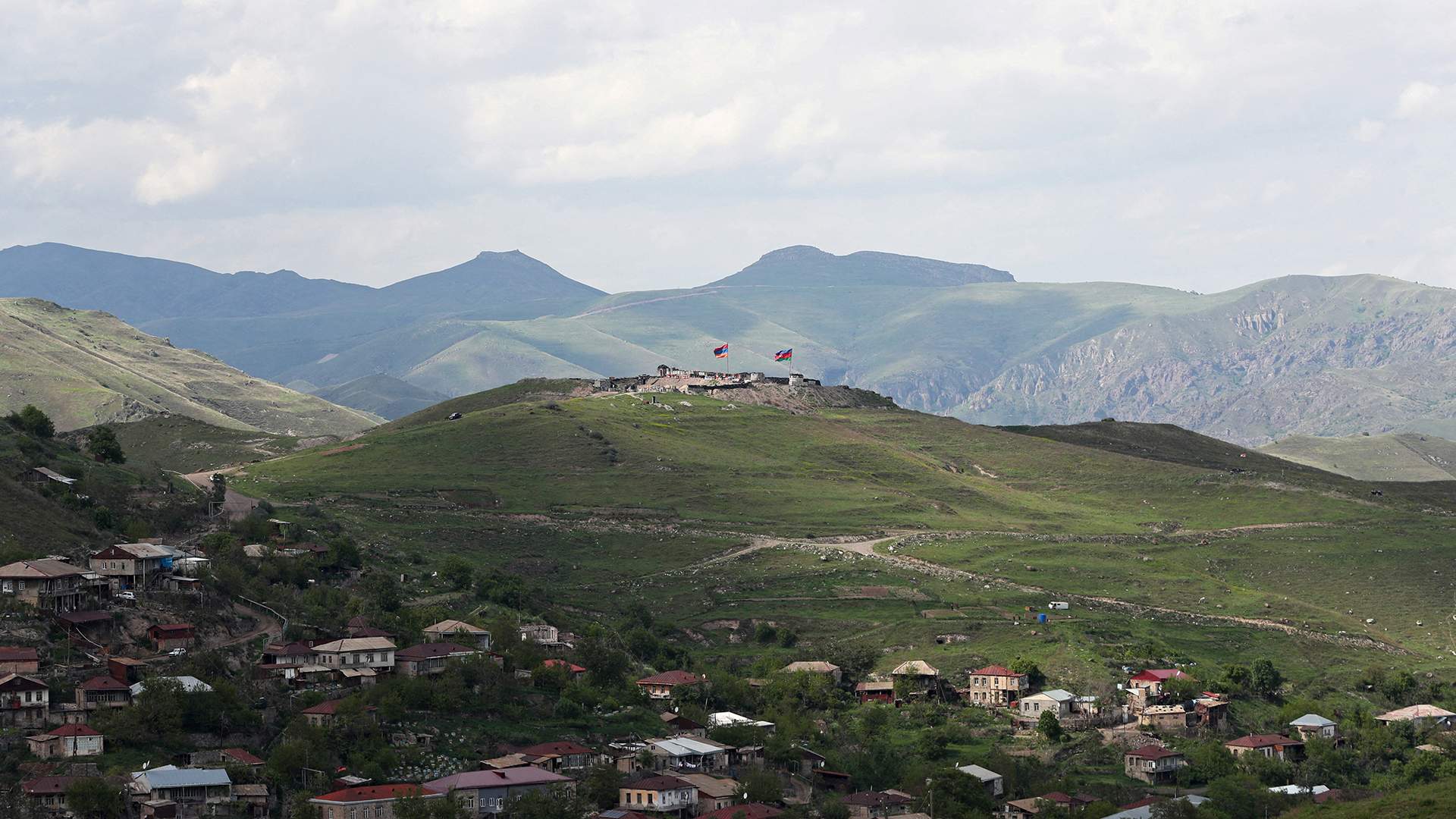
The United States is ready to lease the Zangezur corridor between Armenia and Azerbaijan. Initially, information about this was published in a semi-official mode, but now Prime Minister Nikol Pashinyan has confirmed the fact of the negotiations. Experts say that the appearance of Americans in the region can change the entire existing security architecture. Izvestia studied the situation.
We'll take it for ourselves.
The Zangezur corridor is a road that Azerbaijan wants to lay through the territory of Armenia in order to have a direct land connection with the Nakhichevan exclave and Turkey. Baku insists that the highway should be extraterritorial in nature, meaning that those passing through should not pay customs duties or undergo border checks. Yerevan traditionally refuses, responding that such a format would be an encroachment on the country's sovereignty.

This summer, it turned out that the American side wanted to join the project. In early July, media reports surfaced that Washington had offered its mediation services to both countries. The main idea is that an American company will manage the corridor, which will help ease tensions between Baku and Yerevan. "The Trump administration is determined to move forward," one of the publications emphasized.
Soon, Armenian Deputy Foreign Minister Mnatsakan Safaryan confirmed that negotiations were indeed underway. According to him, Yerevan does not object to the transfer of the road to the management of an international organization. "This process must be carried out within the framework of Armenia's sovereignty, jurisdiction and territorial integrity. If it complies with these principles, then it can be implemented," he noted.
The US Ambassador to Turkey, Tom Barrack, spoke in more detail. According to him, the American side is ready to lease the corridor for a period of 100 years. "They [Armenia and Azerbaijan] are arguing over 32 km of road, this has been going on for ten years. And then America comes and says, "Okay, we'll take this for ourselves. Give us 32 km to rent, and you will be able to divide them among yourselves," he said.

Finally, on July 16, the negotiations were confirmed by Armenian Prime Minister Nikol Pashinyan, who said that the US proposal was being actively discussed. "We are interested in it, but so far we have no agreement on this issue. Can such consistency be achieved? Yes, it can," he stressed and added that similar initiatives from other countries are being discussed, although the American option is still considered the main one.
Pashinyan also said that he sees no risks in transferring key communications to a third party. "For example, the management of Zvartnots Airport is extraterritorial. I do not believe that the sovereignty, jurisdiction or territorial integrity of the Republic of Armenia is violated in this case. Our water supply system is also being managed extraterritorially," he said.
Fighting the blockade
The main part of Azerbaijan and its Nakhichevan exclave is divided by the Syunik region of Armenia, which is called Zangezur in Baku. In Soviet times, a highway and the southern branch of the Transcaucasian Railway passed through these territories along the Araks River bordering Iran. After the collapse of the unified state and the outbreak of the Karabakh war, transport links were interrupted, and the railway track was dismantled.
For many years, it was necessary to get from Baku to the exclave by air or through the territory of Iran. At the same time, the issue of unblocking communications was constantly raised during the negotiations. The parties came closest to resolving the issue in 2001. Former Armenian President Robert Kocharyan recalled that Heydar Aliyev was ready to give up his claims to Karabakh for the sake of the road through Syunik, but the resistance of the Azerbaijani parliament prevented it.

The situation changed in 2020, when Azerbaijan regained control of the border areas during the second Karabakh war and reached the border with the Syunik region. As a result of that conflict, a trilateral ceasefire statement was signed. It indicated that all transport communications in the region would be unblocked. It was separately stipulated that Armenia would not interfere with Azerbaijan's communication with Nakhichevan.
Since then, the topic of the Zangezur corridor has been regularly heard in the public sphere. It is known that construction works are actively underway in Azerbaijan, Nakhichevan and the border territories of Turkey in order to create a direct land connection in the future. The head of the Turkish Ministry of Transport, Abdulkadir Uraloglu, stressed that all major preparatory work will be completed by 2028.

At the same time, Baku and Ankara hint that a new war is quite possible in case of Armenian resistance. "We want them not to interfere with us, not to act as an obstacle. We must have a direct connection. They shouldn't make us nervous, we have the right to vote. In the modern world, the power factor is in the foreground, and no one should forget about it," Ilham Aliyev said in an interview.
It should be noted that the creation of the Zangezur corridor will have not only economic, but also important political and geopolitical significance. Firstly, the tandem of Turkey and Azerbaijan, in the case of the construction of an extraterritorial road, will completely dominate the South Caucasus. Secondly, Ankara will receive direct communication not only with Baku, but also with the countries of Central Asia, which will further strengthen the ideas of the "Turkic world".

Interestingly, Baku and Ankara have not yet reacted in any way to the possible participation of Americans in the project. Apparently, both capitals are not very happy with this option, because they consider the absence of any control on the road to be ideal. At the same time, the involvement of a third party still seems acceptable to them, as it allows them to blur this control. In the future, under some pretext, for example, in the case of an incident on the road, the issue of putting their own forces on the highway may be raised.
At the same time, Armenia has consistently rejected the Zangezur Corridor project, emphasizing that the creation of an extraterritorial road violates the principles of sovereignty. Instead, they suggest that neighbors unblock all transport communications in the region on a parity basis. For a number of years, Prime Minister Nikol Pashinyan has been promoting his "Crossroads of the World" project, which assumes that the countries through which they pass will control the roads.

Interestingly, Armenia's position is changing in the face of fierce pressure. At the end of last year, at a meeting with the leaders of the CIS countries, Pashinyan stressed that Yerevan was ready to provide Azerbaijan with transport links on its territory on the same terms as Iran, but now we are talking about some kind of "outsourcing" format.
What the experts say
Sergey Melkonyan, a researcher at the Armenian Institute for Applied Policy Research (APRI), notes that the interests of Turkey and the United States coincide on the issue of the Zangezur corridor.

— Ankara wants to increase its influence in Transcaucasia and Central Asia, while Washington seeks to weaken the positions of Russia and Iran in these regions. At the same time, we do not yet know the details of the American initiative. It is difficult to imagine that any commercial company would take over the functions of customs and border control and monitor security. There are more questions than answers. But I note that Armenia is in a difficult situation, the threat of border escalation and a semi—blockade situation remain, and the task of preserving peace looks extremely difficult," he emphasizes.
Artur Ataev, a Russian Caucasus expert, says that much has changed in the region after the "12-day war" between Iran and Israel.
— Iran was the main opponent of the creation of the Zangezur corridor, and it is extremely unprofitable for Tehran to strengthen the tandem of Azerbaijan and Turkey on its northern border. During the war with Israel, however, the Islamic Republic suffered serious losses and was noticeably weakened. Apparently, this was one of the reasons for the resumption of discussions about the construction of the highway. If we talk about Armenia, we have seen more than once how the position of the country's leadership is changing. After coming to power, Nikol Pashinyan was an ardent supporter of Armenian Karabakh, and now recognizes the region as part of Azerbaijan. It is likely that the position may change on other topics," the expert explains.
Переведено сервисом «Яндекс Переводчик»
