What a Lion: Bakst's Anniversary Retrospective focuses on the personal


The family ties of Lev Bakst and Pavel Tretyakov, the artist's travels with Valentin Serov in Greece, and efforts at self—promotion are some of the unobvious subjects that are revealed in Bakst's new major retrospective, launched at the State Tretyakov Gallery. However, even if we leave aside the curatorial narratives, the exhibition impresses with the set of works themselves: they managed to collect all the hits here — from early oil paintings to sketches for Diaghilev's entreprise, complement them with posters and original costumes of the "Russian Seasons" and accompany them with a variety of archival documents, including previously not exhibited. Izvestia rated the project among the first.
Jubilee Parade
Ten years ago, an exhibition dedicated to the 150th anniversary of Lev Bakst's birth was held at the Pushkin State Museum of Fine Arts. At that time, it seemed that it was simply impossible to tell about this genius of Russian Art Nouveau more fully, on a large scale and colorfully. The Russian Museum also presented its view of the artist, practically repeating the scope, but preferring a more academic presentation. But 10 years have passed, and now the Tretyakov Gallery could not pass by another anniversary. GTG, however, had its own reason. Pavel Tretyakov's brainchild turned 170 this year, and by linking the two dates, the museum decided to emphasize the family connection of the great ones: Lev Samoilovich was married to Pavel Mikhailovich's daughter. Well, the painter's son (therefore Tretyakov's grandson) donated most of his archive to the State Tretyakov Gallery.

However, the conceptual foundations could hardly make the curatorial task easier. It is doubly difficult to talk about Bakst today. Firstly, surpassing the relatively recent exhibitions of Pushkin and the State Museum of Fine Arts is a task with an asterisk. Secondly, the artist's legacy is scattered all over the world, in particular, many works are located in France and the USA. American items, of course, were not available in 2016 either, but French (and European in general) items could have been obtained then, and museums could not do without them. Now we have to rely only on domestic meetings.

And most importantly, although Bakst's research continues, no one claims to radically rethink his legacy and the figure itself. And there have been practically no previously unknown works in the last decade. Therefore, it is especially difficult to surprise a sophisticated viewer with a retrospective, but it is easy to disappoint.: on the one hand, we are waiting for something new, and on the other, we want to see all the main things again, without them there is nowhere in such a project.

Admittedly, GTG has coped with the latest challenge with flying colors. The museum managed to obtain a monumental antique-themed painting "Ancient Horror" and an exquisite "Dinner" (both provided by the Russian Museum), the Tretyakov Gallery took such gems as portraits of Lyubov Gritsenko-Bakst and Zinaida Gippius from its own funds, and finally, the theater museums of Moscow and St. Petersburg shared the most famous costume sketches. These drawings seem to wander from exhibition to exhibition — I can't count how many times they have already been shown. But it's still a pleasure to see everything together as part of a monographic project.
Olive groves and oil
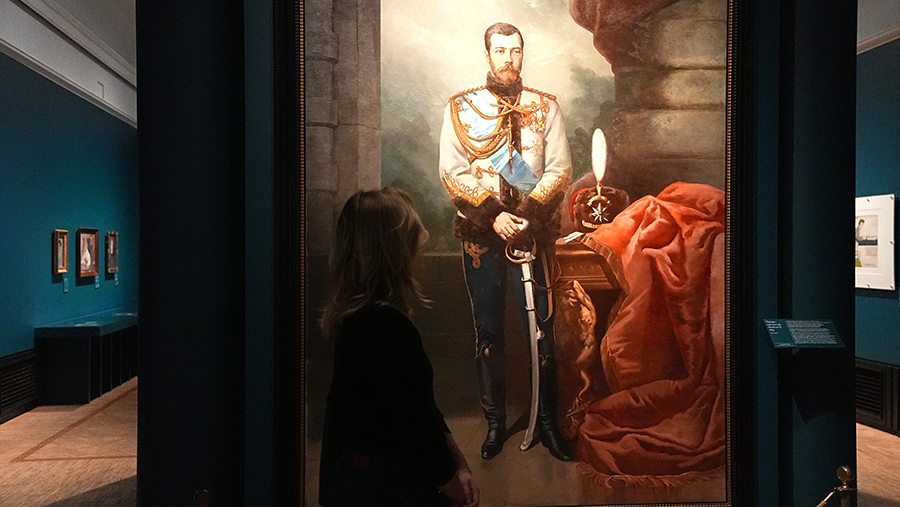
More interesting, however, is the block of early works, especially Bakst's oil paintings, which are so rare. In addition to the hits mentioned above, there are surprises among the canvases presented. For example, the impressive portrait of Nicholas II is the epitome of loyal academicism, in which the hand of Diaghilev's future colleague is still practically invisible. This painting in the Historical Museum was restored only in 2018, so it was not at the exhibition at the State Museum of Fine Arts. And, of course, in close proximity to such purely Bakst things as elegant graphic portraits of figures of the Silver Age (Bely, Bryusov, Benoit and others), it looks strange. But that was probably the intention: to show the artist's formation in all its contradictions and paradoxes.

Another atypical, obviously custom-made piece, which came from the Central Naval Museum of St. Petersburg, is "Carnival on the streets of Paris in honor of the arrival of Russian sailors on October 5, 1893" (1900). Although this image of a colorful, dynamic crowd, as if dancing in the "scenery" of the French capital, is already close to the magnificent "Sacred Siamese Dance" that appeared a year later, anticipating the theatrical extravaganza of Diaghilev's time (this canvas is also represented in the exhibition, although it hangs too high, and it is more difficult to examine it than in the State Museum of Fine Arts). By the way, in the context of current European events, Carnival looks not at all like a holiday, but like a pogrom or a riot — an excellent illustration of what is happening in the city on the Seine today.
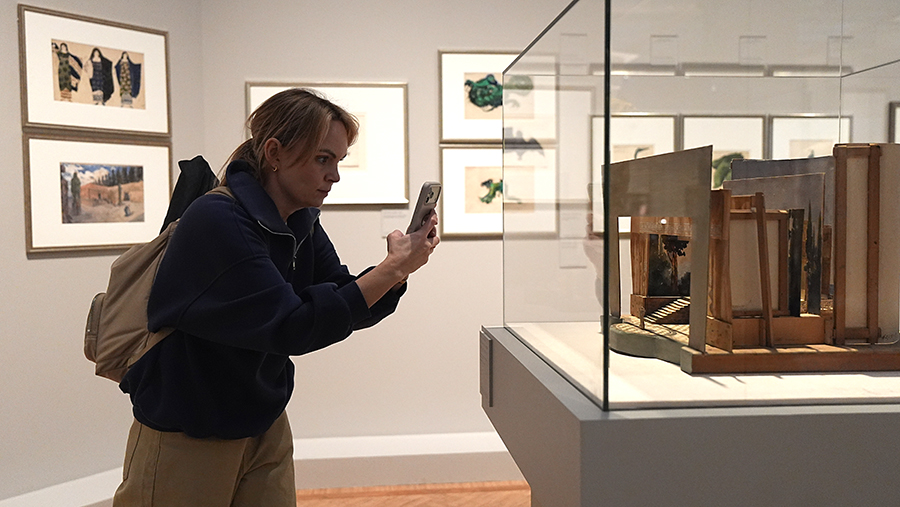
But, for example, the small, "magical" in mood and exquisite in painting canvas "Coppelius and Coppelia" (from the I.I. Brodsky Apartment Museum) is already pure Contrast. The hero here brings the doll to life: the motif from Hoffman's The Sandman is connected with several performances that Lev Samoilovich worked on over the years. Or the almost pointillist "Olive Grove in the Mountains" technique, which came from the Pskov Museum-Reserve. The artist paints a Mediterranean look with spots and dots, achieving an amazing combination of landscape verisimilitude and post-Impressionist decorative conventions.

Instead of rich southern colors, he uses shades of faded silver-green, as in another work on a similar topic: "Olive Grove. Mentone" (it was given to the State Tretyakov Gallery by the Novgorod Museum-Reserve). I would like to recall Borisov-Musatov with his melancholic manor scenes in cold bluish tones: the exhibition of the great symbolist recently ended in the same Tretyakov Gallery, literally passing the baton to Bakst's retrospective.
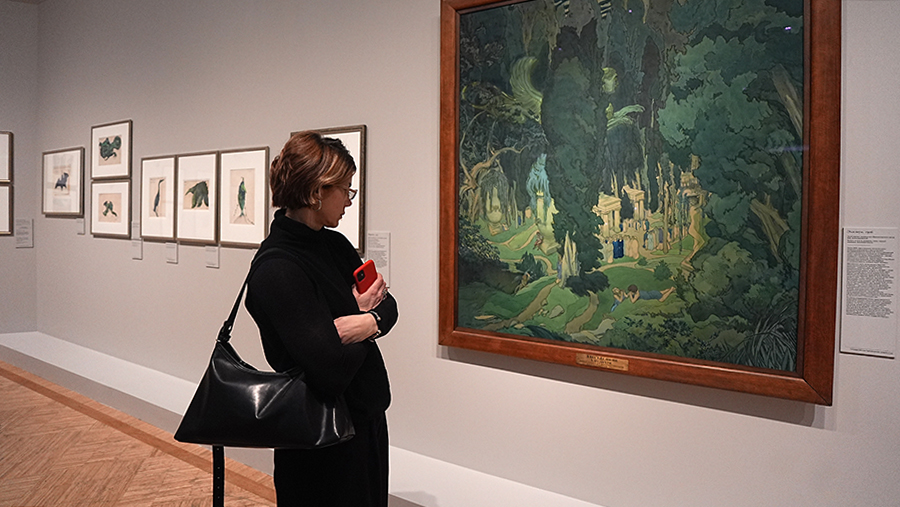
In general, Bakst's travels at the GTG received a lot of attention, especially focusing on his joint voyage to Greece with Valentin Serov. Moreover, an entire wall here is devoted to Serov's works on antique themes, including two versions of the "Abduction of Europe". Ancient amphorae, jewelry and other treasures of Hellas continue this story (they were provided by the Pushkin Museum). One can argue to what extent such an "intervention" of a completely different era is organic in the story of Bakst, but looking at the characteristic two-dimensional images of people on vases, one involuntarily sees in them the harbingers of Bakst theatrical graphics.
Between the momentary and the eternal
The story about the trips with Serov is supplemented by a lot of documents — letters, memoirs of Bakst himself, postcards… And this is one of the key motives of the exhibition. Storefronts with archival materials accompany each section. Unable to show something fundamentally new in terms of artistic works, the curators relied on items from the manuscript department. For the general public, this decision is not very advantageous — few people will want to bend over and decipher Bakst's complicated handwriting. But there are some spectacular things here too. These are, first of all, homemade albums with press clippings.
Bakst collected such folios all his life, carefully preserving all publications about himself and even asking friends from other countries to send notes found in the press. The artist sent his first album to his ex—wife, the same daughter of Tretyakov, with whom he was already divorced by the time of his European fame. Look who you've lost. But he did not stop collecting newspaper and magazine reviews. In total, the artist left 10 such volumes, and today they are priceless artifacts: both in terms of Bakst's perception of his work by his contemporaries, and in terms of his own sense of self.
At the exhibition, scrapbooks are displayed in showcases, but an interactive installation has been made in one of the halls: in front of the visitor is a folio with white sheets on which real scans are projected. They change when you scroll through them. Moreover, it looks like it's not immediately clear whether the picture is real or not. The most spectacular pages are given in large lightboxes, like movie theater posters. The artist would certainly have liked it: he knew a lot about spectacular solutions and loved when texts about him were given their due place in the press.

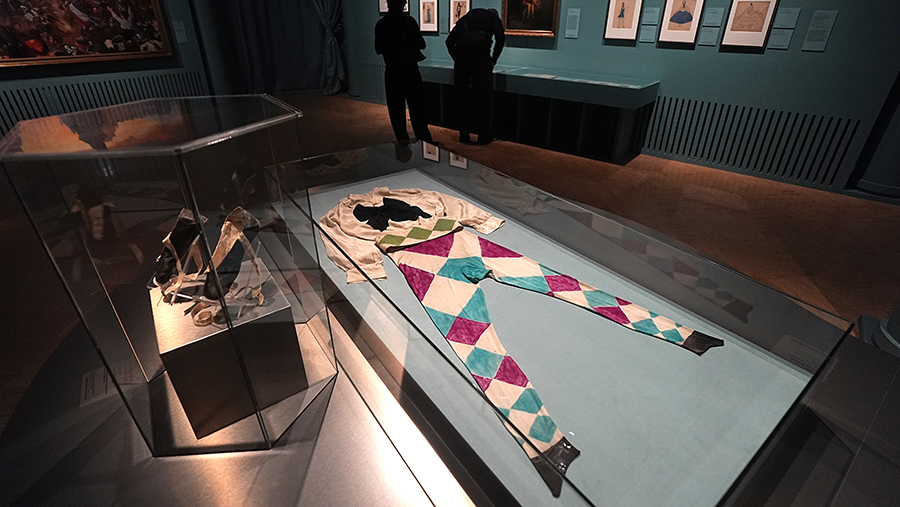
For all his narcissism and self-awareness, Bakst did not avoid genres that were considered applied and even low. Magazine illustrations, posters and even design for textile production — he was engaged in all this with no less passion than theatrical works and painting. The proof of this is in the last hall of the exhibition, where the sketches of fabrics and the advertisement created by him for the performance of the Karyatis dancer are shown (the artist painted the printed image manually).
Bakst didn't just create art. Being a great stylist, he formed a universal aesthetic applicable both to the stage and to everyday life. Something similar was done in Russia in the early 1920s, that is, simultaneously with Lev Samoilovich, but on a completely different ideological platform — the constructivist one. Bakst, however, remained faithful to Art Deco, that immediate beauty that pleases the eye in itself and does not require comment. And this journey into the serene world of grace and well-being is perhaps even more necessary for us today than it was 10 years ago.
Переведено сервисом «Яндекс Переводчик»
