- Статьи
- Science and technology
- Izba variety: low radiation will help to breed plants for colonization of other planets

Izba variety: low radiation will help to breed plants for colonization of other planets

Russian biophysicists have found out that small doses of radiation can affect the signaling systems of plants. In the future, this opens up opportunities for the development of technologies that can increase crop yields, strengthen their immunity and resistance to adverse factors. Studying the effects of ionizing radiation will make it possible to develop varieties suitable for growing in space. Such crops will be able to provide crews of long-term space expeditions with fresh food. However, cosmic radiation differs from terrestrial radiation, which requires further development of experiments, experts explained to Izvestia. In addition, it is important to determine the optimal radiation doses.
How plants "feel" radiation
Scientists from the A.V. Gaponov-Grekhov Institute of Applied Physics of the Russian Academy of Sciences and N.I. Lobachevsky Nizhny Novgorod State University have discovered that the "nervous system" of plants turned out to be more sensitive to radiation than previously thought. This is because when irradiated with small doses, changes primarily affect the internal signaling system — electrical impulses that are responsible for transmitting information between cells.
In the experiment, the experts irradiated wheat seeds with various doses of radiation and monitored how the plants that grew from them developed. To assess the changes, the specialists analyzed the growth rate of shoots and roots, photosynthesis parameters, pigment content, as well as electrical signals propagating through tissues in response to stress.

The results showed that the parameters of the electrical signals changed already at the minimum dose. Such plants were still developing normally, but their internal information transmission system was already working differently.
— To our surprise, we found an effect that had not previously been described in radiobiology. We expected that radiation would weaken the electrical processes in plant cells, but we got the opposite result: when irradiated, their activity even increased," Marina Grinberg, a researcher at the Department of Geophysical Electrodynamics at the IPF RAS, told Izvestia.

According to the researchers, one of the reasons for such changes is the reactive oxygen species that are formed during irradiation. According to the hypothesis, they trigger cascades of intracellular reactions that affect the signaling system. The patterns found in the experiment will make it possible to predict how the response will change depending on the stimuli.
The results obtained will help to better understand how plants behave in conditions of increased background radiation, for example, in polluted areas. Also, the identification of radiation-sensitive systems and specific molecules can contribute to the creation of varieties for the tasks of space biology, said Marina Grinberg.

Radiation "greenhouses" and space greenhouses
—Small doses of ionizing radiation can affect plants, causing the effect of hormesis, a phenomenon in which a weak effect of certain factors on the body has a stimulating effect, and a large one has an overwhelming effect," Ulyana Bliznyuk, head of the laboratory for Radiation treatment of biological objects and Materials at the D.V. Skobeltsyn Moscow State University Research Institute of Nuclear Physics, told Izvestia.

According to her, according to numerous studies, in many crops, at optimal doses of radiation, seed germination accelerates, weight and yield increase. In addition, processes are activated that increase the resistance of plants to adverse factors such as drought, salinity, and extreme temperatures. In this case, a further increase in doses, on the contrary, can lead to inhibition of growth and tissue damage.
— The first reaction to stress is recognition. Then there is a mobilization and activation of resources, then the body activates recovery mechanisms and strives for homeostasis, that is, to a new equilibrium. He often feels better than before. For example, needles grow more actively in coniferous plants. Then, if the dose increases, suppression of functions occurs and eventually death. Everyone knows this stage, so they are afraid of radiation," said Nadezhda Kudryasheva, a professor at the Department of Biophysics at Siberian Federal University.
In her opinion, the effects of high doses of radiation have been studied in the most detail, while reactions to low-dose exposure are of considerable interest for both basic science and applied research. She explained that it is the early stages of the stress response that underlie the mechanisms of adaptation and survival of living systems. As long as the body is able to trigger compensatory processes and withstand adverse effects, this effect can potentially be used in practice. In particular, there are already approaches to cancer treatment using low-dose radiation. It is possible that similar principles will be applied in agriculture in the future.

However, the effect of such stimulation depends on many factors, including the type of plant, its age, physiological condition and environmental conditions. Therefore, additional studies are needed to determine the optimal exposure modes and minimize possible risks, Nadezhda Kudryasheva emphasized.
— The study of the described mechanisms is of interest to space biology. Plants are an integral part of future bioregenerative life support systems for long—term missions and the creation of lunar or Martian bases," says Polina Borshchegovskaya, associate professor at the Faculty of Physics at Moscow State University.

According to her, during long-term space expeditions, plants will provide the crew with oxygen, water and fresh food, so increasing their resistance to adverse factors is key to the reliability of such life support systems. At the same time, the expert stressed that the radiation situation in space is significantly different from Earth's, so the results of such studies cannot be directly transferred to the conditions of interplanetary flights. At the same time, they allow us to determine the dose ranges that can have a stimulating effect and develop optimal approaches to growing plants outside the Earth's magnetosphere, which protects the planet from a significant portion of cosmic radiation.
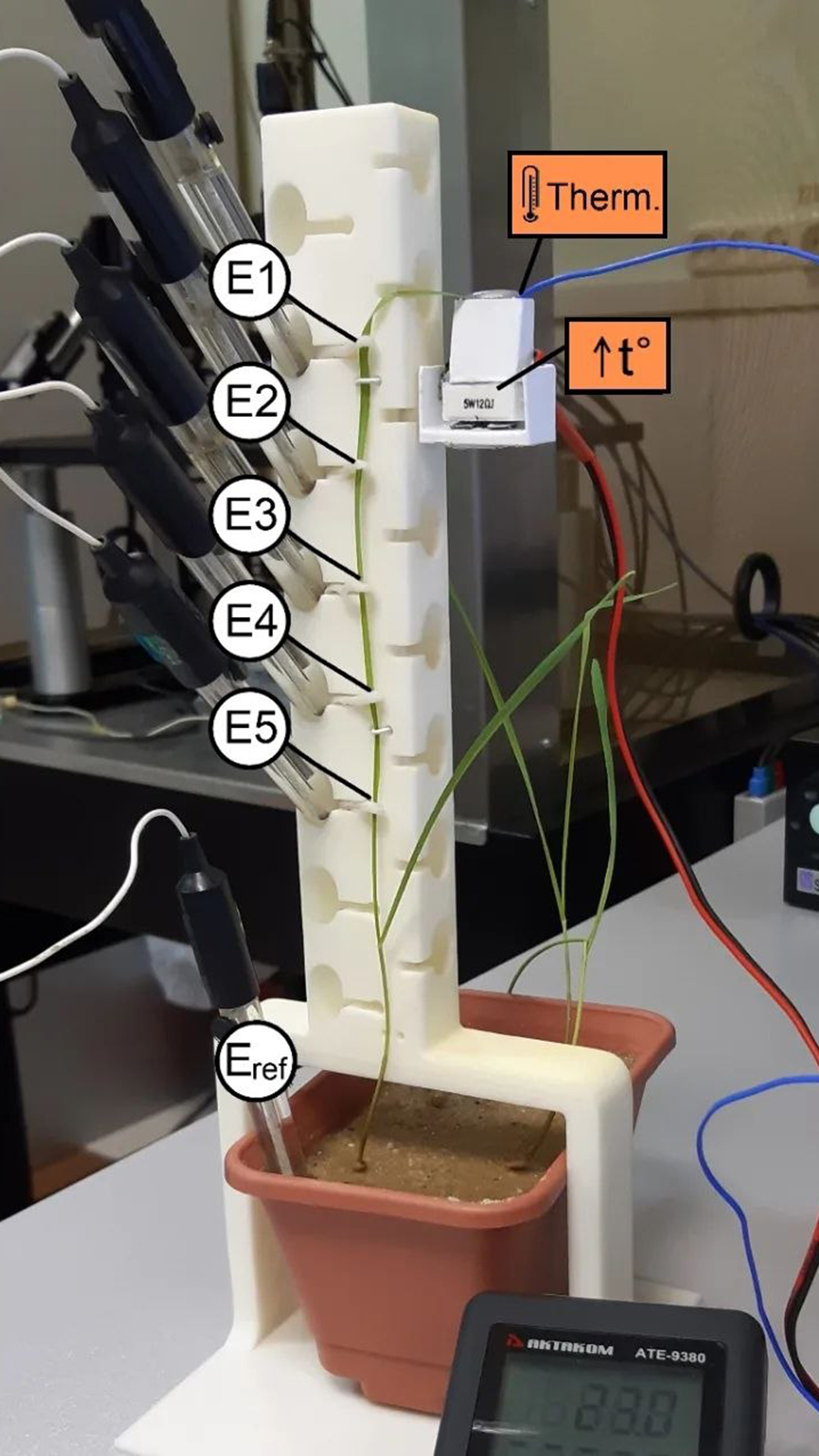
Bioelectric signals are one of the earliest sensitive indicators of the physiological state of plants. Their study allows us to observe the moment when the adaptive response is triggered. In addition, the analysis of electrical signals makes it possible to link physical effects with biochemical and molecular mechanisms of resistance or damage," commented Victoria Ipatova, a junior researcher at the Department of Nuclear Physics Methods in Medicine and Industry at the Moscow State Institute of Nuclear Physics.
This could lead to the creation of sensor platforms for early diagnosis of plant conditions, she added. Such systems will allow you to detect stress or infection before the appearance of visible symptoms, as well as evaluate the stability of varieties, select optimal growing conditions and predict their productivity. The combination of electrophysiological measurements with artificial intelligence tools is particularly promising.
Переведено сервисом «Яндекс Переводчик»
