- Статьи
- Science and technology
- A worm without a doubt: Spanish slugs will take over new cities and crawl to Kamchatka

A worm without a doubt: Spanish slugs will take over new cities and crawl to Kamchatka

The Spanish slug, which has already settled in the European part of Russia, will continue its expansion and will be able to reach the Far East. These are the conclusions of Russian scientists who found out that the main driver of its spread was not climate change, but human activity. Therefore, the mollusk has every chance of becoming the same companion of civilization as rats and cockroaches. According to experts, the species is no less dangerous than the hogweed plant, and it must be dealt with just as radically. However, there are no industrial means for this yet.
The slug's movement to the east
Experts from St. Petersburg State University (St. Petersburg State University) investigated the spread of the Spanish slug in regions where this species had not previously been recorded. Based on data on its migration in Asia, scientists have built a model that makes it possible to explain the mechanisms of large-scale expansion of the species. The results of the work are published in the scientific journal Scientific Reports.

While early models took into account mainly climatic factors, new calculations have shown that the key driver of the spread today is the transformation of territories under human influence.
— The previous model did not take into account many things. First, the species appears in cities or, say, in gardens and vegetable gardens, and only then does it try to enter the wild from there. We have added data from satellite images on the economic use of territories, on urbanization, and on the use of agriculture. And we have identified this trend. With a high degree of probability, over time, these slugs will be everywhere where humans live, just like rats or cockroaches," said Ivan Nekhaev, senior researcher at the Department of Applied Ecology at St. Petersburg State University.
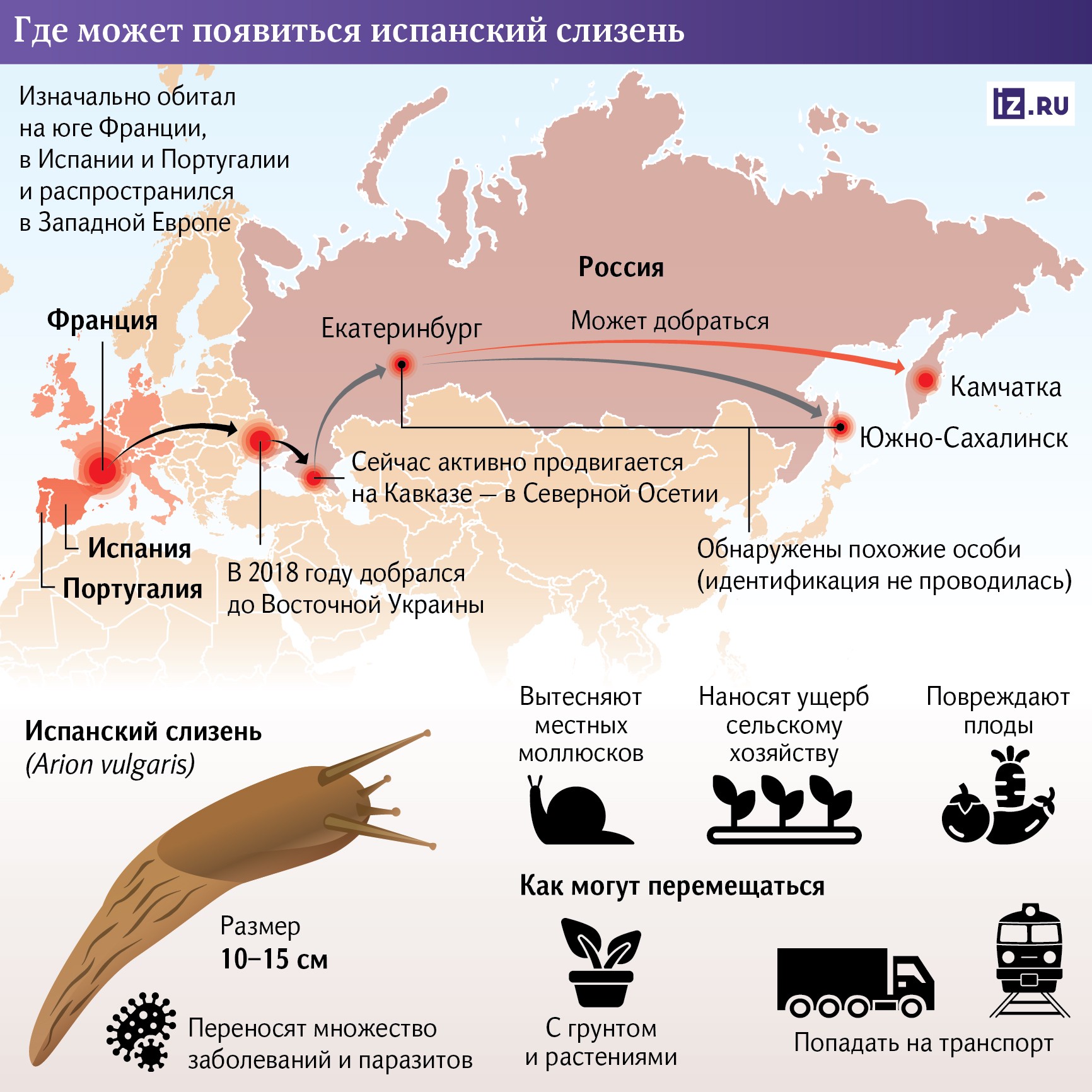
The Spanish slug (Arion vulgaris) is a large terrestrial mollusk, it is considered one of the most dangerous and invasive pests in the world. It originally lived in the south of France, Spain and Portugal, but in the twentieth century began to actively migrate to the north and east. It has a brown color and is about 10-15 cm in size. It feeds on any parts of plants, insects and other organic food.
According to the scientist, this is due to the fact that humans transform the environment, influence the climate, form favorable shelters for slugs, reduce biodiversity and thereby weaken the stability of local ecosystems. All this creates additional ecological niches for invasive species and facilitates their entry.

Initially, Spanish slugs lived in Western Europe, a region with a high level of anthropogenic impact. There they successfully mastered the new conditions and then spread eastward, all the way to the European part of Russia. Now the species is actively advancing in the Caucasus: it has been recorded in North Ossetia and Alania. Individuals similar to it were also found in the Urals, Yekaterinburg, Yuzhno-Sakhalinsk and other cities of Siberia, but their exact identification in these cases was not carried out.
— Most of Siberia is unsuitable for their habitat. But they can gain a foothold there in cities, towns and along roads. With the help of such a network, they can reach the Far East, Sakhalin, and Kamchatka. The model suggests that there is a very high degree of suitability of natural conditions for them," the scientist said.

A dangerous pest
Naturally, slugs spread extremely slowly, but their transfer is significantly accelerated by human activity: they can move along with soil and plants, get on vehicles, including cars and trains. In addition, their eggs are often present in the soil, which also contributes to the dispersal of the species.
By colonizing new territories, Spanish slugs are able to displace local mollusks that live only in certain regions. This species is considered one of the most dangerous invasive organisms in the world, as it causes significant damage to agriculture: slugs multiply massively in vegetable gardens, eat plants and often damage fruits. At the same time, large agricultural fields are less suitable for them due to the lack of shelter from sunlight.

Most often, they are dealt with in a mechanical way — by manual collection. Beer is sometimes used as bait; studies show that slugs show different reactions to different varieties of it.

The Spanish slug is a hermaphrodite, so one individual or a clutch of eggs is enough to consolidate the population in a new place. It spreads mainly together with the soil and planting material. Without human intervention, its natural migration would be extremely slow, therefore, according to experts, strict phytosanitary control is necessary when moving plants and soil to curb its spread, said Igor Shkradyuk, coordinator of the industrial greening program at the Wildlife Conservation Center.
— Back in the middle of the last century, it was only in Western Europe, but by 2018 it had reached Eastern Ukraine. There are no specific means of combating it, as well as natural enemies in nature. He's an omnivore himself. He carries a lot of diseases and parasites, so you can't touch him with your bare hands," said the ecologist.
The Spanish slug is a dangerous pest and a serious problem, noted Honored Ecologist of the Russian Federation Andrey Peshkov.
— I believe that the Spanish slug should be dealt with as seriously as the hogweed, because it is the same invasive species. The fact that they have been ignored for so long is an omission," he said.
According to the expert, these animals arrive in new areas with various modes of transport, so control over logistical flows is needed.
Переведено сервисом «Яндекс Переводчик»
