They weave wherever they can: wasp spiders have spread to 20 regions of Russia


Wasp spiders (Brunnich's argyops) may spread to about 10 more Russian regions in the coming months, experts have warned. Since the beginning of summer, these arthropods have already spread to non-traditional territories in Central Russia, and in total, as estimated by Izvestia, they have been spotted in 20 regions. Spiders will move further and further to the north of the country in the coming months, and in the future, most likely, they will gain a foothold in its center due to climate change. The bites of such spiders cause severe discomfort and can lead to anaphylactic shock, the doctors noted, urging allergy sufferers and children to be especially careful.
Where are the wasp spiders found?
Since the beginning of the summer of 2025, wasp spiders have already been spotted in 20 regions of Russia, Izvestia estimates. It is a venomous arthropod, the bites of which are quite harmless to a healthy adult, but can be extremely dangerous for children and people with chronic diseases — in this case, a fatal outcome is possible.
Previously, the habitat of wasp spiders was much narrower. They met only in the southern regions, Ruslan Butovsky, Professor, Head of the Department of International Cooperation at the VNII Ekologiya Federal State Budgetary Institution, recalled. These spiders usually live in the Caucasus and Crimea, said Andrey Bespyatykh, head of the Invertebrate Department at the Eversman Zoological Museum and Herbarium of Kazan Federal University (KFU) and a key employee of the invertebrate department.
But in recent years, such arthropods have become increasingly common in non-traditional territories, and this year the number of reports of their discovery from local residents and authorities has increased significantly.
So, in 2025, the largest part of such reports occurred in August. Spiders have been spotted, for example, in Nizhny Novgorod, Chelyabinsk, Tula, Moscow, Lipetsk, Vladimir, Kaluga regions, as well as in Moscow.
But with continued warmth, Brunnich's argyops may reach the Perm Region, Khanty-Mansiysk Autonomous Okrug, St. Petersburg, as well as the Bryansk, Smolensk, Kirov, Vologda, Pskov and Novgorod regions this year, arachnologists and entomologists interviewed by Izvestia believe.
Moreover, under favorable climatic conditions, wasp spiders can become permanent inhabitants of Central Russia, Ruslan Butovsky believes.
"The changes are related to global warming," he said. — If the spiders don't freeze out in winter, they will stay for a long time. But if there is a severe winter, then their entire population, which has reached Central Russia, may die.
At the same time, according to the expert, in subsequent warm periods, the wasp spiders may return again.
— Under favorable conditions, Brunnich's argiopes can spread further. This is normal for living organisms," Ruslan Butovsky added.
Due to rising temperatures, there is a shift in the boundaries of natural zones, confirmed Roman Pukalov, director of environmental programs at the all-Russian public organization Green Patrol and ecologist.
— Where the taiga zone is now, conditions may change in the coming decades, there will be a forest-steppe, — he noted. — A vivid example of this year is the fires in the Trans-Baikal Territory due to the hot and dry weather and the snowy winter.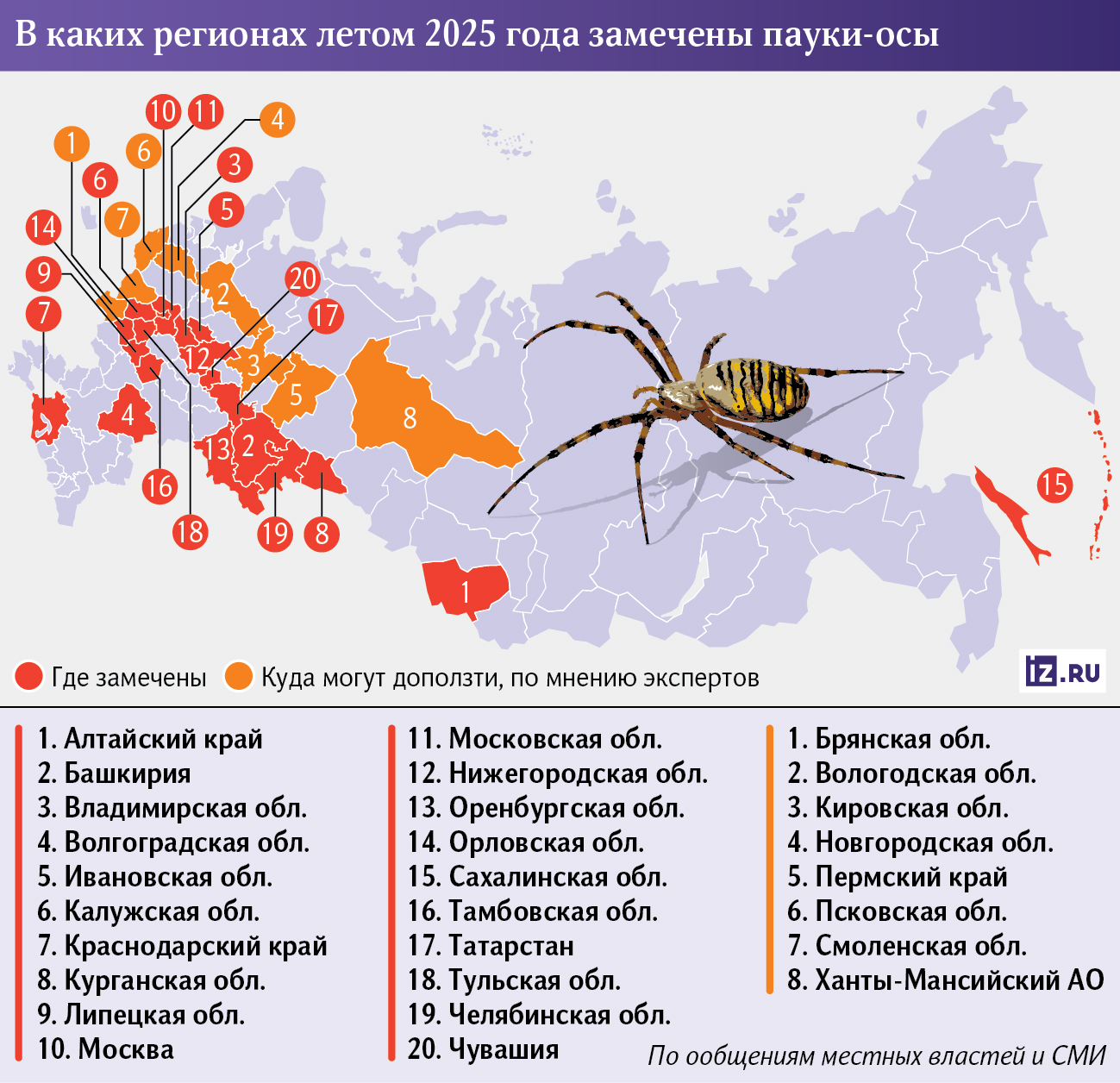
Along with natural areas, the habitats of insects and others, including arachnids, are changing, Roman Pukalov emphasized. According to him, the greatest concern is the expansion of locust, Siberian silkworm and bark beetle habitats to the north.
According to him, the first finds of wasp spiders in the Moscow Region date back to the late 2000s, and by 2011-2012 they had reached Moscow, said biologist Ilya Gomyranov.
What are the dangers of wasp spiders?
The bite of such a spider is extremely unpleasant — it is comparable to that of bees and wasps, said arachnologist Fyodor Martynovchenko. Despite the fact that these arthropods are poisonous, the amount of toxic substances they emit is insufficient to cause serious harm to an adult. In addition, wasp spiders, as a rule, cannot bite through the skin of adults — it is too thick for them.
But children, people with thin skin and allergy sufferers should still avoid being bitten by this spider, warned Andrey Bespiaty.
— They can lead to swelling of the respiratory tract, fever and anaphylactic shock. Occasionally, but a fatal outcome is also possible," he stressed.
Allergic reactions to insects and arthropods are a consequence of hyperreaction of the immune system, explained Ella Churyukina, allergist and immunologist at Invitro.
According to her, the prevalence of this type of allergy in different countries of the world is estimated at about 0.4–4%. Hypersensitivity is more common in people under the age of 20, about 40% of whom are children under the age of 12, the expert noted.
For minor symptoms of discomfort after a bite, such as a slight burning or itching, she recommended applying a cold compress. With a pronounced local reaction, antihistamines are also used, added Ella Churyukina.

If there is a large-scale local reaction, the victim should be taken to the hospital immediately, the doctor stressed. Also, according to her, people with allergies to insect bites need to have a first-aid kit with them.
In most people, the symptoms after wasp spider bites are limited to a local reaction and resolve on their own within one to two days, added Alexandra Fileva, an expert at Hemotest.
"The risks of negative consequences are higher if there are a lot of bites, for example, if you disturb a nest or a cluster of such spiders," she stressed. — In this case, the symptoms will become more pronounced due to a greater toxic load.
Wasp spiders do not show aggression first and sting only in case of direct contact - for example, if they are picked up or accidentally touched and squeezed, noted Fyodor Martynovchenko.
In Russia, in addition to wasp spiders, the ladybug spider is also spreading (it is poisonous, but its bite is not fatal), noted Andrey Bespyatykh. He also moved to the central regions from the southern regions and became the only representative of this genus in temperate latitudes.
Переведено сервисом «Яндекс Переводчик»
