Zero readiness: Moscow sees no desire on the part of the EU to start a dialogue


Moscow sees no signs that the European Union is ready to start a dialogue with Russia, including on Ukraine, the Russian Foreign Ministry told Izvestia. EU leaders themselves cannot decide on this issue: on the eve of the summit, which takes place on June 18-19, representatives of Italy and Austria spoke in favor of establishing contacts, and Dutch Prime Minister Rob Jetten said that strengthening Kiev's position on the battlefield should remain a priority. At the summit, EU leaders will also discuss the 21st package of anti-Russian sanctions. And the chances of its approval are "quite high," the European Parliament said. Brussels is once again making a fundamental mistake — instead of having a conversation with Russia, European politicians prefer to talk about it, said Vladislav Maslennikov, director of the Russian Foreign Ministry Department. Experts are also confident that the EU countries are only dragging their feet and are not really interested in negotiations with the Russian Federation.
Discussions on dialogue with Russia
A summit of EU leaders will be held in Brussels on June 18-19. The main and, perhaps, the most discussed topic on its sidelines was the attempts of European bureaucrats to build bridges with Russia. A lively discussion was sparked by reports in the Western media that the head of the European Council, Antonio Costa, has been conducting secret talks with Moscow for several weeks, trying to test the ground for possible negotiations on Ukraine. However, there has been no official confirmation of this information yet.
Trying to bargain for at least some place at the negotiating table, some European leaders on the eve of the summit called for the appointment of a special representative for dialogue with the Russian Federation on Ukraine. In particular, Italian Prime Minister Giorgia Meloni spoke in favor of this. Austrian Chancellor Christian Stoecker also called on the EU to open communication channels with Russia. However, Moscow does not see any signals from the EU about its readiness to engage in dialogue, Vladislav Maslennikov, director of the Department of European Problems at the Russian Foreign Ministry, told Izvestia.
— We have been hearing about this for several weeks, but so far they are following the path of their long-term mistake. Instead of talking to Russia, they talk about Russia among themselves," he said.
Russia regularly proves that it is ready for dialogue with Europe. So, on May 9, Vladimir Putin received Slovak Prime Minister Robert Fico in the Kremlin, and on June 11, the Russian Foreign Ministry held a meeting with the ambassadors of Great Britain, France and Germany. Commenting on the recent talks, Foreign Minister Sergey Lavrov noted that European diplomats had not announced new positions, but were obsessively offering their services, trying not to stay away from the negotiations on Ukraine.
Experts interviewed by Izvestia are confident that European countries are dragging their feet and therefore are in no hurry to appoint any negotiator for a dialogue with Russia.
— It is clear to the Europeans that a dialogue with Russia is overdue, that the Americans are in favor and Russia is ready to talk with Brussels. But for some reason, the leaders of the European Union think that Russia has begun to lose in the conflict zone and that the West has a new chance to strengthen Ukraine's position," said Alexander Rahr, a German political scientist and chairman of the Eurasian Society.

The Kremlin states that the heads of European states mistakenly believe that the situation on the battlefield is changing in favor of Ukraine. "The Europeans are clearly insisting that it is necessary to continue the war," said Russian presidential aide Yuri Ushakov.
One of the confirmations of this position was the statement by Dutch Prime Minister Rob Jetten - on June 18, he called on EU countries to "continue to help Ukraine," that is, to strengthen Kiev's position on the battlefield, rather than discuss possible peace negotiations with Russia.
On the eve of the G7 summit held in France on June 15-17, Ukraine and its European partners tried to bury the "spirit of Anchorage", which is understood as Kiev's territorial concessions, Ukraine's refusal from NATO membership and the easing of anti-Russian sanctions. They wanted to convince US President Donald Trump to side with Vladimir Zelensky and increase pressure on the Russian Federation. The American president later said that the United States would deal with Ukraine immediately after signing a peace memorandum with Iran.
— The EU stands completely on the side of Ukraine, unlike the United States, which is trying to play the role of a neutral mediator. And the European leaders want to put the squeeze on Russia with new sanctions, force Russia to pay "compensation" for Ukraine, and so on," Alexander Rahr said.
Sanctions and new military aid
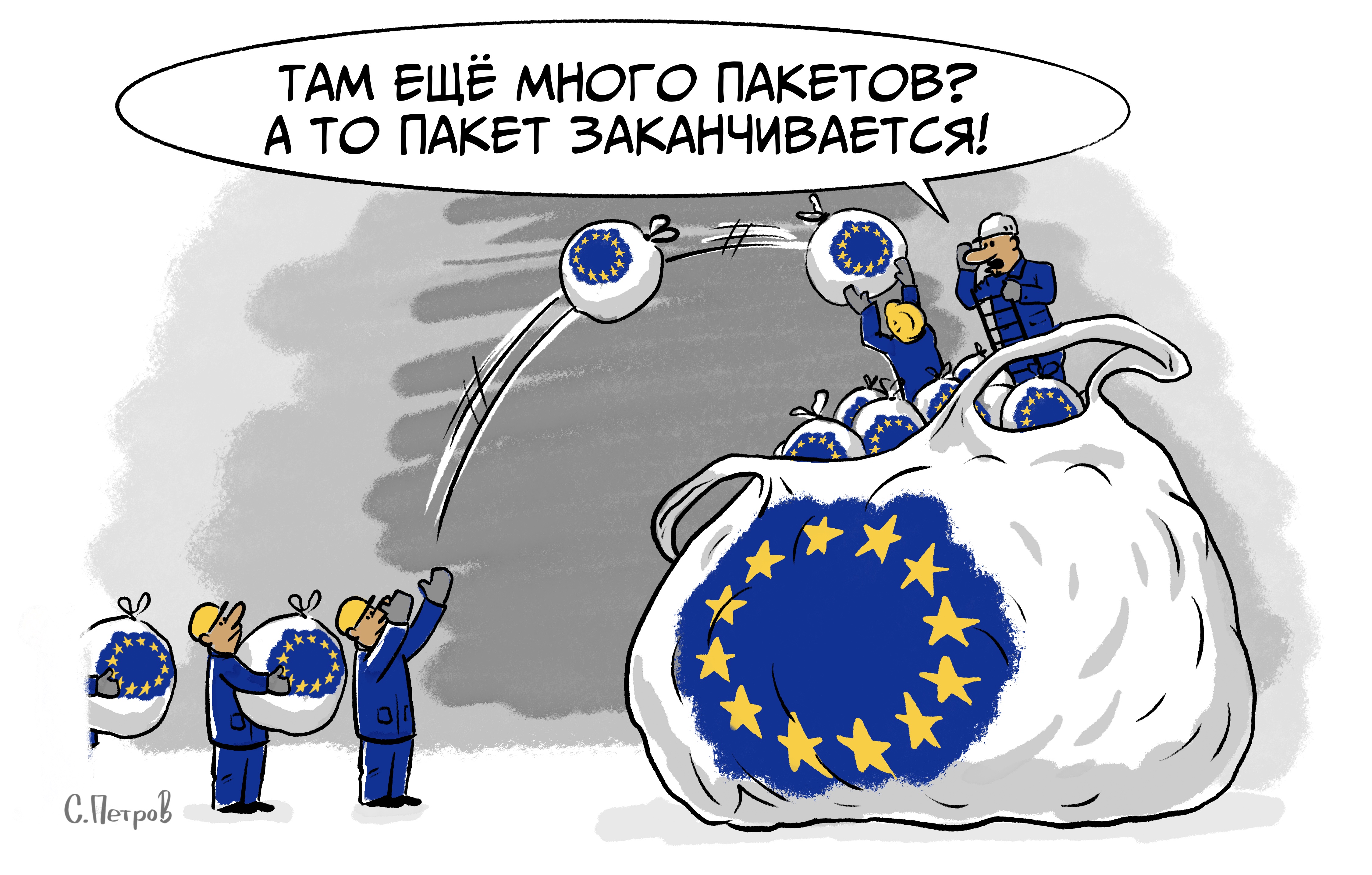
Another topic at the EU summit will be the coordination of the 21st package of sanctions against Russia. Restrictions may affect the energy sector, financial services, and cryptocurrency transactions, and for the first time extend to the fishing industry. The European Parliament believes that European countries are likely to be able to reach an agreement.
"The chances are pretty high, provided that no EU member state raises fundamental objections," MEP Milan Mazurek told Izvestia. — However, many Europeans are increasingly wondering whether more and more new sanctions are in Europe's interests. The priority should be to protect European citizens, industry and national economies, rather than adopting new measures solely for the sake of political symbolism.
A few days before the EU summit, Bulgaria raised objections. Sofia stated that she would not support restrictions related to energy. The country sees risks to Lukoil's operations, the supply of spare parts for the Sofia metro and fertilizers. Bulgaria also does not agree with the sanctions against Patriarch Kirill of Moscow and All Russia. The fact is that the Russian Orthodox Church is close to the Bulgarian Orthodox Church. "I'm not interested in Patriarch Kirill, I'm interested in the millions of people who are part of this church," said new Prime Minister Rumen Radev.
He also questioned the effectiveness of the new 21st package of sanctions. Radev's rhetoric is reminiscent of the steps of former Hungarian Prime Minister Viktor Orban, under whom Budapest regularly questioned the expediency of restrictions against the Russian Federation. However, experts are confident that Brussels will quickly overcome Bulgaria's objections.
— After the Hungarians returned to the ranks of the European "mainstream", the queue for "arm-wringing" reached Bulgaria. Sofia will be intimidated by the blockade of European money, and Hungary will be set as an example, which resisted, but which was eventually defeated," Alexander Rahr emphasized.
In general, the EU's sanctions pressure is a new norm that will exist regardless of how the situation develops in other areas, said Egor Sergeev, a senior researcher at the MGIMO Institute of International Studies.
— No one is going to abandon this policy, it is a new tool of competition, a convenient means of influencing the counterparty. And in this case, Bulgaria's position does not change anything. This is not a country that can have a real impact on the decision—making procedure in the EU," he said in an interview with Izvestia.

Nevertheless, the unpleasant news for Kiev may be another public refusal by European leaders to accept Ukraine into the European Union — Kiev still does not meet the EU criteria, not to mention the conflict with the Russian Federation. The Euractiv portal reported that France and the Netherlands are the most hindering Ukraine's accelerated entry into the community. Disagreements on this issue may completely disrupt the EU summit, writes the Financial Times.
The lack of European prospects, it seems, should be compensated by new military tranches and financial assistance to Ukraine. Over the past few days, Kiev's allies have agreed on major new military support measures. The UK has allocated a record package of $996 million, including 150,000 drones, 350 air defense missiles and ground-based radars. Germany has allocated $400 million for the purchase of PAC-3 guided missiles for Patriot complexes. The Netherlands has approved a $526 million package for drones and air defense systems. Belgium has confirmed the dispatch of seven F-16 fighter jets by the end of the year, and Sweden has allocated $108 million through NATO programs.
Following the results of the next meeting of the Ramstein contact group, held on June 18 at the NATO headquarters in Brussels, Ukraine was promised military assistance worth about $4 billion.
The media also reports that NATO is preparing a new €70 billion financial aid package. The proposal to raise such a sum could be one of the main potential outcomes of the alliance's July 7-8 summit. At the same time, the participation of the United States in the new initiative proposed by Germany remains questionable.
Переведено сервисом «Яндекс Переводчик»
