- Статьи
- Economy
- The family does not have no income: in Russia, they can open part of the parent capital for investment

The family does not have no income: in Russia, they can open part of the parent capital for investment

Mother Capital can turn into not only help "here and now", but also into a financial cushion for the future. Families with children want to be allowed to transfer part of their funds to long-term savings accounts, Izvestia found out. The issue is being actively discussed — the Ministry of Finance, the Ministry of Economy and the Central Bank have no fundamental objections. However, access to money is likely to be limited: we are talking about limits on the transfer amount and other conditions so that people have money left for housing or education. Whether there are risks and what prevents the adoption of the law now — in the material of Izvestia.
What will change for families with children
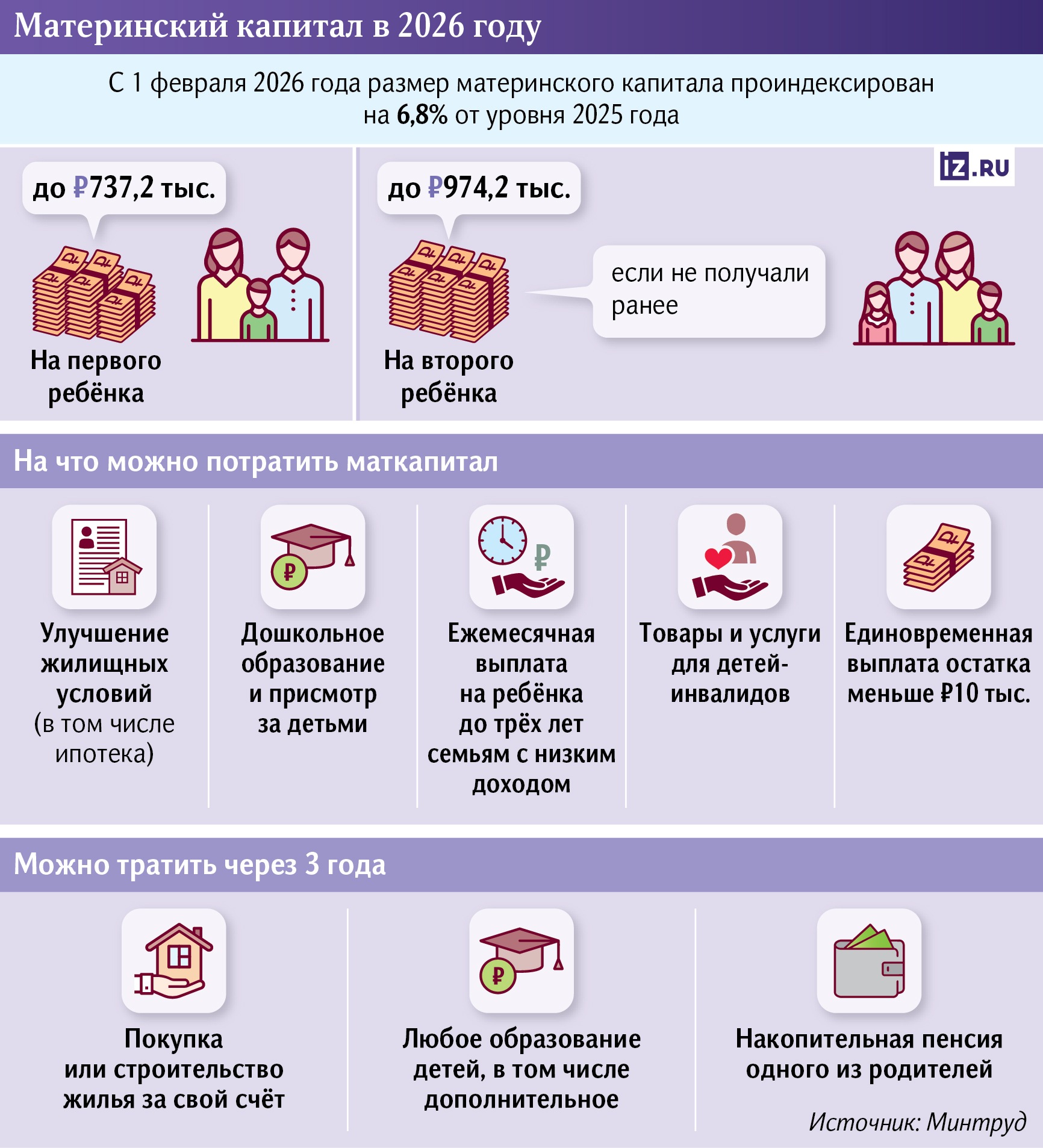
The Mother Capital program has been operating in Russia for more than 15 years, during which time the authorities have repeatedly changed the rules of its use. Currently, funds can be used to improve housing conditions (for example, to invest money in buying an apartment), children's education, a funded pension for one of the parents, goods and services for the rehabilitation of children with disabilities, as well as monthly payments for a child under three years old for families with low incomes.

At the same time, the authorities continue to discuss how else this money can be used. Moreover, some current options may be reconsidered. Earlier, the media, citing a report by the Ministry of Labor to the president, reported that the agency proposes to abandon the use of maternity capital for monthly payments from the birth of a child and for the formation of a funded pension. It is assumed that more funds should be used to solve the housing issue.
At the same time, new directions for the investment of maternity capital are being discussed. Back in April 2025, Izvestia wrote that the certificate's funds could be allowed to be transferred to the long-term savings program. Later, Deputy Prime Minister Tatyana Golikova stated that the government was not considering such an initiative. However, the Finance Ministry then informed Izvestia that the issue remained on the agenda. One of the market participants also shared with the editors that individual departments of the social block opposed the idea.
The long-term savings program allows you to form savings through NPFs with state support. Participants receive co-financing from the state of up to 36 thousand rubles per year for 10 years, as well as a tax deduction from contributions of up to 400 thousand annually. You can receive funds after 15 years or when you reach the age of 55 for women and 60 for men. In certain life situations, for example, in case of serious illness, money can be withdrawn ahead of schedule. The funds are insured for 2.8 million.
I'm still continuing the discussion now, Sergey Belyakov, president of the National Association of Non-Governmental Pension Funds (NAPF), told Izvestia. According to him, the financial authorities — the Ministry of Finance, the Ministry of Economy and the Central Bank — have no objections to the initiative. The editorial board sent a request to these departments and to the Ministry of Labor.

The Central Bank does not object to using the funds of the parent capital for transfer to the PDS, they confirmed to Izvestia. But the parameters require a comprehensive discussion, the regulator said.
The size of the maternity capital in 2026 depends on which child it is issued for. The family receives 737 thousand rubles for the first child. If the payment for it has already been received, then at the birth of the second baby, an additional payment of 237 thousand rubles is due. In the event that the right to a certificate did not arise (if the firstborn was born before 2020), 974 thousand rubles are given for the second.

Under what conditions will it be possible to transfer mother capital to accounts
One of the questions is related to how exactly these funds will work after the transfer to the PDS. As Deputy Finance Minister Ivan Chebeskov explained in June, non-governmental pension funds (NPFs) are ready to accept matkapital into the program, but under certain conditions.
— When we discussed this with market participants, the funds declared their willingness to work with matkapital, but with one condition: by entering the SDS, these funds should lose the special status of matkapital. That is, they cease to be indexed by the state according to the same rules, they cannot be taken back on the same terms, and so on," the deputy minister said.
According to Sergey Belyakov, the opportunity to send part of the parent capital to the PDS will make it more attractive to citizens. The very logic of the program implies financial support for actions that help create and develop a family, stimulate the birth of children and reduce the associated burden, he noted.

At the same time, the authorities are discussing an option with restrictions. As Sergey Belyakov explained, we can talk about both the amount that will be allowed to be transferred to the PDS, and the conditions for the subsequent use of these funds.
According to him, if the government supports the initiative, the necessary amendments can be adopted fairly quickly. From a technical point of view, we are talking about relatively minor legislative changes.
"If the concept itself is supported, then a corresponding law can be introduced and adopted by the end of the autumn session," Sergei Belyakov said.
According to the NAPF, this issue has already been included in the priority category.
Who will benefit from the new rules
PDS is already in high demand. According to the NAPF, by the beginning of June, Russians had signed almost 13 million contracts, and the amount of funds raised was close to 1 trillion rubles.
If matkapital is allowed to be included in the program, families will receive an additional tool for building savings for the future of their children, the association noted. These funds will become a start-up capital for the future for children, or they will help them buy their first home, pay for education, or start their own business.

Another advantage of the NAPF was the opportunity to receive money ahead of schedule without loss of income in the event of special life circumstances, for example, if expensive treatment is necessary or if the breadwinner is lost.
According to Roman Karneev, Director of Product at Gazfond PN, the mechanism must necessarily include restrictions. For example, only a portion of the parent capital's funds can be allowed to be transferred to the program so that families can use the remaining money to buy housing or pay for their children's education. In addition, additional conditions may be provided for the duration of the placement of funds or the age of the child. It is also important to ensure the transparency of the mechanism and the opportunity to review the decision.

The idea of allowing the transfer of part of the maternity capital to the long-term savings program is also supported by Sberbank. As Olga Izyumova, CEO of the fund, noted, at the first stage, 10-15% of certificate holders can use the mechanism, which will ensure an influx of 70-100 billion per year into the SDS. At the same time, they consider it necessary to maintain restrictions on the withdrawal of funds by analogy with the current rules for a funded pension: it will be possible to return money only before payments are made (after 15 years of participation). Citizens also need to be informed in advance about the consequences of such a decision, since after the transfer to the program, funds become less available for other purposes, and the program itself is designed for a long period of savings, she said.

The transfer of maternity capital to the PDS is likely to become an additional option for families who do not plan to spend it immediately, added Freedom Global analyst Vladimir Chernov. According to the Ministry of Labor, since the beginning of 2025, 364 thousand families have allocated funds for housing, 370 thousand for education, and 627 thousand for monthly payments. Therefore, the new mechanism will primarily interest those who have already solved the housing issue, do not need current payments and want to save in advance for the future of the child.
A massive transition to a new model should not be expected in the coming years, Anastasia Gorelkina, Chairman of the Board of Directors of HC Siberian Business Union, is convinced. It is realistic to assume that about 10-15% of the recipients of the maternity capital will transfer it to the PDS, since many still perceive it as a tool for buying a home.
— At the same time, some families today have not used the mother capital at all for years. For them, the PDS will be an opportunity to activate a "frozen" resource," she stressed.
At the same time, even a partial redirection of funds can ensure a noticeable influx of "long money" into NPFs, added Elena Fiveyskaya, director of NRA ratings of financial institutions. According to her, in 2025, the volume of transfers on applications for the disposal of the parent capital amounted to 460 billion.

Another effect may be the rejuvenation of the NPF's customer base: now the main recipients of maternity capital are women aged 25-35, she stressed. Pre-retirees and the elderly predominate among the participants of the SDS, which limits the funds' opportunities for long-term investment. As a result, NPFs are forced to invest more in short and liquid assets rather than in long-term projects.
Thus, if the initiative is approved, for the first time mother capital will be able to work not only as a measure of family support at the moment, but also as a tool of accumulation for decades to come. In this case, the state payment, which has traditionally been associated with the purchase of housing or tuition fees, can turn into a start-up capital for a child's adult life. However, to do this, the authorities will have to find a balance between the freedom to dispose of funds and the protection of families from rash decisions and financial risks.
Переведено сервисом «Яндекс Переводчик»
