
Immured demons: daily life and religious beliefs of the Old Believers

Anthropologist Elena Danilko's book about the closed and sometimes mysterious world of the Ural Old Believers combines history, ethnography (including data from modern field research) and folklore, but begins with a small portion of art criticism. Critic Lidia Maslova presents the book of the week, especially for Izvestia.
Elena Danilko
"Old Believers of the Urals. Nevyanskaya Tower, Cossack circumnavigation and the Zamora Demon"
Moscow: MIF, 2026. — 208 p.
In the introduction, the author suggests recalling Vasily Surikov's famous painting "Boyarina Morozova", which depicts an activist of the early Old Believers, Theodosia Morozova, who heroically gave her life for the old faith: "A sledge is driven through a crowd by a woman in shackles. A clear, expressive profile. His eyes are blazing with anger in his pale, bloodless face. The right hand is proudly raised in a double-jointed formation."
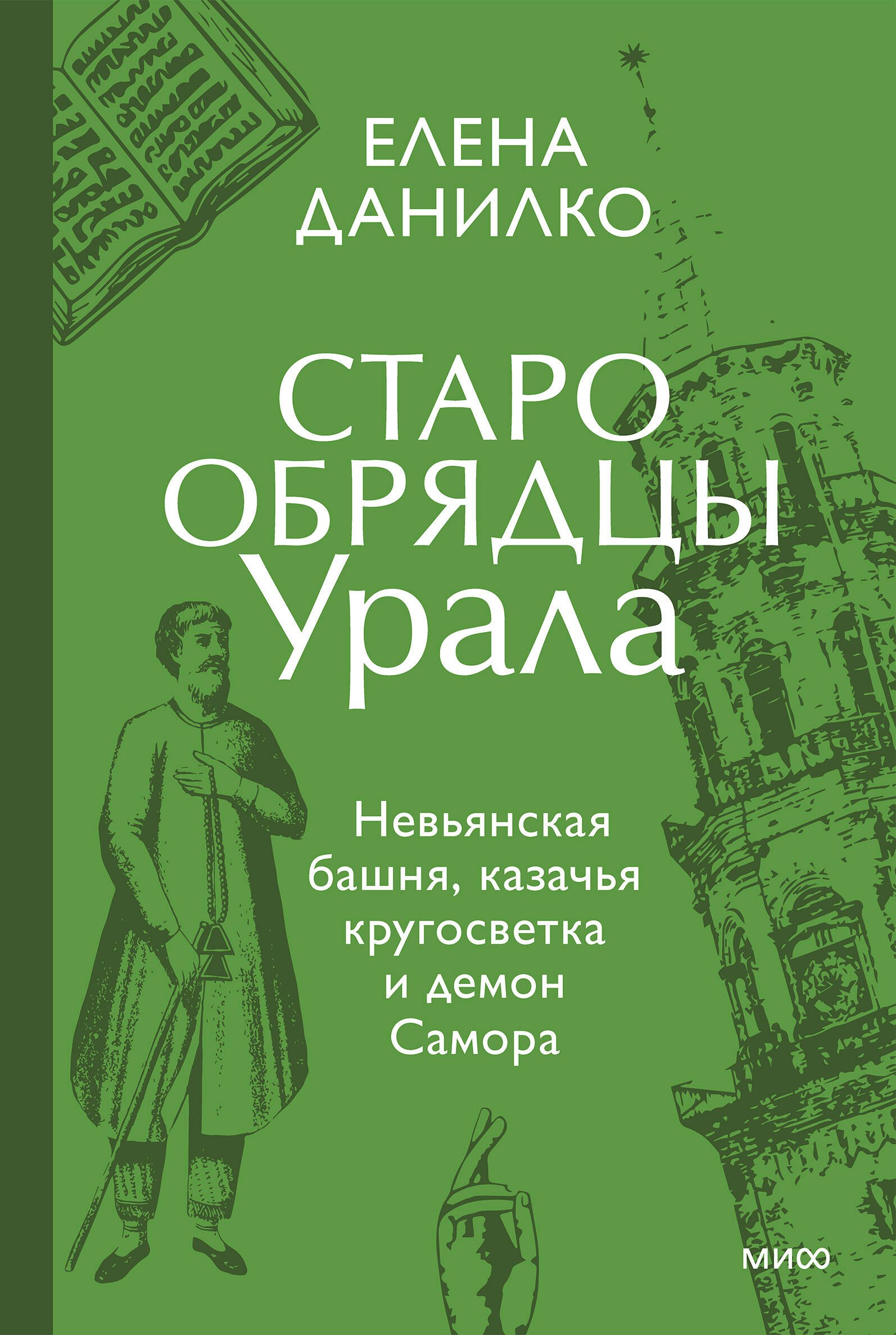
Danilko explains in detail the meaning of the double-finger as the most expressive and famous symbol of the Old Believers, familiar even to people very far from religion, in the chapter "Religious practices and everyday life": "With a double-finger addition, the little finger, ring finger and thumb symbolize the Holy Trinity; the middle and index fingers embody the divine and human essence of Christ; the slightly bent middle finger indicates the diminution (kenosis) of the divine nature." Next to it is a modern epic recorded by anthropologists in the Perm Region, which testifies to the effectiveness of doublespeak in the fight against evil spirits in our days: a resident of the village of Vankova tells how she overcame the sign of the cross of a local sorcerer who turned into a huge red mouse.
The book presents other examples of the intervention of sacred forces in everyday life, illustrating the specific worldview of the Old Believers, the origins of which Danilko associates with one of the most significant Old Believer writings of the mid—twentieth century - "Ural-Siberian Patericus", which also had a short self-name "The Tale of miraculous events." Compiled under the guidance of Father Simeon (Laptev) (1895-1954), rector of the Dubchessky monasteries on the Yenisei, the Ural-Siberian Patericon was based on specially collected oral traditions, written works and hagiographic biographies of the hermitage elders. Among the miraculous events collected in paterica are meetings with saints, cases of healing with water from holy springs, exorcism of demons or, conversely, corruption through air and water.

A certain dose of superstition, of course, can be seen in some of the everyday practices and rules of the Old Believers, which Danilko talks about, for example, in such as "chashnichestvo." This means very careful handling of personal dishes, which is highly undesirable to give to non—Old Believers, and sometimes to members of one's own family who have too close contact with the external social world, which is undoubtedly influenced by the Antichrist: "The rule of "one's cup", or "not hanging out" with Gentiles, is a truly significant attribute of the Old Believers household culture. It is enshrined in the writings of ancient Orthodox authors and the decisions of later councils and serves as one of the ways to protect against the Antichrist world. <...> The elderly in the family sometimes eat separately from family members who are forced to maintain active social ties."

At the same time, paradoxically, the desire to isolate themselves as a reliable barrier from the Antichrist world has always been combined in the Old Believers with the ability to achieve significant social and economic success — this is what Danilko says at the beginning of the book. There is every reason to consider Old Believers with their special work ethic as a kind of analogue of Protestantism: "The Old Believer owner considered himself not so much a private citizen, working hard for his own enrichment, as an organizer responsible for the fate of other people and the true faith, for their salvation and support." Like Protestants, the Old Believers perceived labor as a godly work related to the salvation of the true faith.: "Contrary to popular opinion about the eternal confrontation between traditionalism and progress, the Old Believers turned out to be innovators and successful entrepreneurs. <...> Add to this a high level of literacy, community and family solidarity. It is not surprising that a variety of crafts, trade, and industrial production flourished in the Old Believers' environment."

The development of the Ural mining plants is connected with the Old Believers, and many merchant dynasties subsequently emerged from Guslitsy near Moscow, known for the high concentration of Old Believer settlements.: The Morozovs, the Rakhmanovs, the Soldatenkovs, the Kuznetsovs. By the way, Pavel Tretyakov, the founder of the gallery in which the indomitable boyarina Morozova now threatens with the double-finger sign, also came from an Old Believer family. The author of the book explains the success and entrepreneurial spirit of the Old Believers by saying that in order to preserve their traditions in an unfriendly environment, sometimes actually underground, "the Old Believers had to become as flexible as possible and learn to adapt quickly to changes."
One of the key ethnographic concepts used by Danilko in her research is "lived religion." Proposed by French religious scholars, this concept makes it possible to interpret religion in a broad social sense and to look for its manifestations "not only in temples, but also in the kitchen, at work, on social networks..." With this approach, the anthropologist gets the opportunity not to limit himself to the study of religious doctrines, but to project them onto everyday life— "how people they interpret their faith, how they use objects and build a connection with space, how they pray and celebrate holidays." Thus, religion turns from a static set of rules into a continuous and "dynamic process of creating meaning in everyday life," which Danilko follows through various examples and different stages of the history of the Old Believers.

In the Russian context, given the tragic fate of many Old Believer martyrs, the phrase "lived religion" has an additional heroic meaning, when the nuance of how to cross oneself with two fingers or three becomes a matter of life and death, on which the outcome of the last battle of good and evil depends. The Old Believers' expectation of the "last times" is logically discussed in the conclusion of the book, where Danilko compares the utopian and eschatological ideas of the Old Believers, stating the great vitality of the eschatological ones. If the active existence of the utopian narrative ended at the beginning of the twentieth century, then the eschatological narrative is useful in the Old Believers to this day as a way to explain and accept social reality: "Everything unfamiliar, meaningful in terms of its own culture, becomes understandable and familiar. Objects, phenomena, and events recognized as signs of recent times are not rejected, but are organically woven into everyday life."
Переведено сервисом «Яндекс Переводчик»
