
Without internal troubles: how the Moscow Sovremennik appeared

Evgenia Kuznetsova was in charge of the literary part of the legendary Moscow Sovremennik Theater from 1995 to 2020, so she did not personally see the birth of the theater, but recreates the most important moments of its formation in great detail, based on archival documents, memoirs, as well as a huge volume of short stories by contemporaries, published for the 50th anniversary of the theater. Critic Lidia Maslova presents the book of the week, especially for Izvestia.
Evgeniya Kuznetsova
"The madness of the brave. How the legendary Sovremennik Theater was born and why it changed the Russian stage forever"
Moscow: Bombora Publ., 2026, 608 p.
The first landmark document illustrating the book is a typewritten program of a play based on Viktor Rozov's play "Forever Alive" printed on an ordinary A4 sheet. It is from this performance, played on the night of April 15-16, 1956 on the educational stage of the Moscow Art Theater Studio School, that the story of Sovremennik is usually counted.
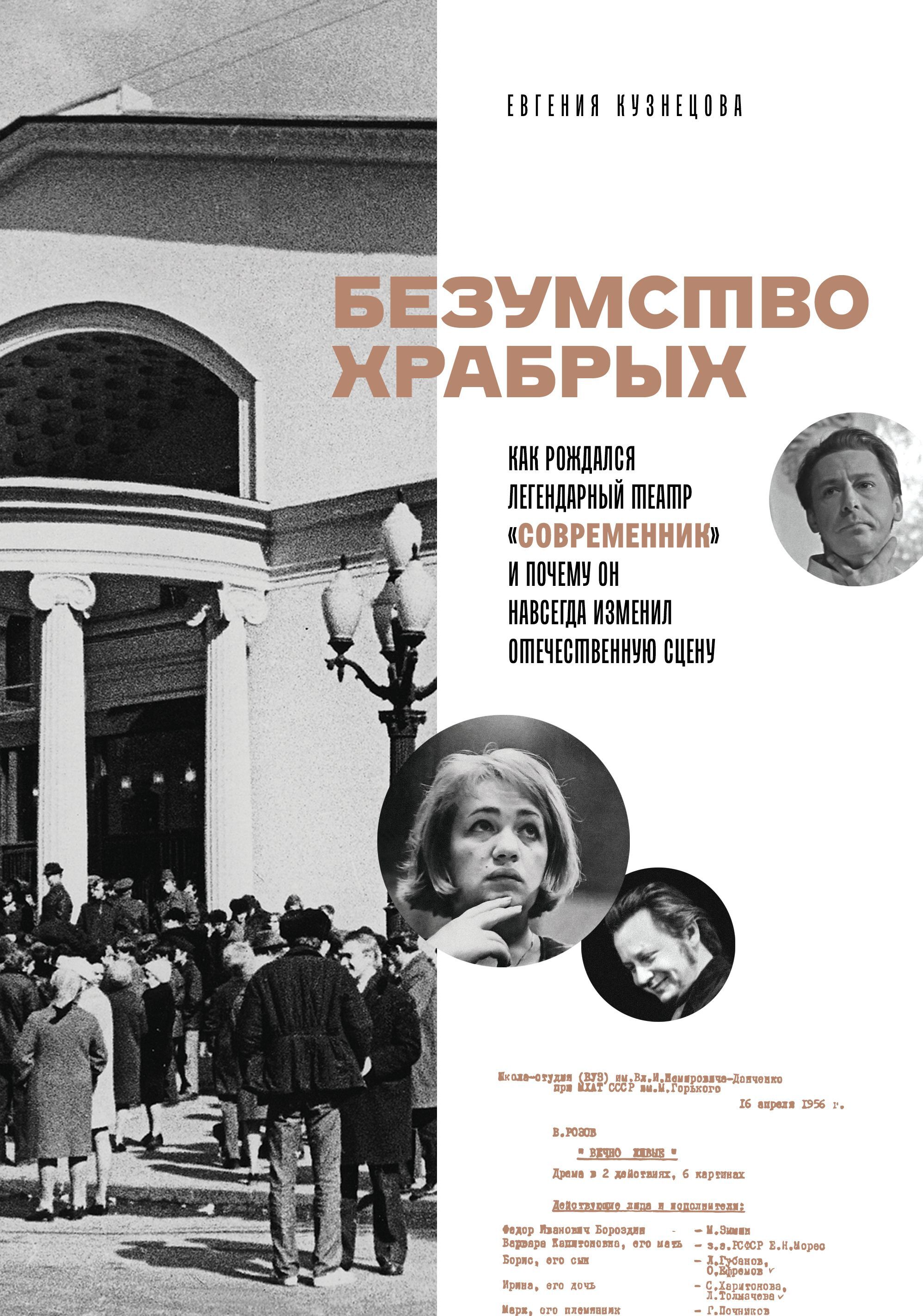
Before delving into the description of the heroic, selfless work of creating a play that blew up theatrical Moscow, Kuznetsova describes the socio-cultural atmosphere in which life itself demanded the appearance of something new on the basis of the Moscow Art Theater, traditionally designated as a standard (both creatively and organizationally), but in reality far from ideal: "In One-day performances appear in the repertoire of the Moscow Art Theater. They are played in a half-empty hall and removed from the current repertoire after 20-30 screenings. There are also productions by the founding fathers, but in a strange way. The actresses who appear on stage as the three sisters from Chekhov's famous play are all over 150 years old." After the deaths of Stanislavsky and Nemirovich-Danchenko, the Moscow Art Theater clearly needed to be renewed, on the one hand, but on the other, to cultivate followers of the traditions of psychological theater, "learned in the right faith."

Both of these requirements were successfully combined in the personality of Oleg Yefremov, who graduated from the Moscow Art Theater Studio school in 1949, and four years later became a "young and infectious" acting teacher there. In this capacity, Yefremov showed the ability to rally a close company of like-minded people around him, who, after graduating from the studio school, found it boring and hopeless to disperse into various already established theater troupes. The result was the emergence of an essentially amateur creative association, which called itself the "Theater Studio of Young Actors" and began staging the previously banned "Forever Alive" on pure enthusiasm, in their free time from their main job.: "After a full day of work with morning rehearsals and evening performances, there was full-fledged work every night before the subway opened." The main thing that united the future contemporaries, as Kuznetsova puts it, was the belief in the possibility of bringing a living person back to the stage: "The audience should recognize themselves in the characters, and not watch someone who climbed onto the inner walls — it doesn't matter whether by their own will or by the director's will."

Oleg Novikov, President of the Eksmo-AST publishing group, and Evgenia Kuznetsova, former head of the Sovremennik Theater, at the presentation of their book written for the 70th anniversary of the Sovremennik Theater in Moscow
The theme of a man's return to the stage, and most importantly, a modern man (even if he formally lives in another era, but is close and understandable to today's audience), runs through the entire book by Kuznetsova, who explains, among other things, the meaning of the name of the theater, proclaiming in her first manifesto program: "The repertoire of the theater must be modern, regardless of moreover, a Soviet or Western play is included in it, and in a broad sense, regardless of whether the play is modern or classical. Only classics that have something significant in common with modernity will be selected." Referring to the memoirs of Igor Kvasha and the director of the theater, Alexander Solodovnikov, Kuznetsova writes that the name Sovremennik was invented in 1958 almost on the fly, having quite a bit hesitated whether it was appropriate to call the theater the same as the magazine once published by Pushkin.
The book examines in detail the history of the creation of all the performances of Sovremennik, including both the famous ones and, by an unfortunate coincidence, those that did not reach the target audience and therefore did not last long, as well as outright failures. One of the final chapters is called "On victories and defeats" and contains the golden words: "When you are in search, it's no wonder to make a mistake." But the opportunity to at least partially present the details of the rehearsal process of even unsuccessful performances is of undoubted value, especially since many of the "contemporary" hits have not been preserved in the original composition, even in the recording. Sometimes, for Kuznetsova, descriptions of not the most famous performances arouse even more interest and excite the imagination than unconditional successes, for example, Kirill Vytoptov's production of "Genatside. A village joke" based on the novel by Vsevolod Bennigsen. The author sincerely regrets the audience's rejection of this ironic, completely non-provocative, "born in understanding and love" performance.: "Perhaps the first word in the name played a role. The highlighted letter "a" only hinted at a mistake to literate people, they were not enough. Or the lack of media personalities in the cast played a role."

In general, the success or failure of any performance, as can be understood from Kuznetsova's book, is a delicate matter, often unpredictable and inexplicable, as is the entire process of survival of a complex theatrical organism, often depending on a miraculous combination of circumstances. The word "miracle" repeatedly appears on the pages of "Madness of the Brave", starting from the moment when, at the dawn of the studio theater's existence, the Moscow Art Theater economist Grigory Kotlin suggested to Oleg Efremov such a form of labor relations with the Art Theater as "sabbath" - without this wonderful idea, Sovremennik might not have taken place for non—artistic reasons. purely for financial reasons. A miracle also happens on April 5, 1960, when instead of the expected order to close the too free-spirited theater, an article by critic Alexander Karaganov appeared in Literaturnaya Gazeta, who composed a panegyric for Sovremennik, allegedly relying on the weighty opinion of the district committee commission.: "There was a time when the printed word mattered: after the appearance of such an article, the closure of the theater would look like self-will and tyranny."

By distributing the load between the two pillars on which Sovremennik was based, Kuznetsova maintains a precise balance, balancing the contributions of founding father Oleg Yefremov and Galina Volchek, who succeeded him as head. The expressive finale of the book is a kind of dialogue constructed by zavlit between two luminaries. First, Efremov's performance on the stage of Sovremennik in 1993, on Volchek's 60th birthday, is quoted: "She was amazingly able to predict, anticipate time. Prophesy to some extent. <...> Galya, believe me, already at this age you should know the truth — you are on the only right path in understanding and experiencing art in general. But we all don't." In response, there is a quote from a book published in 2006 for the 50th anniversary of Sovremennik, where Volchek thanks Efremov, who determined her fate: "...His departure to the Moscow Art Theater was one of the most dramatic events in my life, after which, two years later, I had to take over the theater against my will. <...> He was and remains an absolute value for me. And therefore, what he said on my sixtieth birthday became for me an important and essential assessment of what he had done in the theater he created."

The most recent line in the book belongs again to Efremov and is dated 1969: "The theater is alive with the future. The best is yet to come." Finishing on such a pretentious note, Kuznetsova, of course, slightly gets up on her inner self, however, this is justified by the solemnity of the moment, and of course, by the understandable desire to finally reassure the theater-goers that Sovremennik has not only a glorious past, but also a completely guaranteed future.
Переведено сервисом «Яндекс Переводчик»
