
Roller coaster: in summer, a dollar will cost an average of 78 rubles

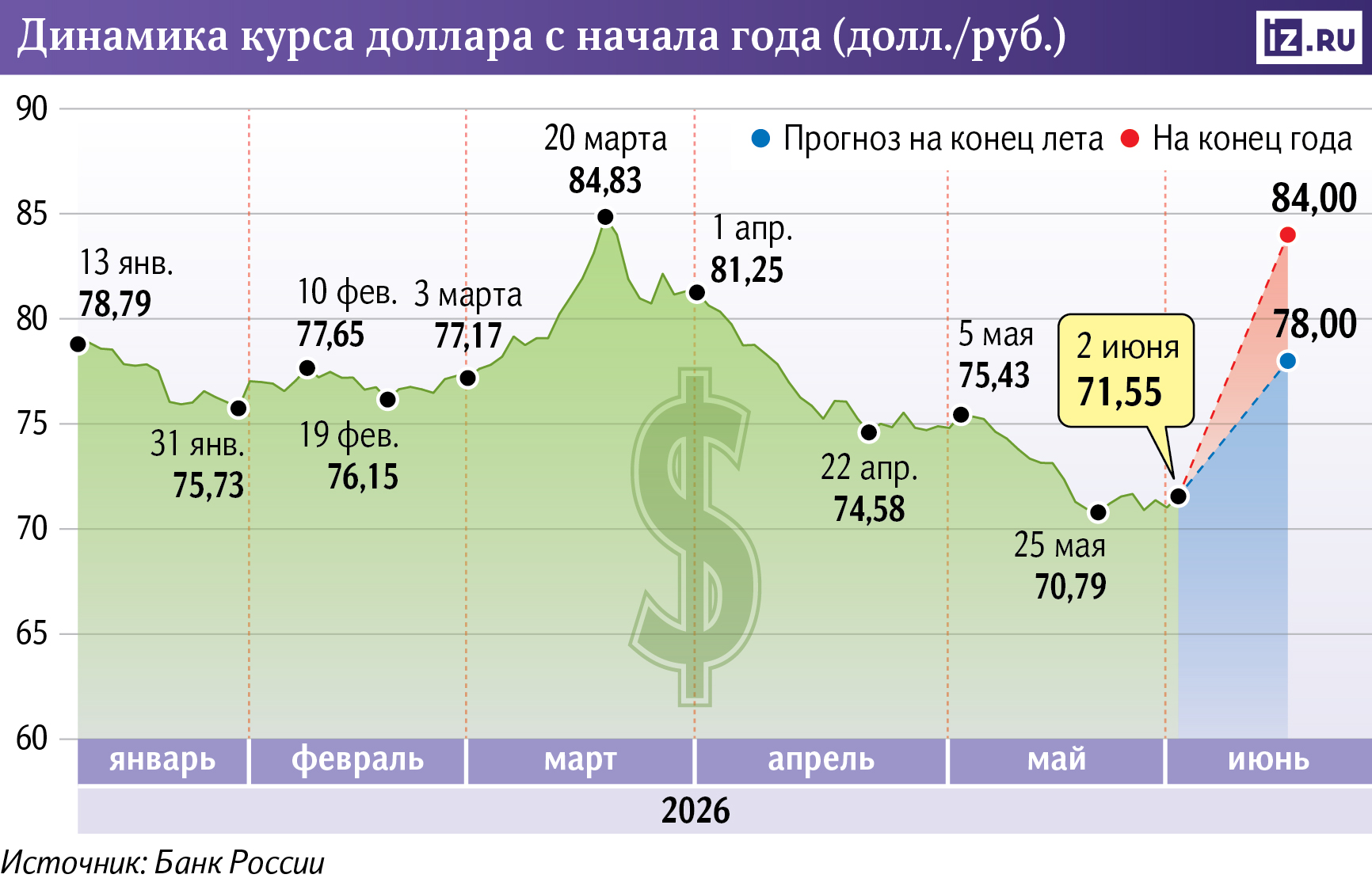
The dollar went up with the start of the holiday season: in the first days of June alone, the US currency rose in price by almost 2% to 73 rubles. And this is probably just the beginning. Experts interviewed by Izvestia expect that in the summer the exchange rate will average 78 rubles per dollar, and by the end of the year it may approach 84. Pressure on the ruble is increased by several factors at once: Russians are more actively buying up foreign currency before traveling, exporters are reducing sales of revenue after tax payments, and the Ministry of Finance is increasing purchases on the market. A weak ruble is beneficial for the budget, but foreign holidays and imports for Russians can become noticeably more expensive. What else can affect the course is in the Izvestia article.
Why did the ruble start to weaken
In the first two days of June, the Russian currency lost more than 1.5%, dropping from 71-72 to 73 rubles per dollar. The weakening of the ruble is explained by the coincidence of several factors at once.
The main reason is the completion of the May tax period, explained Alexander Schneiderman, head of Alfa—Forex's Customer Support and Sales department. At the end of the month, exporters traditionally actively sell foreign exchange earnings to pay off the budget. But after the passage of the main tax payments, the supply of currency on the market decreases, and the ruble loses support.

Additional pressure is created by the actions of the Ministry of Finance within the framework of the budget rule, said Denis Astafyev, founder of the SharesPro fintech platform. According to him, the agency is increasing purchases of foreign currency on the open market, which directly affects the exchange rate. After June 4, the ministry may review the volume of currency purchases upward, said Peter Arronet, chief analyst at Ingo Bank.
The market is also responding to the easing of the Central Bank's policy. The regulator has already begun to reduce the key rate, and investors are waiting for further steps in this direction on June 19, Denis Astafyev added. Against this background, ruble assets are gradually becoming less attractive, which also plays against the national currency.

The holiday season plays its role, as it does every year. In June, Russians traditionally buy foreign currency more actively before traveling abroad, Alexander Schneiderman recalled.
An additional signal for the market was the expectation of the Ministry of Finance's report on oil and gas budget revenues for May, said financial adviser and founder Rodin.Capital Alexey Rodin. The pressure on the ruble was also increased by a slight decrease in oil prices.

Sanctions risks and changes in the structure of export settlements also continue to affect the market, Denis Astafyev emphasized. However, export earnings are still quite high and are holding back a sharper fall in the ruble.
The editorial board sent a request to the Central Bank and the Ministry of Energy.
How much will a dollar cost during the holiday season
In the summer, the dollar will rise in price to about 78 rubles, the consensus forecast of Izvestia showed. According to Denis Astafiev from SharesPro, by the end of June it may gain a foothold in the range of 73-78 rubles. A milder scenario assumes a rate of 71-74 rubles, unless new sanctions are imposed and current export revenue volumes are maintained. Experts are not expecting a sharp collapse of the ruble in the coming weeks yet: exporters are still providing the market with a sufficient amount of currency.
In the next two summer months, the dollar is likely to trade around 74-75 rubles, Alexey Rodin believes.

The trajectory can be expanded by activating the Ministry of Finance according to the budget rule, said Oleg Abelev, head of the analytical department of the investment company Rikom-Trust. The agency will withdraw excess foreign exchange liquidity from exporters, but not in full — this will allow the ruble to weaken smoothly, without sudden jumps. According to him, by the end of the summer, the dollar exchange rate may reach 77-78 rubles, and by the end of the year — 82-83 rubles.
In the summer months, a dollar will cost no more than 77-78 rubles, agreed Olga Gogaladze, an economist and expert on financial markets. In her opinion, such a corridor is balanced: it does not provoke an acceleration of inflation, and at the same time remains comfortable for the federal budget. When the ruble weakens to these values, exporters receive sufficient ruble revenue, and the budget receives expected oil and gas revenues, but at the same time, rising prices for goods and services remain under control.

Anton Nikitin, founder and CEO of Fingold, gave a more radical forecast. According to him, the base scenario for the summer of 2026 assumes a rate of 85-95 rubles per dollar. According to him, the current strong ruble is supported by currency control, high commodity revenues and weak imports. However, as soon as export earnings decrease or pressure on the budget increases, the exchange rate quickly returns to weaker values.

In the second half of the year, the situation will change significantly more — the exchange rate may rise to 82-88 rubles, and by December it will approach 88-93, Denis Astafyev warned. Among the main risks are the cessation of currency sales by the Central Bank, a further decline in the key rate, an increase in demand for dollars from the population and a possible decline in oil prices.
A more noticeable weakening of the ruble is likely already in the third quarter, said Natalia Milchakova, a leading analyst at Freedom Finance Global. According to her, the pressure on the Russian currency will increase if the conflict over Iran ends, and oil will fall in price against this background. Possible new sanctions from the United States and the European Union remain an additional risk. In this scenario, the dollar will approach 80 rubles by the end of the year.
How the weakening of the ruble will help the budget
A weaker ruble is beneficial to the federal budget. With a decrease in the exchange rate, the ruble revenue of exporters increases, and with it, tax revenues, which are calculated in the national currency. As Izvestia previously wrote, each ruble of strengthening in excess of the level of 81.5 rubles per dollar included in the treasury costs the treasury 100-150 billion per month. Accordingly, when the exchange rate weakens, the state receives additional oil and gas revenues — we are talking about hundreds of billions of rubles with a decrease in the national currency by about 10%.

An additional effect is provided by the support of import substitution and exports. More expensive foreign currency makes foreign goods less affordable within the country, and Russian products more competitive in foreign markets.
Starting from the beginning of the second half of the year, the Bank of Russia will reduce the volume of mirroring operations, said Alexander Potavin, an analyst at Finam Financial Group. This means that the market will receive less additional currency from the regulator, and support for the ruble will become weaker. According to financial adviser Alexei Rodin, the volume of currency sales by the Central Bank will decrease by almost half — from $1.1 billion to $0.6 billion.
The oil market may also exert additional pressure on the ruble. At the end of May, expectations increased that the United States and Iran would be able to agree on a de-escalation of the conflict, Alexander Potavin noted. In this case, full-fledged movement of tankers and commercial vessels through the Strait of Hormuz will be restored, and the supply of raw materials on the world market will increase. Against this background, oil prices had already dropped by about 17% by the end of May, and this trend could continue in the coming months if nothing prevents the deal from being concluded again, the expert believes.
The decline in oil prices has a direct impact on export earnings coming to Russia, and hence on the ruble exchange rate. Therefore, in the second half of the year, the Russian currency is likely to continue to weaken gradually, analysts agree. At the same time, further dynamics will continue to depend on geopolitics, new sanctions and the situation on the commodity markets.
Переведено сервисом «Яндекс Переводчик»
