- Статьи
- Science and technology
- Play with discovery: "robobronosets" and a new exoplanet with stone clouds

Play with discovery: "robobronosets" and a new exoplanet with stone clouds

A portable MRI machine will make diagnostics more accessible to patients with limited mobility, and quantum data protection will ensure the security of critical infrastructures. The Solar Terahertz device has been launched in Earth's orbit, which will help predict solar flares more accurately. Technology is also inspired by nature: American researchers have created protection for soft robots in the image of an armadillo. And the James Webb telescope has revealed the secrets of exoplanets with extreme weather cycles. Read more about the most interesting science news of the past week in the Izvestia article.
Scientists have created Russia's first portable MRI machine
ITMO has created Russia's first portable magnetic resonance imaging scanner, which operates from a regular 220 V outlet and does not require a special shielded room, cryogenic cooling and complex infrastructure.

The device operates on a weak magnetic field, so it does not need a special room, cooling and powerful power supply — it is capable of operating from a regular outlet. The portable device can be moved directly into the wards of patients with limited mobility, and its weak magnetic field allows for research on patients with metal implants.
"Such a device can be brought to a bedridden patient, positioned so that the patient's head is in the work area, and the study can begin,— Ekaterina Bruy, head of methodological and algorithmic development and senior researcher at the ITMO Faculty of Physics, told Izvestia.

A device for hunting for solar flares has been placed on the ISS.
On May 27, Roscosmos cosmonauts Sergey Kud-Sverchkov and Sergey Mikaev went into outer space from the International Space Station (ISS). They have successfully completed all the scheduled tasks. In particular, the "Sun-Terahertz" device was installed. During the experiment, scientists will have the opportunity to study the Sun in the terahertz range, which will allow them to "peek" into previously inaccessible layers of the star's atmosphere. This will help to make more accurate forecasts of solar flares and space weather.

"The device turns on automatically and works continuously. Its optics perform integral measurements of the entire solar disk. In this case, changing the signal of a relatively calm Sun is of key importance. Thanks to this, the data can be adjusted to take into account the background radiation level, which makes it possible to reliably record flashes and active events," Olga Krivolapova, curator of the experiment, chief system design specialist at RSC Energia, explained to Izvestia.
The "Sun-Terahertz" project can be supplemented with data from the ground-based scientific infrastructure. In particular, we are talking about the Siberian Radioheliograph, a megascience class installation of the National Heliogeophysical Complex of the Russian Academy of Sciences, as well as the RATAN—600 radio telescope located in the Caucasus, said Yuri Yasyukevich, Deputy Director for Research at the Institute of Solar-Terrestrial Physics of the Siberian Branch of the Russian Academy of Sciences. Comparing data from various instruments will allow us to reconstruct the three—dimensional structure of processes in the solar atmosphere - from the lower layers to the upper ones. This, in turn, will create the basis for developing more reliable indicators and forecasting solar flares, the expert noted.
Super secure communication will protect banking information from hacking
Skoltech specialists (VEB GroupRussian Federation), by order of Russian Railways, developed a software and hardware complex that provides secure data transmission in mobile networks using quantum key distribution technologies. This is the first system in Russia that allows transmitting information encrypted in this way in fifth-generation (5G) networks.

The presentation of the development took place for the first time at the conference "Microelectronic Systems – 2026". The complex includes a server part for organizing communication between users, two 4G and 5G base stations, as well as subscriber devices based on the Aurora and Android operating systems.
"Such complexes can be used in a wide range of industries where increased requirements are placed on the protection of transmitted data and the resilience of the communication infrastructure to future cyber threats. First of all, we are talking about the transport industry and critical information infrastructure facilities, including railway control systems, dispatch centers, digital monitoring platforms and mobile service channels," said Alexey Frolov, Professor, Director of the Skoltech Wireless Communications and Internet of Things Project Center.
The technology is also of interest to energy, industry, the financial sector and government agencies, where preparations are already underway for the transition to post-quantum methods of information protection, he added.

Armadillos helped scientists create protection for soft robots
Researchers from North Carolina State University have developed an innovative protective structure for soft robotics and flexible electronics, inspired by the behavior of armadillos. The device, dubbed the "robobronosets", automatically reacts to external threats — from a light touch to a strong blow — and curls into a ball, protecting the built-in electronic components. According to the author of the project, Yong Zhu, the goal of the development is to enable fragile technologies to function reliably in difficult conditions.
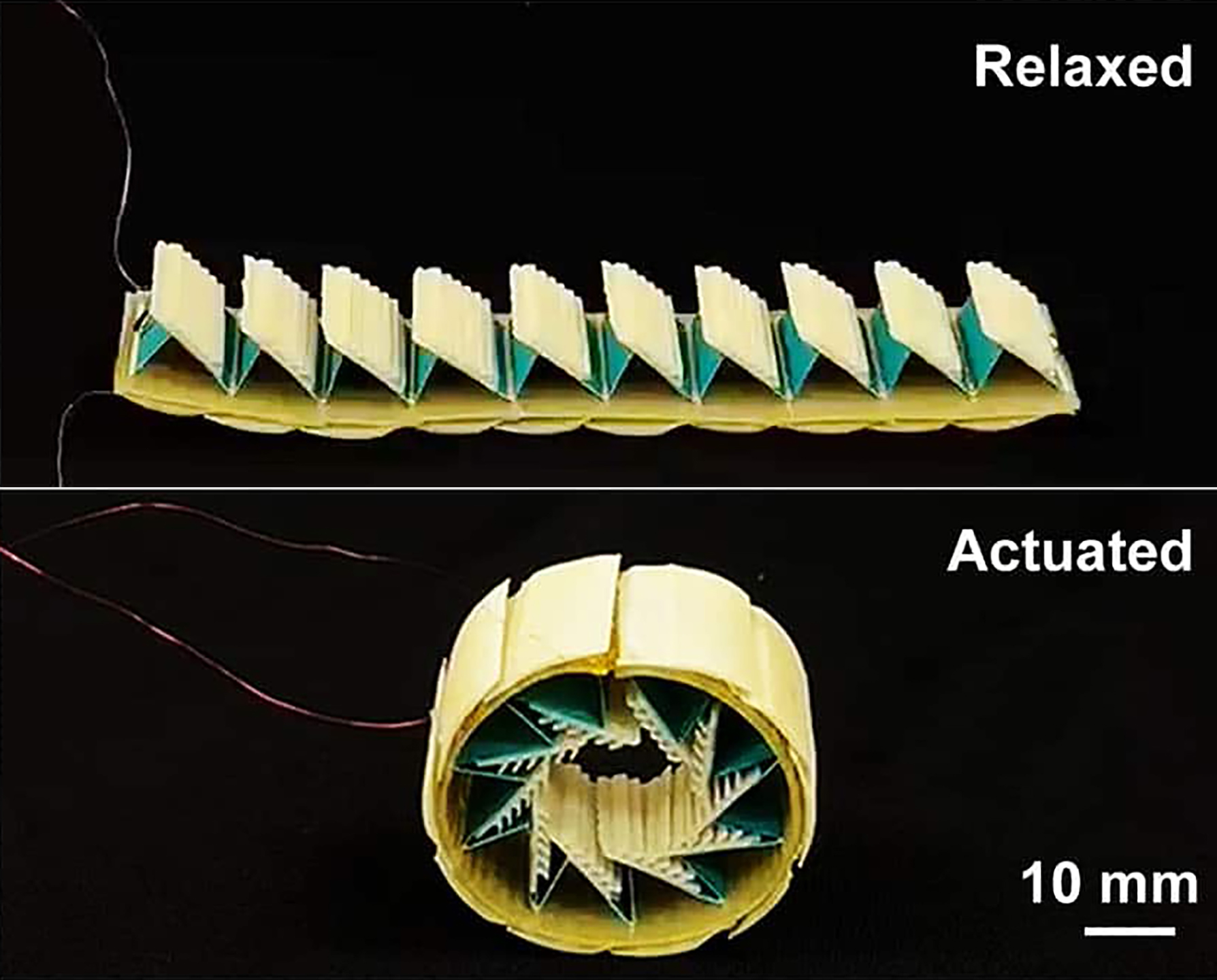
The structure consists of three layers. External (exoskeleton) It is made of segmented curved plates based on 3D‑printed resin. The middle "sensor‑executive" device includes a liquid crystal elastomer, a strain gauge with silver nanowires, a kapton tape and a conductive heating layer. The inner layer (endoskeleton) is formed of thick paper with protrusions and rigid polymer "segmented scales". When an impact or touch is detected, the strain gauge triggers a mechanism: heating causes some layers to contract and others to expand, which leads to the collapse of the entire structure into a protective circle with the exoskeleton outside and the interlocked scales of the endoskeleton inside.
Scientists have found a planet with stony clouds disappearing at night
Astronomers using the James Webb Space Telescope (JWST) have discovered the giant exoplanet WASP-94A b, which has an extreme diurnal cycle: clouds of rocky minerals form in the sky every morning, which completely disappear by evening.

The object is located at a distance of almost 700 light-years from Earth in the constellation of the Microscope. Researchers have recorded a weather cycle in which the morning side of the planet is densely covered with clouds of magnesium silicate, a mineral often found in rocks on Earth. At the same time, the evening side remains almost cloudless.

Scientists observed WASP-94A b at the time of its passage against the background of its parent star. The JWST telescope made it possible to study separately the leading edge of the planet (the morning side), where winds carry air from the cool night side to the hot daytime side, and the trailing edge (the evening side).
WASP-94A b belongs to the class of hot Jupiters, gas giants orbiting very close to their stars. After analyzing the data from this planet, the research team studied eight more similar objects and found similar cloud cycles on the worlds WASP-39 b and WASP-17 B. In the future, astronomers plan to expand the Webb observation program to search for similar weather events on other exoplanets.
Переведено сервисом «Яндекс Переводчик»
