- Статьи
- Economy
- Dark playground: despite biometrics, the number of "black creditors" has increased by a third

Dark playground: despite biometrics, the number of "black creditors" has increased by a third

Mandatory biometrics for MFIs, conceived as protection against fraudsters, led to the opposite effect: the number of illegal creditors began to grow sharply. According to the Central Bank, in just three months of 2026, it increased by more than a third compared to the previous quarter. Many players were not ready for the new rules, and borrowers began to look for money in the gray area more often after refusals. Experts warn that if the situation does not change, up to 15% of the microloan market customers may go to illegal immigrants. Why protection has turned into a problem for the Russians themselves and whether the authorities will have to soften the requirements is in the Izvestia article.
How Biometrics pushed borrowers towards "black lenders"
Since March 2026, all microfinance companies (IFC) are required to use a Single Biometric System (EBS) for remote loans. But two months later, the Central Bank announced a moratorium on fines for violations of the requirements — the sanctions will take effect only from 2027. At the same time, starting next spring, the rule will be extended to all microfinance organizations, including micro-credit companies (MCCS).

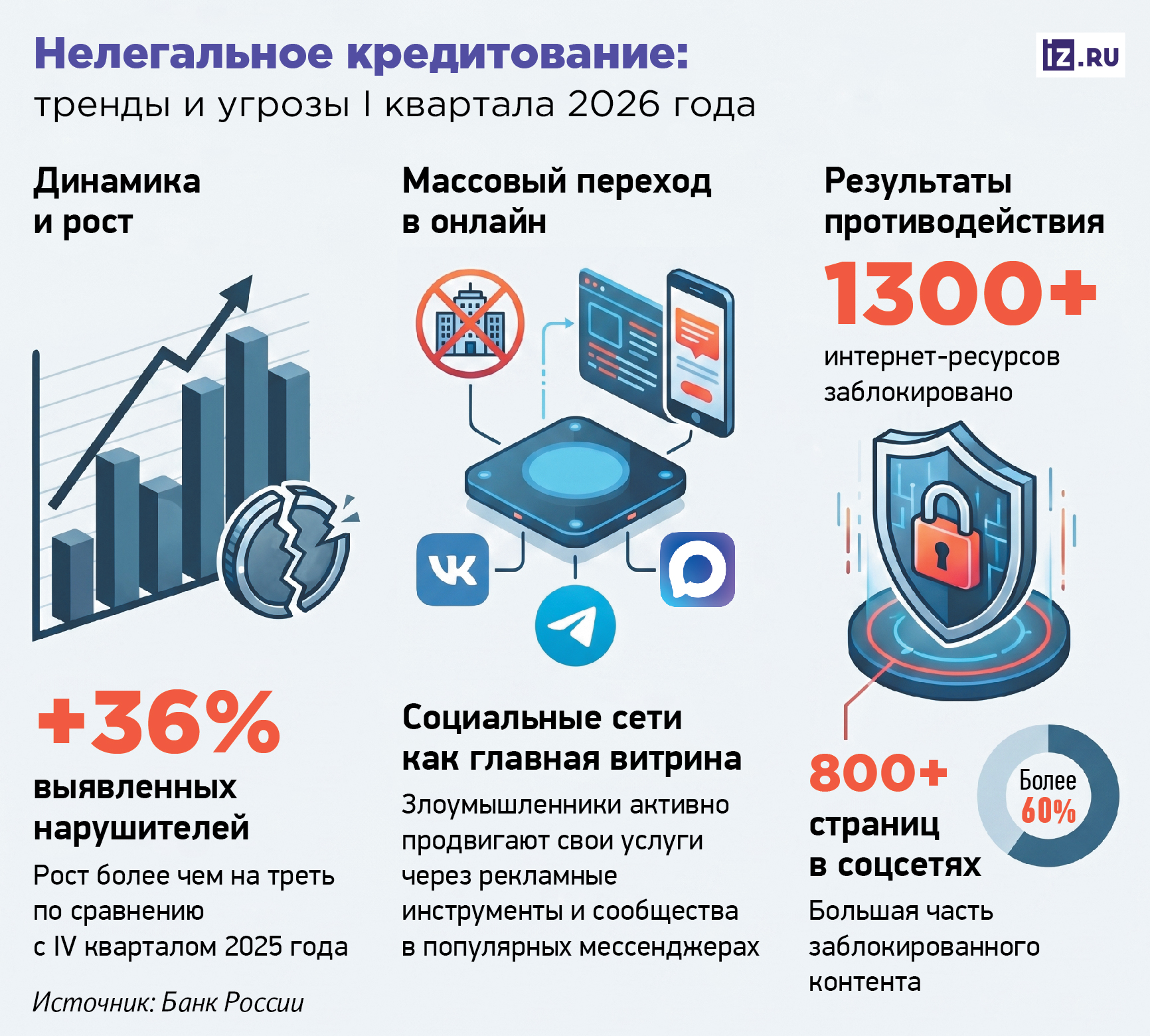
Against this background, the number of illegal creditors in Russia has increased. According to the Central Bank, in the first quarter of 2026, the regulator identified 36% more "black creditors" than a quarter earlier. Experts interviewed by Izvestia believe that the reason is the new requirements for microfinance companies. Legal players were not ready to launch the system, and some of the clients, after rejecting online loans, began to look for money in the shadow sector.
MFOs in Russia operate in two forms — microfinance companies (MFCs) and micro-credit companies (MCCS). The main difference is in the size of loans and the possibilities of raising money. MCCS can give out up to 500 thousand rubles to one client, and IFC — up to 1 million. In addition, the IFC has the right to issue bonds and attract investments, while the MCC is deprived of such an opportunity. At the same time, loan terms, interest rates, and requirements for protecting borrowers' rights are the same for both categories — they are set by the Central Bank.
The press service of the Bank of Russia told Izvestia that the introduction of identification through the EBS has become a difficult regulatory change for the market. As the editorial board previously wrote, since the beginning of the year, 13 IFC have changed their status to MCC in order to receive a delay in mandatory connection to biometrics.
The reform took the market by surprise, according to Denis Astafyev, founder of the SharesPro fintech platform. According to him, by the end of March, not a single IFC had been able to establish mass issuance of loans using biometrics. The reason was not the unwillingness of the business to work according to the new rules, but the technical unavailability of the system itself.

The main problems remain the low occupancy of the EBS database, poor awareness of citizens and the high cost of connection, said Artem Bykov, CEO of Moneyman. According to him, the implementation of the system can cost companies tens of millions of rubles. At the same time, the expert predicts that up to 15% of MFOs' clients may go to illegal immigrants amid stricter requirements.

The decrease in the availability of legal loans is already pushing people towards "black creditors," Natalia Milchakova, a leading analyst at Freedom Finance Global, agreed. According to her, it is increasingly difficult for heavily indebted Russians to get a new loan, while bank rates are falling slower than key rates, household incomes are not growing as fast, and inflation remains high. In such conditions, the demand for "fast money" remains, which is what the shadow sector uses.
The MIR SRO confirmed that the market is still only testing the new mechanism. The first trial issues using biometrics took place only last month, so the full launch is still far away.

Even after the participants are connected, the problem may persist, Denis Astafyev warned. Currently, more than 10 million Russians have voluntarily submitted biometrics, which is about 7% of the country's population. At the same time, the active client base of MFIs reaches 15 million people. That is, millions of borrowers risk losing access to legal online loans and turning to "black lenders."
Why was the market not ready for the introduction of biometrics
The postponement of the mandatory connection to the EBS was a recognition that the market is not ready for rapid changes, said Maria Brodovskaya, First Deputy Chairman of the Board of JSC National Savings Bank. According to her, if legal MFIs start to refuse customers without biometrics en masse, some of the borrowers will go to illegal immigrants. Therefore, the Central Bank's decision to postpone fines is an attempt to avoid a surge in "black lending."
The Ministry of Finance informed Izvestia that the EBS itself is technically ready and is already processing millions of requests. However, the Center for Biometric Technologies recognized that the main problem is the adaptation of the market. MFOs have to rebuild client services, connect IT systems to the EBS and Public Services, and train employees.

Large players will be able to implement new requirements faster thanks to resources and their own IT teams, Maria Brodovskaya believes. It is more difficult for small companies because the costs of connecting and maintaining the system are too high for them.
At the same time, the mass withdrawal of legal MFOs into the shadows should not be expected, says Anton Egorov, executive director of Cyberbird Fintech Group. According to him, the new expenses only indirectly strengthen the position of illegal creditors.

How illegal immigrants work
The growth of the shadow market is noticeable not only according to the statistics of the Central Bank, but also by how the work patterns of such lenders are changing. More and more of these players go completely online and advertise loans through social networks. According to the Central Bank, in the first quarter alone, more than 1.3 thousand illegal resources were blocked, including over 800 pages on social networks.
The regulator associates a particular danger with the issuance of loans in cryptocurrency — such schemes are almost impossible to track and stop, fraudsters endlessly create clone sites, and the borrower has no protection. In the first quarter, the Central Bank received almost 200 complaints about projects with crypto loans and has already blocked 123 resources.

If a person receives a refusal from all legal organizations, the need for money does not disappear — he will still be looking for someone who will approve the application, the MIR SRO warned. Most often, these turn out to be illegal firms, where borrowers are practically not protected in any way.
What will happen next with the "black market" of loans
If by the end of 2026 Russians are still poorly connected to biometrics, and small MFIs do not have time to adapt to the new requirements, the Bank of Russia may again soften the timing of the system's implementation, says Maria Brodovskaya from the National Savings Bank. Otherwise, the market risks facing a new wave of "black lending" when technological requirements turn out to be tougher than the real capabilities of customers and businesses.
By March 2027, the biometrics database should grow significantly, and the market's IT systems should become more stable, says Denis Astafyev from SharesPro. However, for small companies, there are still open questions about the cost of integration and the speed of connecting customers to the EBS. At the same time, according to him, the Central Bank does not yet have effective mechanisms to combat the illegal market, so postponing fines only temporarily postpones the problem.

The postponement of sanctions has nevertheless reduced the risk of borrowers abruptly leaving for the shadow sector, said Anton Egorov from Cyberbird Fintech Group. This gives legitimate companies time to rebuild their processes and adapt to the new rules.
The MIR SRO informed Izvestia that only about 20% of potential clients of MFIs know about biometrics now. Therefore, market participants intend to rely on financial education in order to prevent mass withdrawal of borrowers to illegal immigrants. The organization believes that an additional moratorium will no longer be required — the market has almost a year to prepare.
As a result, mandatory biometrics has become not only a new stage of regulation for the microfinance market, but also a serious stress test. Experts agree that without the expansion of the EBS coverage and the smooth implementation of the system, the risks of the growth of "black lending" will persist in the coming years.
Переведено сервисом «Яндекс Переводчик»
