Day to day: a third of MFI clients are ready to go to illegal creditors


If an MFI refuses to issue a loan, more than a third of their clients are ready to go to illegal creditors. Approximately 5 million citizens have such risks. Migrants who cannot confirm their income also increase the risk of the shadow market growing. Starting in 2027, Russia plans to limit the granting of loans to people without official earnings — a bill has been submitted to the State Duma. To avoid a mass transfer of clients to illegal immigrants, banks offered to allow loans in the range of 30 thousand without a confirmed salary.
Who do Russians take money from when banks and MFIs refuse
By the end of 2025, 15-18 million people regularly used the services of microfinance organizations, according to data from the United Credit Bureau (OKB). This is about 10-12% of the adult population of Russia.
More than a third (38%) of the MFI clients surveyed said they were ready to turn to illegal creditors. This is stated in a study by the National Payment Association (NPA) with the participation of the NAFI research company (Izvestia has it). A significant proportion of respondents will consider the services of questionable organizations if they encounter a refusal of a microloan.
This means that about 5-6 million Russians are ready to turn to illegal immigrants.
An illegal lender is a person or company without the status of a credit or microfinance organization and outside the regulation of the Bank of Russia. They systematically provide loans to citizens without complying with the requirements of the legislation on consumer lending and protection of borrowers' rights.
According to a study by the NPA and NAFI, dubious organizations that can be classified as illegal creditors are:
companies offering loans to people with overdue payments or a bad credit history — they are considered illegal in the absence of a license — 19% of MFIs' clients are ready to contact them if they refuse a loan.;
chatbots in Telegram offering remote receipt of money to a card — these may be illegal lenders or scammers, 5% of MFIs' clients are ready to contact them.;
individuals on online ad platforms (for example, Avito) offering money against a receipt or a pledge of property - with the systematic issuance of loans, this is also considered illegal lending, 5% of MFIs' clients are ready to turn to private individuals.;
loan selection services and consultants in case of refusals in MFIs — they can refer clients to illegal lenders and be part of the gray infrastructure, 9% of clients of microfinance organizations are ready to contact them.
When asked if people are ready to use the services of "illegal creditors" without any conditions, almost all respondents answered negatively. At the same time, only a quarter of the respondents were able to identify the real signs that make it possible to distinguish "legal" from "illegal". Upon more detailed questioning, many reported willingness to take money through chatbots in Telegram, from people from online ad platforms and from other controversial places. People often rely on advertising and promises of "fast money" without checking the company in the registry, the press service of the SRO MIR noted.
The demand for borrowed funds in Russia remains consistently high, as a significant part of the population lives on credit, said financial advisor, founder of Rodin.Capital Alexey Rodin. According to him, only about 15% of Russians do not use loans. They are often used by people to cover basic expenses. This means that even with stricter regulation, the demand for loans will not disappear anywhere and may go to the shadow sector.
The volume of illegal lending is difficult to accurately estimate, said Natalia Milchakova, a leading analyst at Freedom Finance Global. According to rough estimates, in 2018 it amounted to about 115 billion rubles and increased by 15-20% annually. If we focus on these rates, by 2026 the market could reach 250-300 billion rubles.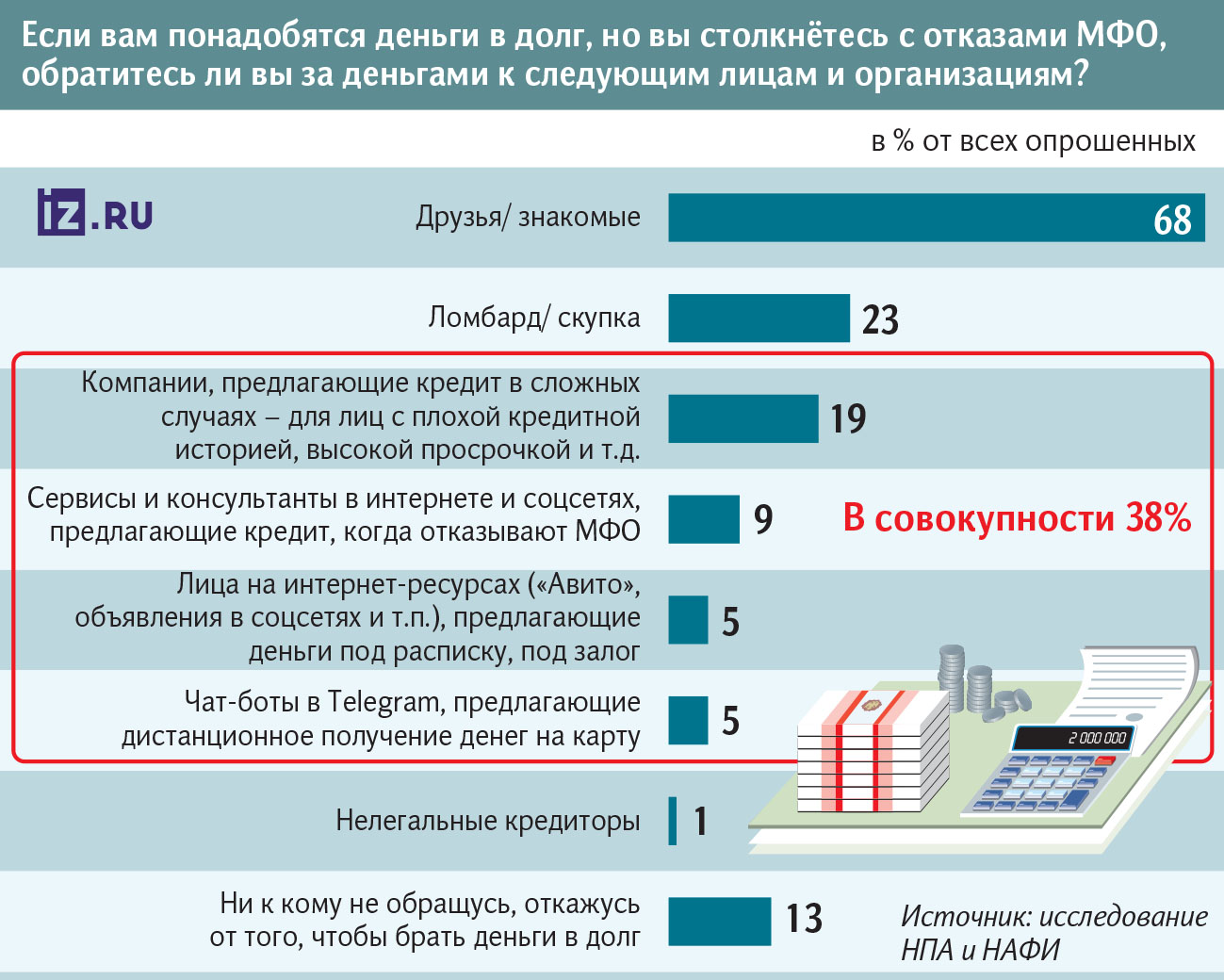
The interest in illegal lenders is largely due to stricter requirements for borrowers, said Vasily Kutyin, Ingo Bank's Director of Analytics. According to him, the share of refusals on applications from both banks and MFIs already exceeds 80%. As a result, clients find themselves in a situation where legitimate sources of money are closed to them, and begin to look for alternatives.
The risks of shadow lending growth
Stricter regulation in the MFI segment reduces the availability of loans, follows from the materials of the NPA and NAFI. First of all, this applies to those who already have a high debt burden or cannot confirm income.
From 2027, banks and MFIs are planned to be prohibited from taking into account unconfirmed incomes indicated by the borrower when calculating the debt burden. This will further complicate the issue of loans to customers without a "white" salary. Such a bill has already been submitted to the State Duma.
This is especially sensitive for citizens with informal employment and migrants. According to estimates by market participants, from 20 million to 30 million Russians cannot fully confirm their income, and among newcomers this share reaches 80%. In addition, to start working in Russia, they need to pay a significant amount (for paperwork and medical examinations). Even before receiving his first salary, Oleg Abelev, head of the analytical department of IC Rikom-Trust, noted. At the same time, access to legal loans will become unavailable to them.
According to preliminary estimates, at the beginning of 2026, there were about 5-6 million foreign citizens in Russia, Rikom-Trust emphasized. About 70% periodically need additional funds, which creates a significant risk zone — up to 3 million people. Low levels of financial literacy and poor language skills also increase the likelihood of falling into shady schemes.
In these circumstances, the NPA proposes to mitigate the planned innovation and allow MFIs to issue small loans without a proven income. And also to expand the methods of assessing borrowers' solvency. We are talking about using data from government systems and statistics on average incomes in the regions.
The initiative is still being discussed, but one option is to allow MFIs to give Russians loans of up to 30,000 rubles without an official salary, said Maria Mikhailova, executive director of the NPA. Such measures can keep clients in the legal field and prevent them from switching to black creditors.
How Black Lenders Work
Contacting illegal immigrants is associated with serious threats to clients, Vasily Kutyin noted. In general, the risk of fraud is high here: the borrower may not receive the money or face fictitious debts. If the money is given out, the rate may be overstated and payments increased due to hidden conditions.
Collection methods pose a separate danger. Black creditors can use pressure, threats, and other illegal ways to refund funds. In addition, schemes are common in which the borrower risks losing property, for example, when signing a contract under the guise of purchase and sale instead of collateral.
Illegal lending is also linked to criminal practices, including the activities of "black collectors," said Natalia Milchakova, a leading analyst at Freedom Finance Global. In some cases, we are talking about direct threats to the safety of borrowers and their loved ones.
— There are stories when illegal lenders took cars when issuing a loan of several hundred thousand rubles that was not comparable in size. Having concluded a deal with such a person, you can be left without an apartment, including the only one, become a victim of aggressive methods of collection and attacks on close relatives," warned Alla Khrapunova, deputy project manager of the Popular Front For Borrowers' Rights.
The responsibility for illegal creditors remains insufficient to curb their activities, the press service of the SRO MIR noted. Fines for illegal loans range from 300 thousand to 1 million rubles and often come out significantly less than the income that such activities bring.
It is necessary to strengthen responsibility not only for illegal creditors, but also for "black collectors," Natalia Milchakova believes. At the same time, the Bank of Russia continues to fight against such market participants: in 2025, the regulator identified more than 1,000 organizations with signs of illegal lending activities, and their websites are blocked through Roskomnadzor.
According to Maria Mikhailova from the NPA, there is no need to create a situation in which borrowers cannot receive funds legally and are forced to turn to illegal lenders. Stricter regulation creates risks of an outflow of clients from MFIs, which creates real threats to the market — this factor must be taken into account when developing legislation, the expert concluded.
Переведено сервисом «Яндекс Переводчик»
