- Статьи
- Economy
- There is no dispute about the rates: the budget loses over 100 billion a month due to the strong ruble

There is no dispute about the rates: the budget loses over 100 billion a month due to the strong ruble

The dollar has dropped below 71 rubles for the first time since the beginning of 2023, and the Russian currency has become the best in the world since April, according to Bloomberg. But what looks like good news for the population is becoming a problem for the economy: every ruble strengthening in excess of the budgeted exchange rate costs the treasury 100-150 billion rubles per month, experts interviewed by Izvestia said. However, such a ruble has advantages: it helps to curb price increases and makes foreign trips more affordable. Why the Russian currency has strengthened its position so dramatically and how long it will last is in the Izvestia article.
Why is the ruble strengthening
On May 19, the estimated dollar exchange rate, which serves as a benchmark for the over-the-counter market, fell below 71 rubles for the first time since February 2023. Since the beginning of April, the Russian currency has strengthened by about 12%. As Bloomberg reported, the ruble became the best currency in the world in terms of dynamics against the dollar this quarter. Izvestia sent a request to the Central Bank.
The strengthening of the ruble is associated with several reasons at once. In April, Urals crude oil rose in price to almost $95 per barrel, 23% higher than March levels. At the same time, amid tensions in the Middle East, the largest exporters tripled their sales of foreign exchange earnings to $7.3 billion, Denis Astafyev, founder of the SharesPro fintech platform, recalled.

Additional support for the national currency is provided by weak demand for dollars and yuan. Exporters are actively selling the proceeds, including for paying taxes, while imports remain restrained due to high prices. In addition, about 60% of payments are already made in rubles, Denis Astafyev noted. According to him, the Central Bank's harsh policy has made Russian assets more attractive and reduced interest in foreign money.

At the same time, a strong ruble is becoming a problem for exporters and the budget. Companies receive less rubles for the sale of oil, metals, fertilizers and agricultural products, while the main costs — salaries and other costs — remain high, the expert noted. According to his calculations, the strengthening of the exchange rate by one ruble reduces treasury revenues by about 100 billion per month.
Denis Astafyev gave a similar assessment: each ruble of strengthening relative to the budgeted level costs the treasury about 110 billion per month. Anton Tabakh, chief economist at the Expert RA rating agency, put the figure at about 150 billion. At the same time, the increase in oil prices partially compensates for the shortfall in income, he stressed. According to the expert, metallurgists, coal miners and part of the agricultural sector suffer the most from the expensive ruble.

Earlier, the Ministry of Energy revised the forecast of the average exchange rate for 2026 to 81.5 rubles per dollar instead of the previous 92.2. However, even this estimate assumes a weaker ruble compared to current values.
The ministry told Izvestia that the strengthening of the ruble creates difficulties for exporters, so the authorities are discussing measures to support such industries. The Ministry of Economy also stressed that the impact of the exchange rate on inflation is reduced due to calculations in national currencies and import substitution.
How a strong ruble affects prices
A strong ruble carries more risks than advantages for the Russian economy, says Alexander Potavin, an analyst at Finam Financial Group. At the same time, it helps to contain inflation in the short term: imported goods and raw materials become cheaper, which means that pressure on prices decreases.
However, the effect does not appear immediately. According to Alexander Potavin, prices in stores usually respond to a change in the exchange rate with a delay of one to two months, since some of the supplies have already been paid at a higher rate. Goods with a high proportion of imports are becoming cheaper the fastest — electronics, household appliances, medicines, clothing and auto parts.

The situation is favorable for importers, but consumers will not see a rapid reduction in the cost of goods, as companies continue to add rising costs to the cost, said Natalia Pyrieva, head of the analytical department at Digital Broker.
It is now profitable to buy foreign currency before a vacation, but you should not expect a rapid decline in import prices, the founder of Rodin warned.Capital Alexey Rodin.
A strong ruble may also push the Central Bank to further reduce the key interest rate, as it weakens inflation risks, Alexander Potavin added.
The winners are importers, retailers, pharmaceuticals and some IT companies, whose revenue is in rubles, and some of the costs are linked to the currency. However, the situation remains difficult for exporters. Oil and gas companies, metallurgists and the chemical industry receive less rubles for their products at the same cost within the country, the expert noted. If the Russian currency remains strong for a long time, part of the business may reduce investments and slow down the hiring of employees.

At the same time, the ruble exchange rate is still formed in a market way - through supply and demand, said Alexander Abramov, head of the Laboratory for the Analysis of Institutions and financial markets at the Presidential Academy. According to him, this avoids a situation with multiple exchange rates.

How much will a dollar cost in 2026
Despite external restrictions, the authorities and the Central Bank manage to keep the situation under control, Alexander Abramov believes. According to him, in the future, the ruble is likely to gradually weaken as investment activity recovers and the key interest rate decreases. The expert explained that the revival of lending and the growth of business investments will lead to an increase in investment imports, and hence demand for foreign currency.
At the same time, such a weakening of the ruble will occur against the background of economic growth and will not be a negative signal for the economy. According to Alexander Abramov, by the end of the year, the exchange rate may stabilize at about 75 rubles per dollar.
Alexander Potavin from Finam believes that the market may see minimum dollar values as early as the end of May — up to 70 rubles. However, such a rapid strengthening of the national currency, reaching 1.5% per trading session, indicates a high proportion of speculative transactions. Therefore, it is difficult to predict the exact minimum of the exchange rate now, the expert noted. According to him, any significant events can become the reason for the reversal, for example, a decrease in oil prices in the case of agreements between the United States and Iran.

Natalia Pyrieva from Digital Broker shares a similar opinion. She believes that in May-June, the ruble can still maintain a strong position due to expensive oil, but the market does not expect further strengthening significantly below 70 rubles per dollar. In the second half of the year, a reduction in the key interest rate and a possible stabilization of the situation in the Middle East may lead to a weakening of the exchange rate to 75-80 rubles per dollar.
Sofia Donets, Chief Economist at T-Investments, noted the growing interest of investors in foreign currency bonds. According to her, the current strengthening of the ruble seems unstable to many: the inflow of currency from expensive raw materials may decrease if the situation around Iran stabilizes. In addition, in June, the Ministry of Finance is likely to increase purchases of foreign currency under the budget rule, which will make the market more balanced. Therefore, currency instruments now look attractive to investors, the expert believes.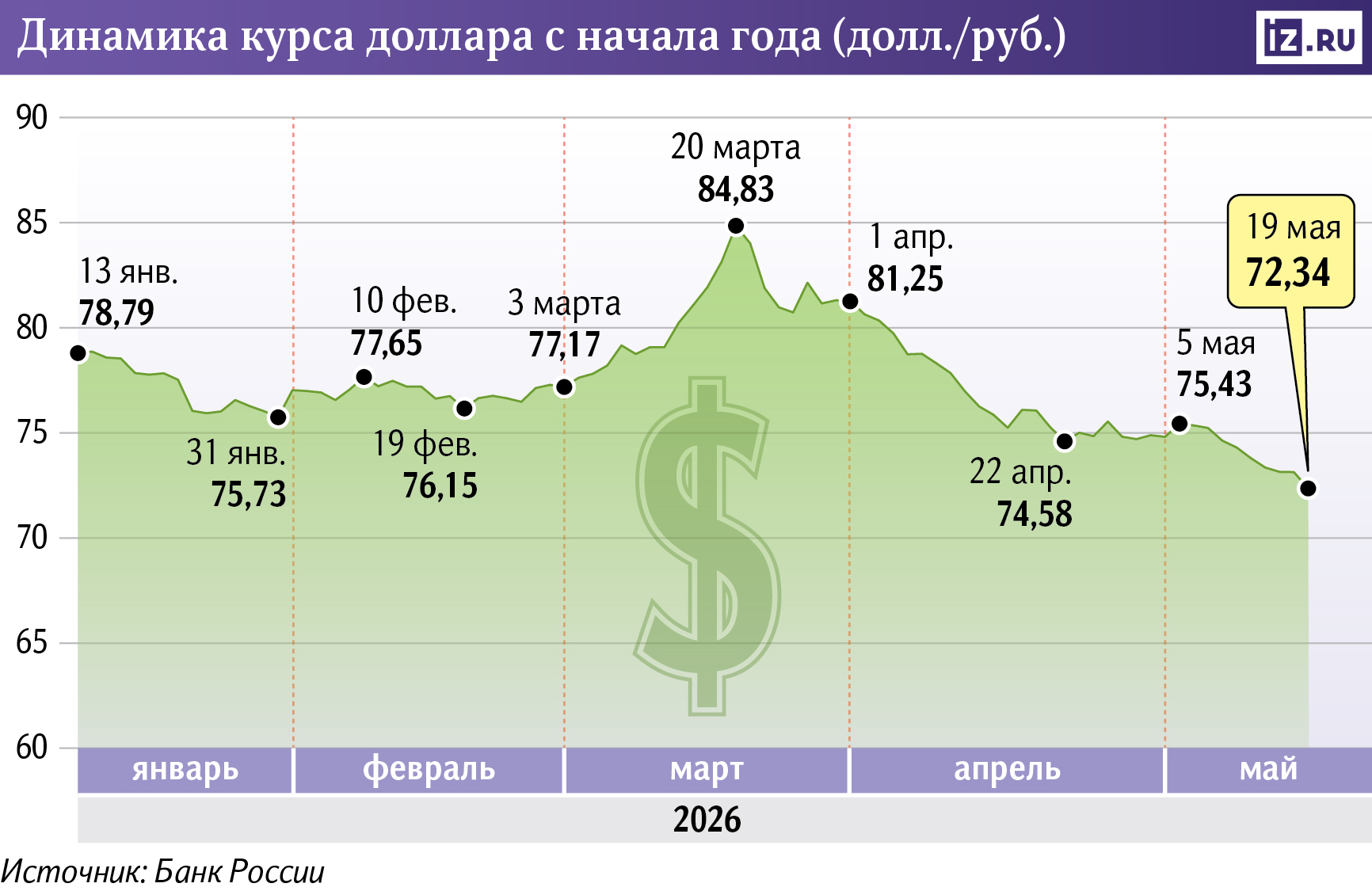
In general, experts agree that the current strengthening of the ruble is temporary, and in the second half of the year, the exchange rate is likely to gradually weaken.
Переведено сервисом «Яндекс Переводчик»
