- Статьи
- Science and technology
- Both into the forest and for firewood: Russia's first mass-produced all-terrain vehicle will help rescuers in search operations

Both into the forest and for firewood: Russia's first mass-produced all-terrain vehicle will help rescuers in search operations

Russian engineers have developed a new model of an economical wheeled all-terrain vehicle, which is expected to enter mass production in the near future. The creators expect that mass production will ensure quick repairs, availability of spare parts and low operating costs. With an engine power of 100 hp, the all-terrain vehicle consumes about 4-6 liters of fuel per hour, and large wheels with low pressure ensure confident movement on almost any hard surface. According to rescuers, they are interested in such equipment, provided that its reliability is confirmed, however, experts note that a more powerful machine with increased load capacity may be required for full-fledged operation in remote areas.
The first production all-terrain vehicle
Specialists from the Irkutsk Tracked Vehicle Plant have developed a new model of MR-2 all-terrain vehicle with low-pressure tires. This is the first domestic car of this class to be mass-produced. Thanks to mass production, the developer will be able to quickly supply spare parts to users, which should significantly simplify and speed up repairs. At the same time, the wheeled design makes the operation of the machine noticeably cheaper compared to tracked counterparts. The all—terrain vehicle combines a power of 100 hp with economical fuel consumption of only 4-6 liters per hour.

— To bring the car to the market today, it was necessary to start designing it five years ago. That's how long it took to work on the new all-terrain vehicle. The experience of our previous developments formed the basis of the new MR all—terrain vehicle: two years of testing confirmed its reliability, and the entire journey, which cost us over 400 million rubles, allowed us to select optimal design solutions and components that currently have no analogues," Alexander Gorin, head of the Irkutsk Tracked Vehicle Plant, told Izvestia.
Until now, the market for such all-terrain vehicles in Russia consisted of single models produced by small enterprises. The repair of such machines was often delayed for months, waiting for details and feedback from the manufacturer. The machines were made by special order — they all differed from each other and did not have unified solutions, which created difficulties for end users. The only company that mass-produced such equipment was the foreign Sherpa, but now its machines are practically unavailable for purchase in Russia. The developers claim that the MR-2 has become an improved analogue of these models: the plant's own team of designers and engineers worked on the project.

Unlike many similar models, the MR-2 does not use outdated units such as the main transmission and on-board gearboxes from the GAZ-71, which complicate and make the machine heavier. The developer uses only new components, which means that the ROVER will not be idle for a long time due to a shortage of spare parts. The planned service life of the machine is comparable to its analogues and even exceeds them due to the abandonment of used components.
The MR-2 is capable of carrying up to 1 ton of cargo or up to eight passengers, it is equipped with an intuitive control system with a steering wheel and an integrated on-board computer, and uses high-resolution cameras with a wide viewing angle instead of mirrors. Additionally, air ducts are provided to prevent the windows from freezing.

Fully Russian development
All components of the MR-2, with the exception of the engine and manual transmission, are of domestic production. At the same time, even imported components have certificates in the Russian Federation and are widely used in the automotive industry. The rest of the components, including transmission elements and load-bearing systems, are manufactured by the plant itself.

The all-terrain vehicle is suitable for working on all types of surfaces: sand, stone placers, swamps, windbreak, ice, snow. The MR-2 stays safely on the water. According to the developers, it can be used in any branch of the national economy and industry — for expeditions, rescue operations, delivery of goods and people in the oil and gas sector, housing and communal services, forestry, hunting and tourism enterprises, as well as in the structures of the Ministry of Emergency Situations. The temperature range is -40 to +40 degrees.

As rescuer Maxim Shtyb explained, special services really need a new domestic all—terrain vehicle and the main requirement for it is reliability.
"Such a machine is definitely needed if it is really reliable, because rescuers are engaged in search operations, for example, in forests or in adjacent territories," he told Izvestia.

This development is very promising, as it is aimed at solving the most acute problem of the Russian market — the lack of a mass-produced maintainable all-terrain vehicle with ultra-low pressure tires, which would be available without the risks associated with cooperation with foreign manufacturers. The project has a high chance of being in demand, as it solves several key tasks at once, said Igor Mishin, an expert at the National Technology Initiative (NTI) Avtonet.
— The main advantage of the development is serial production and unification, which increases maintainability compared to current "garage" units. The MR-2 model completes the task of import substitution in the niche of light floating all—terrain vehicles for hunting, exploration and tourism," he added.

The prospects are enhanced by the fact that the snowmobile and all-terrain vehicle market in the country is showing steady growth and a trend towards import substitution, the specialist emphasized.
The development will not be able to become a universal vehicle for the national economy in remote areas, as this requires a much larger load capacity. At the same time, the abandonment of unified parts from old equipment, of which there are many left in warehouses, can complicate repairs, added Konstantin Sorokin, an Autoreview columnist.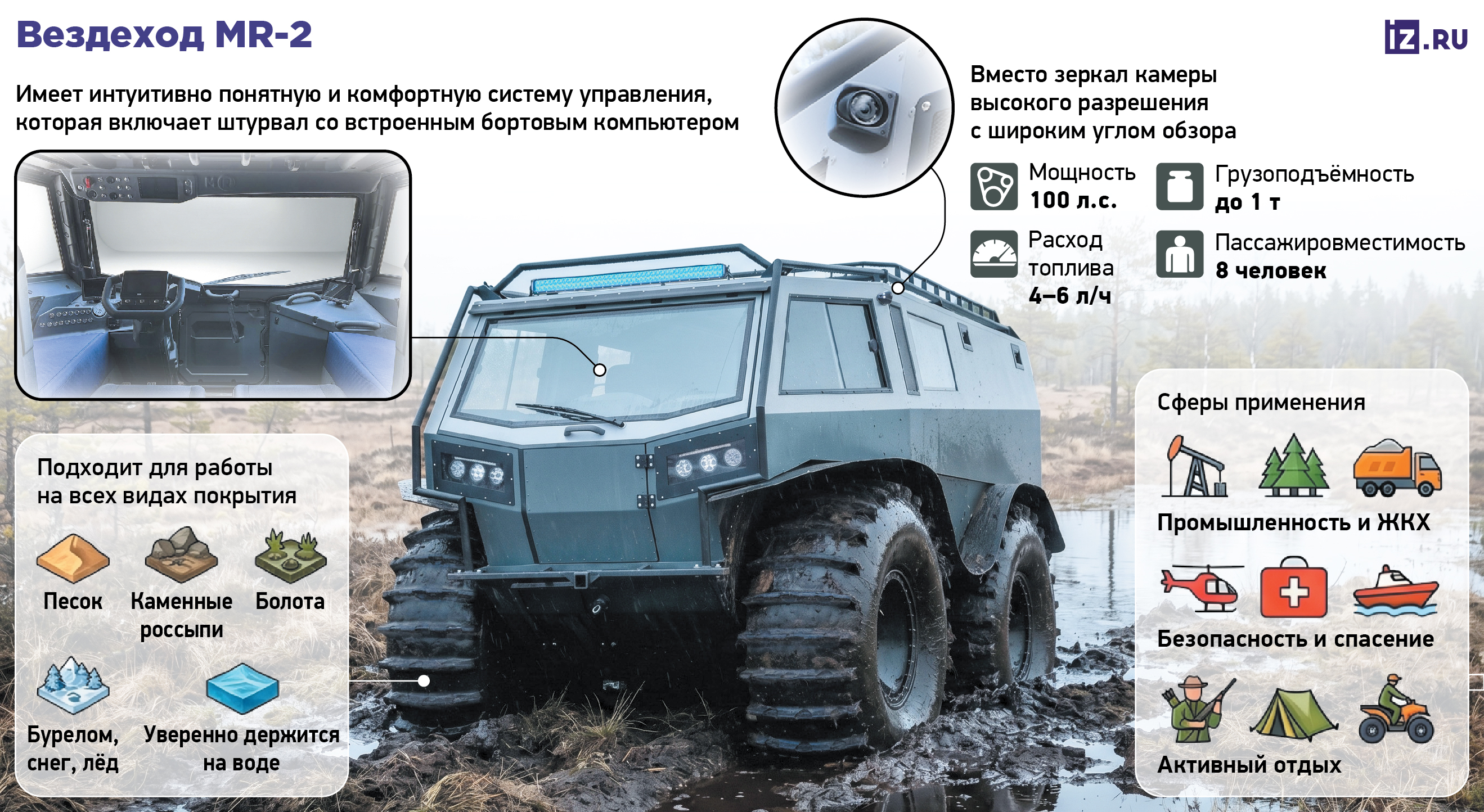
Переведено сервисом «Яндекс Переводчик»
