
Cold wave: The West is working on deterring Russia in the Baltic

The West uses the Baltic region as a platform for testing Russia's deterrence, Russian Deputy Foreign Minister Alexander Grushko told Izvestia. According to him, now they are trying to transfer this scenario to the Arctic: the previous mechanisms of regional cooperation with the Russian Federation have been destroyed or frozen, and Kiev is increasingly being connected to NATO's Northern European strategies. In particular, the Ukrainian military joined the exercises in Sweden, where they practiced repelling the attack of an "unnamed country." The West now links any interaction with Russia in the Arctic and the Baltic with the settlement in Ukraine, the diplomat added. At the same time, despite talks in Europe about possible contacts with Moscow, the general degree of confrontation is likely to remain in the near future, experts say.
Tensions in the Baltic region
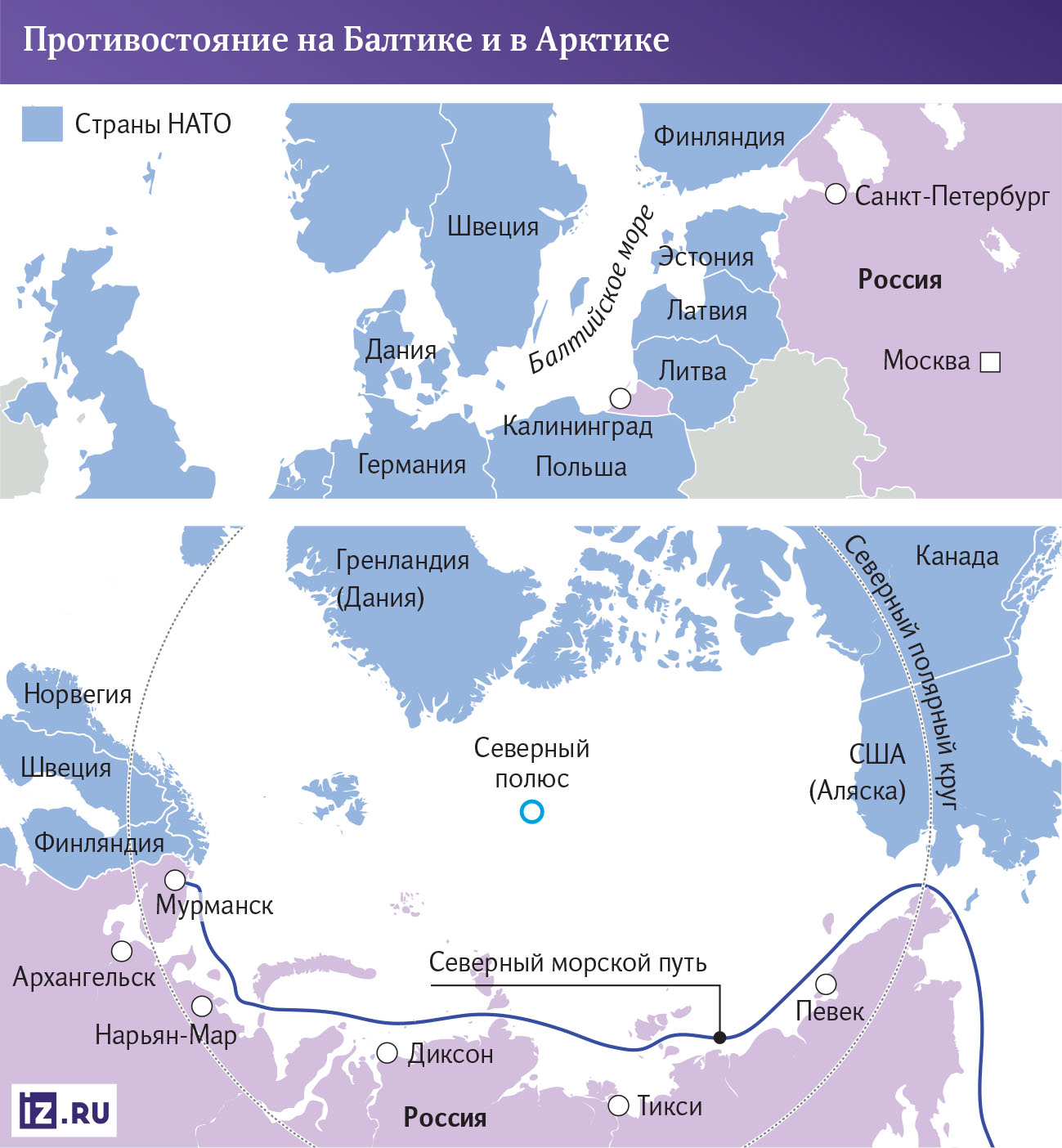
The Baltic region has recently consolidated its status as one of the most tense zones in which the interests of Russia and Europe clash. The countries of the region and their NATO allies regularly accuse Moscow of violating their airspace and threatening their security. Russia, in turn, rejects these accusations and clearly points to the militarization of the region, the strengthening of the alliance's military infrastructure near its borders and the growing number of exercises with anti-Russian scenarios. However, this was not always the case.

— The region was the most peaceful militarily. There were no conflicts, neither frozen nor unfrozen. There were no prerequisites for increasing tension at all. The Baltic region is now being used by the West as a laboratory [to study] how to escalate the situation and how to restrain Russia from various regional and geographical directions," Russian Deputy Foreign Minister Alexander Grushko told Izvestia.
In recent months, military activity in the region has become even more intense. Poland and France are to conduct joint maneuvers over the Baltic Sea and in northern Poland. According to media reports, French Rafale fighters are involved in them, and the scenario includes testing elements of nuclear deterrence and strikes against targets in Russia and Belarus. The Russian Foreign Ministry called such plans an outright provocation, while the Kremlin pointed out that such scenarios do not contribute to stability on the European continent.

However, clouds are gathering over the Baltic Sea not only because of the exercises. The West is also increasing pressure on maritime logistics. A year ago, the Estonian parliament approved amendments to the laws on the Defense Forces and on the economic zone, granting their Armed Forces the right to sink suspicious civilian vessels. In 2026, regional countries have already begun to inspect and detain them more often. As a result, Russian warships began escorting individual tankers across the English Channel and the Baltic Sea.
Ukraine is already involved in deterring the Russian Federation. In May, drone operators participated in the Swedish Aurora 26 exercises, which took place, among other things, on the island of Gotland in the Baltic Sea. According to NATO, the maneuvers gathered more than 18,000 troops from 13 countries, and the Ukrainian military helped practice repelling the attack of an "unnamed country."

This interest of NATO in the Baltic region is due to several factors. First of all, it is geography: the region is located at the junction of Russia, Scandinavia and Central Europe. Secondly, the Kaliningrad region, where the Russian military infrastructure is located, is of particular importance to the alliance. However, there is a simpler explanation — the specifics of local countries.
— For various historical, political and other reasons, they have taken perhaps the most radical positions towards Russia, which greatly influences decisions in Brussels. The countries of the region are practically on the line of confrontation with Moscow, unlike, for example, Bulgaria, Romania or Turkey in the Black Sea basin, which do not have direct borders with Russia," Andrei Kortunov, an expert at the Valdai Club, told Izvestia.
The Baltic states are trying to use this position to raise their status in Europe. Therefore, they sometimes take not just tough, but radical positions regarding relations with Moscow, he added.
 However, with their policies, they create problems not only for Russia, but also for themselves. In the spring of 2026, Ukrainian drones appeared several times in the Baltic States and Finland after flying through Russia. Literally on May 7, two suspected Ukrainian UAVs entered Latvian airspace: one of them exploded at an oil depot in Rezekne. This worsened the political crisis that was beginning in the country so much that Prime Minister Evika Silin resigned, having previously dismissed the Minister of Defense.
— Now they are getting closer to the Arctic, different coalitions are being created. This is, of course, a very worrying development. And this development, this line, is completely inconsistent with the fundamental interests of the state and the peoples who are members of the Arctic Union," Grushko stressed. — I can't help but recall the slogan of the Norwegian presidency (in the Arctic Council. — Ed.): high latitudes — low tension. These words sound very beautiful, but in fact, the practical line pursued by our Western enemies is to turn the Arctic into an arena of military confrontation.

Deterring Russia in the Arctic
First of all, the Baltic and the Arctic are geographically connected. Moreover, for the northern NATO countries, this is a single military planning space — from the Baltic Sea and the island of Gotland to Norway and Finland. After Finland and Sweden joined NATO, the alliance received an almost continuous northern flank near the Russian borders, and the Baltic and Arctic began to be considered as interrelated areas of containment of the Russian Federation. The strategically important Kola Peninsula, where Russia's Northern Fleet is based, is located in the region. The West is also looking for ways to control the development of the Northern Sea Route, which will strengthen at least the logistical capabilities of our country.

Elements of Russia's deterrence are already being used in the Arctic, including through exercises. In February 2026, NATO launched Operation Arctic Sentry, which is explicitly described as strengthening deterrence and defense in the Arctic and the Far North. In March, similar exercises "Cold Response" took place in Norway and Finland.
At the same time, it is not only the European countries of the alliance that are engaged in deterring the Russian Federation in the Arctic. Canada's defense documents also focus on protecting sovereignty in the North, modernizing Arctic infrastructure, and developing NORAD, the combined aerospace defense system of Ottawa and Washington. For the United States, however, Greenland is most important as the country's anchor point in the Arctic. The Pituffik base is already located on the island, which is associated with missile attack warning, missile defense and space surveillance. In addition, Washington intends to create elements of the future Golden Dome missile defense system there.
Russia can respond to potential threats by maintaining and expanding the same capabilities of the Northern Fleet, developing infrastructure on the Kola Peninsula, and strengthening control over air and sea space. At the same time, Moscow emphasizes that it does not abandon cooperation in the Arctic, but will respond to attempts to turn the region into an arena of military confrontation.

What really needs to be done in the Arctic is to develop international cooperation, due to the harsh conditions, significant natural resources and the relatively low level of military tension in the region. Russia's task is to preserve this character of the region if Western partners are ready for such an approach, Grushko said. However, according to the diplomat, in reality they lead a completely opposite line.
— The situation in the Arctic is gradually changing — unfortunately, for the worse. If this continues, the difference between the Baltic and the Arctic will gradually fade," Andrei Kortunov also emphasized.

The mechanisms of regional cooperation that used to connect Russia and Europe in the northern direction have been practically destroyed. One of these formats was the Northern Dimension, a mechanism for cooperation between the EU, Russia, Norway and Iceland. Through him, projects in the fields of ecology, transport, healthcare, culture, cross-border development and nuclear safety were developed. After 2022, the EU, Norway and Iceland froze work with Russia's participation, and in September 2025 they officially announced the closure of the format.

The work is still being continued by the Arctic Council, which acts as the main platform for coordinating the policies of regional states: Denmark, Iceland, Canada, Norway, Russia, the USA, Finland and Sweden. The Council deals with issues of sustainable development, ecology, climate, scientific cooperation, support for indigenous peoples, safety of navigation and emergency prevention. At the political level, his work has remained frozen since 2022, but since 2024, the interaction of working groups in a virtual format has been gradually restored.
The dialogue with the EU rests on Ukraine
At the same time, the EU is once again talking about possible negotiations with Moscow. Finnish President Alexander Stubb said it was time for Europe to start a direct dialogue with Russia. It is noteworthy that Western politicians began to discuss not only the possibility of contacts, but also the steps necessary to start them. According to media reports, discussions are currently underway about who could act as an intermediary.

Moscow has never rejected dialogue with Europe, and it is still allowed. Answering questions from journalists on May 9, Russian President Vladimir Putin said that for him personally, former German Chancellor Gerhard Schroeder would be the preferred negotiator from Europe. At the same time, Putin noted that the Europeans themselves should choose a leader whom both sides would trust.

Former German Chancellor Gerhard Schroeder
Schroeder's candidacy was not supported in Europe. Moreover, the EU still does not have a unified position on negotiations with Moscow. According to the head of the European Diplomacy, Kai Kallas, such contacts cannot bypass Kiev. According to Moscow, it is precisely this combination that is blocking the restoration of regional cooperation.
— The West links everything to the Ukrainian settlement. This is an absolutely artificial link. Especially when it comes to regional cooperation mechanisms. If we talk about the European Union, then all those numerous instruments of such cooperation have either been destroyed or frozen," the Russian Deputy Foreign Minister told Izvestia.
Ilya Shcherbakov, a member of the presidium of the Council of Young Political Scientists of the Russian Association of Political Science, believes that a quick return to the previous formats should not be expected. In the foreseeable future, even a partial restoration of regional cooperation between Russia and Europe remains unlikely — at least the EU continues to impose sanctions packages. Despite statements by individual European politicians about their readiness for dialogue with Russia, the general degree of confrontation is likely to remain.
Переведено сервисом «Яндекс Переводчик»
