- Статьи
- Economy
- Following in the footsteps of fathers: they want to catch alimentarians in cars and collect debts from them at night

Following in the footsteps of fathers: they want to catch alimentarians in cars and collect debts from them at night

It will become more difficult for non—payers of alimony to hide - now they want to be caught on cameras on the roads, and bailiffs can be allowed to work on such cases even at night and on weekends. The Accounting Chamber has prepared similar recommendations to the government (Izvestia has a report). At the same time, the punishment is also getting tougher: those who hide their incomes and are not officially employed are more often sent to forced labor in special centers. At the same time, the authorities are also intensifying the fight against shadow earnings. The effect of other measures is already noticeable: in three years, alimony fees have more than doubled to 110 billion rubles in 2025. Why, despite this, the system is still malfunctioning is in the Izvestia article.
How will alimony workers be punished?
In Russia, parents are required to support minor children, regardless of whether they are married or have a job. Alimony can be paid by agreement or through a court, but in practice, the second, compulsory mechanism most often works.
According to the Accounts Chamber, the number of enforcement proceedings for alimony decreased from 1.6 million in 2022 to 1.5 million in 2024. At the same time, the share of cases where money was actually recovered increased from 8% to 10%. However, the gap between completed and unfinished cases is still large, the auditors note.

The most efficient way to recover is to withhold money from wages or other income, according to the Joint Venture report. But it does not work if the person is not officially registered or hides the receipt of funds. Difficulties also arise with new income formats — for the self-employed, on platforms (marketplaces, taxis) or through electronic wallets, since such income is more difficult to track.

To increase the collection of alimony, the Accounting Chamber suggested that the government strengthen the work of bailiffs. In particular, to allow them to collect debts on non—working days and at night - from 22:00 to 6:00. Another measure is to give the Federal Bailiff Service (FSPP) access to the Web system, which tracks the movement of cars. Currently, the lack of real-time data is hindering the search: in three years, a little more than half of the debtors and only 8% of their cars have been found, the auditors note.
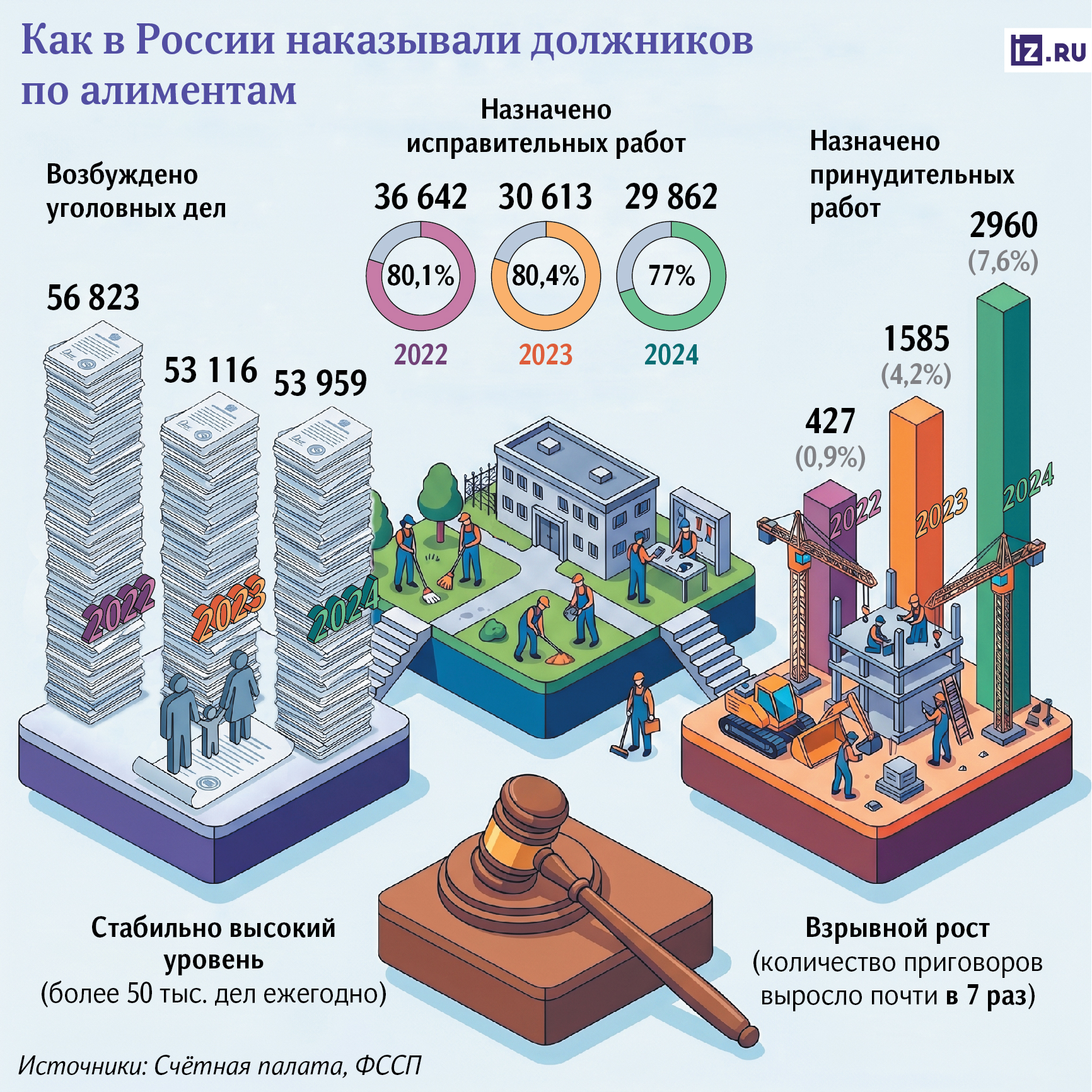
Currently, fines, penalties, as well as administrative and criminal liability are provided for non-payment. In criminal cases, more than 80% of punishments are correctional labor. They take place without isolation — usually a person serves them at the place of their main job and deducts part of their salary to the state, but debtors often evade them, the joint venture notes.

Auditors consider forced labor to be a more effective measure. In this case, the person lives in a special center, works (for example, at a construction site, factory or street cleaning) and directs the salary to repay the debt. So far, such punishments are rarely imposed — from 1% in 2022 to 8% in 2024. But starting in 2026, the situation should change: forced labor has become an independent form of punishment, the joint venture recalled.
This position is supported by the FSPP. Expanding the practice of forced labor will increase the collection of alimony, said Olga Pomigalova, first deputy director of the service, in response to the auditors. According to her, the service has long proposed such changes.
Since January 2026, new rules have come into force: correctional labor is assigned only to those who have an official job. If it is not available, the court may send the debtor to forced labor, Olga Pomigalova explained. This applies to those who do not have a stable income, abuse alcohol or consciously do not get a job, she said.
The first results are already visible. According to the service, in the first quarter of 2026, the courts ordered forced labor in 13% of cases (744 out of 5.7 thousand sentences) against 8.5% a year earlier. In addition, bailiffs are strengthening cooperation with employment centers and plan to involve commissions to combat shadow employment in order to identify hidden incomes.

Additionally, other measures have been taken. In 2025, a register of alimony debtors was created - there are already more than 300 thousand people in it. Also, in the regions where there are the most "fugitives", special units have been opened that deal only with such cases.
These steps are yielding results: according to the FSSP, the amount of alimony collected has increased from 48 billion in 2022 to 110 billion by the end of 2025.

How debtors avoid paying alimony
Debtors today adapt quickly and find ways to hide their income, said Alla Georgieva, a civil lawyer. The most common option is a gray salary: a person is issued at the minimum rate, and receives the rest in cash, which is why the real amounts are not visible.
Another scheme is to withdraw money to other people's accounts. According to Alla Georgieva, debtors ask the employer to transfer salaries to the card of relatives or acquaintances. Technically, this is legal, but it avoids being written off by bailiffs.

Sometimes they use more radical methods — they change their last name or move. And when bailiffs visit, they declare in advance that the equipment and valuables do not belong to them, but are registered to others. This helps to avoid the seizure of property, the lawyer noted.
In general, the alimony collection system does not work efficiently enough and requires more modern solutions, Alla Georgieva believes. Bailiffs are overloaded with routine work that can be automated. She gave an example: the case of collecting alimony from a father hiding income dragged on for more than six months due to endless requests to the tax service and was eventually closed after the child reached adulthood.
Although the indicators are improving, this is not enough. Even with the increase in penalties, the procedure itself remains complex and costly. At the same time, standard measures such as the seizure of accounts or a ban on departure often do not work: debtors bypass them through other people's cards and cash, the expert emphasized.
Additional measures are proposed by family lawyer Mikhail Lisin. He believes that all defaulters should be included in the register of debtors, not just those brought to justice. He also suggests considering the possibility of withdrawing even a single home or a share in it on account of debt.

Another problem is the difference between regions. In large cities, it is easier to find debtors thanks to cameras, whereas in small towns they often go unnoticed, Alla Georgieva noted. In her opinion, digital search systems need to be scaled to the whole country.

In addition, cost control would help to increase income transparency, says Meri Valishvili, Associate Professor at Plekhanov Russian University of Economics. According to her, it is ineffective to focus only on the official salary: many show the minimum, but spend more. The service of the Federal Tax Service "My checks Online" can help in this: if bailiffs get access to it, it will be possible to prove real expenses and use this data in court when calculating alimony.
Переведено сервисом «Яндекс Переводчик»
