
Cash transfer: 15% of Russians keep all their savings "under the mattress"

One in seven Russians keeps all their savings in cash, a study by NPF Future and the GraFin project showed. Many citizens do not trust banks, fearing blockages, and prefer the reliability of profitability. At the same time, the volume of cash on hand is also growing: in March alone, it immediately increased by 300 billion rubles against the background of mobile Internet outages. The authorities, in turn, are strengthening control over settlements — starting in 2027, the tax service will be able to receive data on individuals' accounts from the Central Bank. Why it is unsafe to keep savings at home and what tools you should pay attention to so that money does not devalue - in the Izvestia article.
Why cash is becoming more popular among Russians
The volume of cash in circulation in Russia increased by 300 billion rubles in March. This is noticeably higher than in previous years, according to the Central Bank data. As a result, the figure reached 19.5 trillion rubles.
Surveys also confirm interest in cash. Thus, 15% of Russians keep all their savings "under the mattress," according to a March study by NPF Future and the GraFin project (Izvestia has it). At the same time, securities remain the main instruments of savings (29% of respondents named them), gold and precious metals (25%), bank deposits (18%), and another 13% choose real estate.
The reason for the growing popularity of cash may be interruptions to the mobile Internet, the Central Bank said. Because of this, citizens and businesses are forming a reserve of money for everyday payments. The editorial board sent a request to the regulator.

The vulnerability of non-cash payments against the background of failures has become obvious, said Denis Astafyev, founder of SharesPro. According to him, people are afraid that they may lose access to their accounts at a critical moment. The situation is exacerbated by fluctuations in currencies and markets — against this background, cash is perceived as a "safe haven". In addition, the low level of financial literacy is affected.
This is confirmed by the survey: for almost half of the respondents, the profitability of investments does not matter. At the same time, a quarter does not understand what it is, and 22% prioritize the safety of funds rather than their increase.

For some of the population, cash remains the basic payment tool — in remote and rural areas with limited access to banking services, it is often the only reliable payment method, said Nina Gukasova, director of the Financial Literacy program at IGSU RANHIGS.
An additional factor may be the tax on interest on deposits, which has been renewed since 2024, said Natalia Milchakova, a leading analyst at Freedom Finance Global.

Distrust of the financial system also plays a role, added Artur Galyautdinov, director of the Finam Training Center. According to him, the behavior of Russians is still influenced by the experience of previous years related to the loss of savings. In addition, the habit of keeping money in cash remains, especially among the older generation, said the Associate professor of the Russian University of Economics. Plekhanova Maria Ermilova. She added that citizens are also afraid of restrictions on withdrawals and account locks.
Additional vigilance is reinforced by plans to tighten control. So, in April, it became known that starting in 2027, transfers to individuals in excess of 2.4 million rubles per year may come under the attention of tax authorities: the Federal Tax Service and the Central Bank plan to establish automatic data exchange on accounts of citizens with unconfirmed incomes. The measure is aimed at combating informal entrepreneurship.
What will happen to the cash next
The ruble remains the basis of Russians' savings, said Nina Gukasova, Program Director at the RANEPA. According to the Central Bank, as of November 2025, 95% of individual deposits were in rubles, and this is a record in history.
At the same time, interest in the currency remains, Nina Gukasova added. According to the regulator, in the first half of 2025, the volume of foreign cash in the population increased by $1.4 billion to $94 billion, which may indicate devaluation expectations.

There is an increasing interest in alternatives, said Maria Ermilova from the Russian University of Economics. Plekhanova: the focus is on the yuan and other currencies as a way to diversify.
Further cash growth is possible, but will be limited, says Denis Astafyev of SharesPro. According to him, on the one hand, risks remain — disruptions and economic uncertainty. On the other hand, the government promotes cashless payments, banks offer profitable deposits, and fintech simplifies money management.
As Izvestia wrote, the Central Bank expects a further increase in cash in circulation. In the baseline scenario, the regulator predicts an increase of 22% in the next five years to 24 trillion rubles, in the risk scenario — by 35% to 27 trillion rubles.
The authorities are already preparing a response to this challenge. As part of the structural change plan until 2030, the government is developing measures to whitewash settlements, including control over cash turnover and their export abroad. Deputy Prime Minister Alexander Novak previously spoke about the need to encourage the transition to cashless payments. Vladimir Putin also called for increased control over the circulation of cash at a meeting of the Council for Strategic Development and National Projects in December 2025.

The prospects for storing funds in cash are limited, according to Natalia Milchakova from Freedom Finance Global. According to her, against the background of almost complete Internet penetration, the development of the digital ruble and a decrease in the share of cash payments below 15%, this tool will gradually lose relevance.
What are the risks of keeping money at home?
Money that lies idle does not work for the owner and depreciates over time, said Sergey Belyakov, a resident of the National Association of Non-Governmental Pension Funds (NAPF). Cash loses its purchasing power due to inflation and does not generate income, unlike deposits and investments. Artur Galyautdinov from Finam added that with prices rising by 6% per year, the real cost of cash is steadily decreasing and in five years the amount may decrease by a third or more.

In addition, keeping money at home is associated with risks, Natalia Milchakova emphasized. We are talking not only about thefts, but also about everyday situations — fires, floods or accidental damage. Large sums also attract the attention of intruders, Denis Astafyev from SharesPro added.

It is better to use financial instruments to save and increase funds, Nina Gukasova from the RANEPA believes. These include federal loan bonds, mutual funds, and money market funds, which, with comparable reliability, can yield higher returns.
Deposits and savings accounts are suitable for short- and medium-term purposes, Sergey Belyakov specified. For the long—term - programs of non-governmental pension funds, including the long-term savings program: they involve state support, tax benefits and accrual of investment income, the NPF "Future" added.
The choice of a tool depends on the goals and attitude to risk, however, diversification and the use of secure mechanisms remain key, summed up Maria Ermilova from the Russian University of Economics.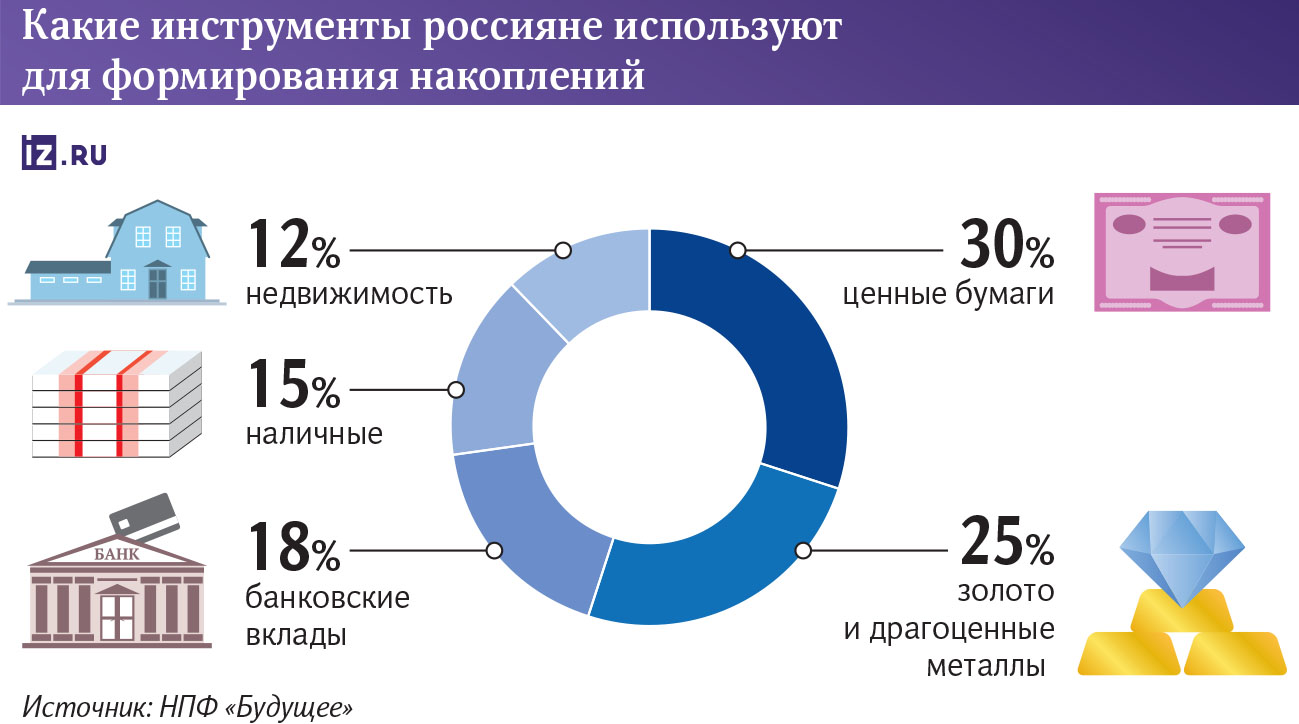
Переведено сервисом «Яндекс Переводчик»
