Bereg Doni: how Trump fits into the "madman theory" and splits the United States


The "madman theory" does not work under the presidency of Donald Trump, American political scientists believe. A war in the Middle East could lead to the complete defeat of the "reds" in the congressional elections and, possibly, even to a decrease in Washington's influence on the world stage. The use of this tactic has traditionally been attributed to Richard Nixon and sometimes Ronald Reagan. However, these Republicans have managed to achieve some success, in fact, maintaining the dominance of the United States. In addition, the risk of accidental global conflict, including nuclear conflict, is now higher than under Trump's predecessors. How he differs from Nixon and Reagan and how he applies the "theory of the madman" in practice is described in the Izvestia article.
The "Madman Theory" and the Middle East
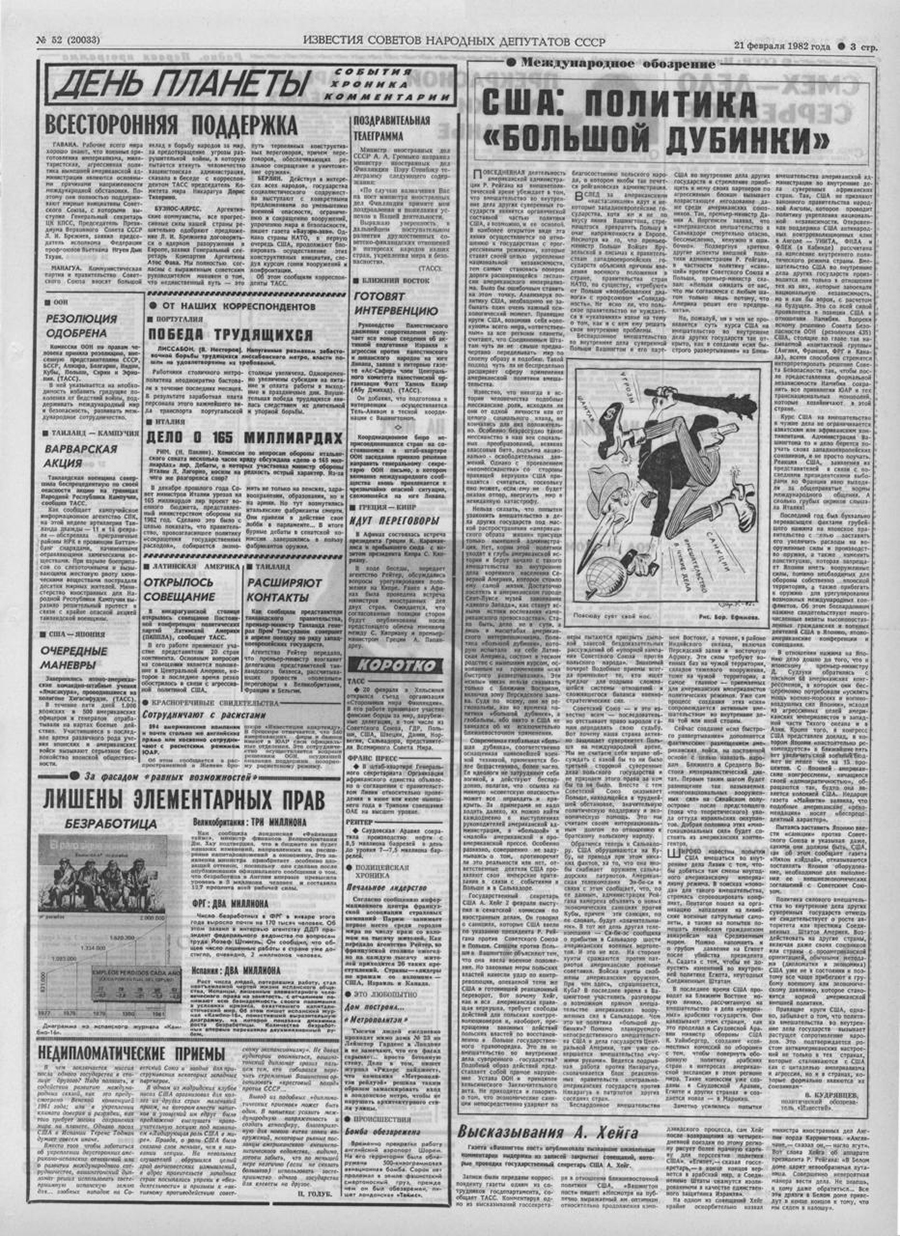
"The ruling circles of the United States, imagining themselves to be the "guardian" of the whole world, "responsible" for all regions of the planet, believe that the United States is almost destined from above to remake the world in its own image and likeness... However, the manifestation of "neo-Messianism" on the part of the ruling elite of the United States has to be reckoned with, because if it is not resisted, it can plunge the world into an unprecedented catastrophe." This is a fragment of the Izvestia article from February 21, 1982, "USA: The policy of the "big cudgel" describing the odious actions of the Ronald Reagan administration. The material is accompanied by a caustic and, as always, accurate illustration by cartoonist Boris Yefimov.
Surprisingly or not, the world is now witnessing the same thing in the Middle East, only now, especially under Donald Trump, the violent expansion of American values has been replaced by a completely undisguised expansion of American interests. And already now the world has witnessed, if not yet a catastrophe, then absolutely the deepest crisis.
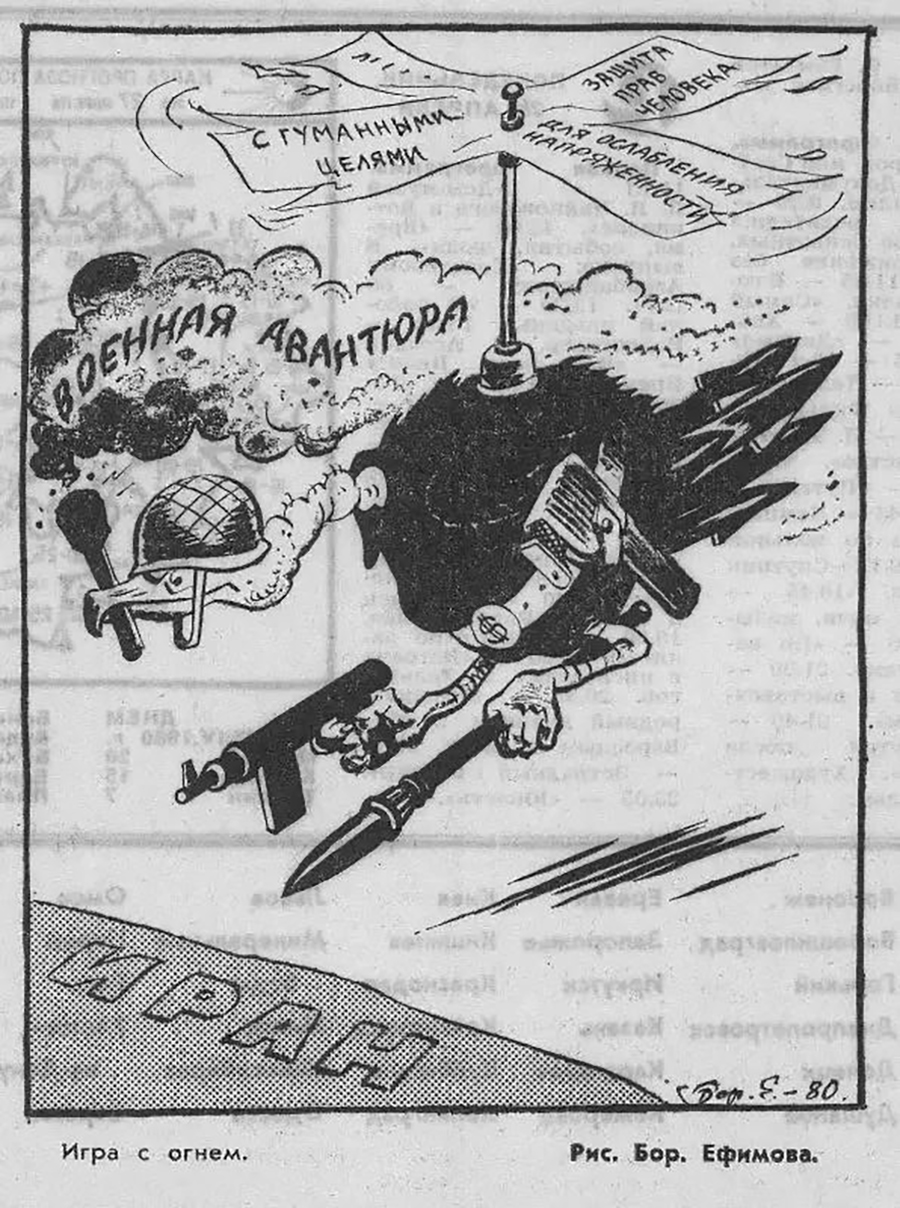
A little more historical symbolism. In 1980, shortly before Reagan's arrival, President Jimmy Carter authorized Operation Eagle Claw to free 53 hostages from the US Embassy in Tehran - the operation ended in fiasco, including for Carter's re—election, which was also reflected in Yefimov's cartoon. Another failure, although not so tragic, happened last weekend. The US operation to rescue the downed American military in Iran has forced the burning of its own planes and may cost the entire American military campaign.
And even considering the already well-known unpredictability of the 45th and 47th presidents of the United States, such a development was not expected anywhere, including in the White House.
At least the "testimony" of key figures in the Republican administration varies. The Pentagon named the IRGC's missile forces and navy as the target, which pose a threat to US military installations in the Middle East. "This is not a so—called war for regime change, but the regime has certainly changed, and the world is only getting better from this," added Pete Hegseth, head of the Ministry of War personally. According to Secretary of State Marco Rubio, the United States joined Israel's operation to protect itself in the event of retaliatory attacks on American forces.
Personally, Trump eventually stated that Iran was planning an attack on the United States, and Washington launched a preemptive strike. "They were going to attack if we didn't… I was firmly convinced of this," the American leader said. At the same time, Trump had previously mentioned successful negotiations with Tehran, and just a few hours before the start of the airstrikes, Omani Foreign Minister Badr al-Busaidi, who had recently acted as the main mediator, announced significant progress and that an agreement was "within reach."
Trump's penchant for impulsive decisions has been evident since his first term as president. And if, for example, only Russia was puzzled by the withdrawal from the INF Treaty, then the whole world was puzzled by the withdrawal from the Paris Climate Agreement. The second term seemed to promise greater predictability. At least, a return to the MAGA concept seemed to be exactly what most Americans expected, given the crushing defeat of the Democrats.

Although here, Trump managed to surprise the world community. He began attempt number two with provocative promises and suggestions. The Republican insulted a close ally, Canada, by saying that it should become the 51st U.S. state, hinted at using military force to annex Greenland, an autonomous territory of another NATO partner, and decided to return ownership and control of the Panama Canal to the United States. In fairness, with the last point, in fact, everything turned out that way.
After all, less than a month after his inauguration, Trump had already spoken with Vladimir Putin that it had been almost impossible to imagine the last few years under the leadership of the Democratic Party, and also again questioned the continued membership of the United States in NATO.
Political scientists call this the "Madman Theory" — when the leader of a world power, in order to achieve concessions, tries to convince the opponent that he is capable of anything due to his temperament. Apparently, Trump has introduced an innovation to this theory — it is necessary to convince his allies of madness. However, are all the decisions of the current head of the White House really explained by tactics already well-known in world politics?
What unites Nixon, Reagan and Trump
Richard Nixon's policy is considered to be a classic example of using the "madman theory" as a deliberate strategy. This was especially noticeable during the Vietnam War.
"On the side of the rabid, as the New York Times testifies, "the majority of military leaders" who "also advocate these attacks." There is also a political jackal, former Vice President Richard Nixon, who is disgusted even by the bourgeois press. The other day, he threatened the Democrats that the Vietnam War would become the "main issue" in the 1968 presidential election unless the current administration did something to "win and end." He called for giving the military the right to bomb any targets in North Vietnam, including Hanoi, at its own discretion," Izvestia wrote on November 27, 1965.
In 1969, during Operation Giant Spear, Nixon ordered the nuclear forces to be put on high alert: a squadron of B-52 bombers circled the borders of the USSR for three days. This was supposed to make Moscow believe that Nixon was ready to do anything to end the conflict in Vietnam.
— It is believed that this theory was initiated by Nixon as a way to make communist leaders suspect that he is so obsessed with communism that he is ready to act irrationally. However, it is difficult to assess whether it applies to his position on China and the USSR. In both situations, Nixon proved himself to be extremely pragmatic and reasonable, especially in 1972, during a trip to Beijing and negotiations with Brezhnev (this became a key stage in the "detente" in the Cold War. — Ed.)," said Khan, a professor at Wayne University in Detroit, told Izvestia.
However, in the end, Nixon, despite his "controlled madness," could be said to have become entangled in his own machinations. The "honorable peace" was signed in 1973, but the war subsequently ended in failure for the United States, and in August 1974, Nixon resigned due to the Watergate scandal, for which he received the nickname Tricky Dickie (from the English Tricky — "sly").
Less often, the Madman Theory strategy is attributed to Ronald Reagan, who is reputed to be an uncompromising idealist. The 40th President of the United States called the USSR an "evil Empire," turning the political conflict into an almost religious confrontation. In addition, it was he who decided to implement the ambitious Star Wars defense program in the form of a missile defense system with space elements to protect against Soviet ballistic missiles. Now Donald Trump is trying to revive this project, only under the name "Golden Dome".
And, of course, it's hard not to mention the famous "joke" from Reagan. In 1984, during a live microphone test, he said: "Dear Americans, I am pleased to inform you that I have signed a decree outlawing Russia forever. The bombing will begin in five minutes."
— Reagan was an American patriot. His primary concern was the safety and well-being of the American people and the prevention of war. His horror at the prospect of nuclear war was genuine. And his commitment to arms control was sincere. And his comment about the "evil empire" was directed against Marxism-Leninism as an ideology, not against Russia or Russians," Jim Jatras, a foreign policy adviser to the Republican Party leadership in the U.S. Senate from 1985 to 2002, told Izvestia.
Nevertheless, Reagan's approach to Russia underwent a transformation during his second term, largely thanks to Mikhail Gorbachev, which led to the signing of important disarmament treaties, such as the historic INF Treaty in 1987. They also laid the foundation for the reduction of strategic offensive arms, which in 1991 was legally embodied in START-1. Recall that under Trump, in February 2026, START-3 expired.
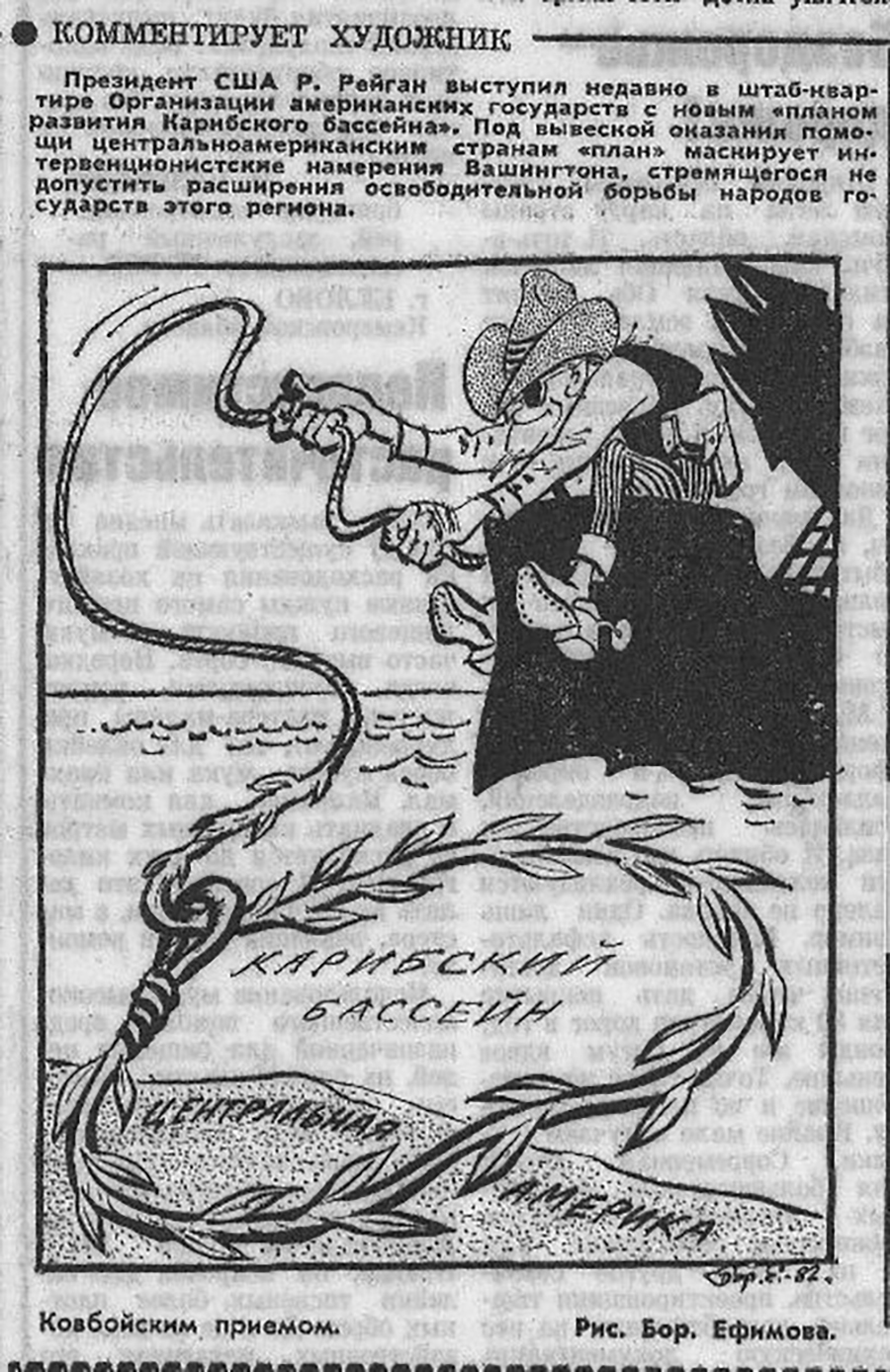
All three Republican presidents did follow the "madman" theory to some extent and are certainly similar in some ways. Reagan and Trump both adopted the same slogan "MAGA" (Make America Great Again). Besides, both were obsessed with Latin America. The world has not yet recovered from the operation of American special forces to capture Venezuelan President Nicolas Maduro, as Washington has imposed an oil blockade on Cuba and periodically threatens Mexico and Colombia. Reagan was actively involved in the war effort to "fight" the insurgency in Central America. Yefimov's cartoon from March 17, 1982 aptly illustrates at that time the American president, who had spread a lasso over the Caribbean.
How will this affect the midterm elections in the United States?
If Nixon used irrationality as a chess move, and Reagan relied on firm beliefs, then Trump embodies "pure chaos," that is, lack of strategy, American experts summarize. Therefore, it is not known whether he has any special relationship with Russia, Jim Jatras believes. His entire policy is focused on personal interests and short-term deals, in which he should always be a "winner," the expert concluded.
— There are two versions of the "madman theory". In the first, the "player" deliberately distorts the interpretation of the enemy's actions and uses strategies that carry a very high risk of war, which no sane person would allow. This is the "rational" madman. In the second case, the player does not process information rationally and also uses strategies that carry a very high risk of war. This is a real "madman". Trump seems to be vacillating between the two versions, says Cornell University professor Richard Bensel.
American political scientists believe that Trump's instability also makes the risk of accidental global conflict (especially nuclear conflict) higher than under his predecessors. At least, we are already witnessing a major regional conflict.
Almost immediately, the expected criticism from Democrats found a response from some Republicans. Conservative Congressman Thomas Massey, already unhappy with trade duties and delays in publishing files on the Epstein case, wrote: "I am against this war. This is not "America first."

Rand Paul, who eventually initiated the failed resolution to limit Trump's actions, also personally spoke out "against another presidential war." According to the Western press, the chairman of the Joint Chiefs of Staff, General Dan Kane, was also against it, allegedly warning about the shortage of ammunition due to Ukraine and Israel, as well as the lack of support from the allies.
Perhaps of the greatest interest is the position of the Vice President of the United States, who has so far played a very significant role in the foreign policy of the White House, J. D. Vance. Since the beginning of the Iran war, Vance has been suspiciously quiet, despite his fondness for very bold statements, at least at the same Munich conference last year. The Western media began to write that he was among the opponents of the military operation. On March 9, Trump even seemed to acknowledge the existence of disagreements with his deputy. "I think he might have been less enthusiastic about this idea," the president said.
— Trump, known as TACO, is full of threats and bravado, hostile to both friends and enemies. But he's not a strategist. His attention is distracted. Now in Iran, he appeared to us as a paper tiger. And he can do something crazy in Iran, because otherwise he will become the object of ridicule and mockery. This war is a disaster for Trump and his party," Peter Kuznik, director of the Institute for Nuclear Research at the American University in Washington, Professor of history, tells Izvestia.
TACO (Trump Always Chickens Out — "Trump always backs out") is an investment strategy and at the same time a nickname that originated on Wall Street in 2025. It describes Trump's habit of threatening harsh tariffs to cause panic in the markets and then pull back, allowing stocks to recover.
Ahead of the midterm elections in November, 55% of respondents, or more than half, are already dissatisfied with military action against Iran, according to an average of RealClearPolitics data. Overall, 56% of citizens disapprove of the current president's policy, which is generally the highest figure since his return to the White House. Even before the outbreak of hostilities in the Middle East, Republicans feared losing their majority not only in the House of Representatives, but also in the Senate — that is, a complete loss of control over Congress. It is noteworthy that in January 2026, Trump publicly warned his party members that losing even the House of Representatives would result in his third impeachment.
There may be more tangible consequences for the United States. If Republicans Nixon and Reagan still managed to achieve some success, in fact maintaining the dominance of the United States on the world stage, then Trump, apparently, is not just fighting the decline of US influence, but also, perhaps, contributing to it.
Переведено сервисом «Яндекс Переводчик»
