- Статьи
- Science and technology
- Organic Continent: How Arctic sea meadows will mitigate climate change

Organic Continent: How Arctic sea meadows will mitigate climate change

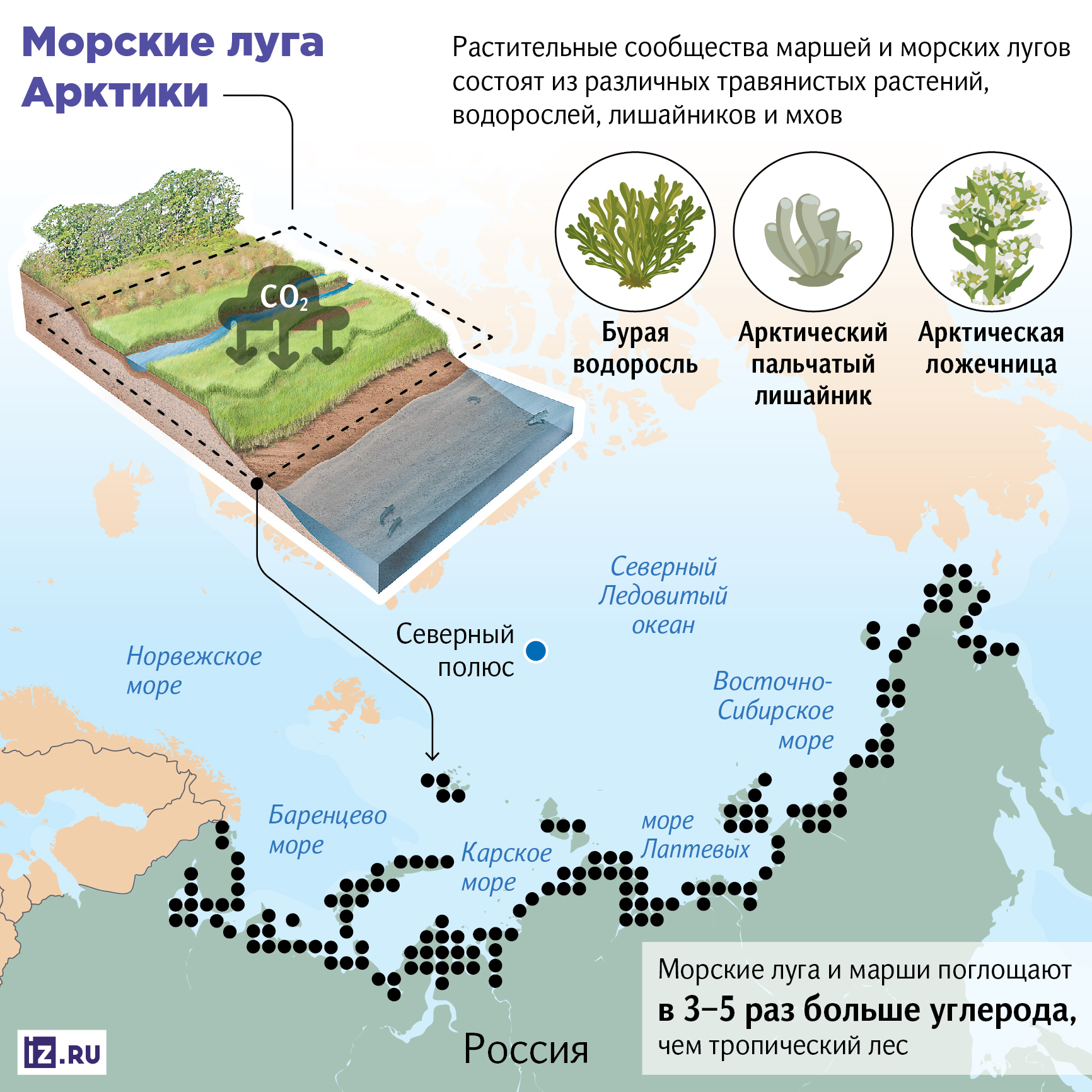
For the first time, scientists have presented a comprehensive overview of the reserves of "blue carbon" in the coastal ecosystems of the cold seas of the Northern Hemisphere. Their findings show that Arctic marshes and marine meadows play a key role in carbon sequestration, contributing to climate change mitigation. And although these ecosystems cover only about 2% of the surface of the oceans, they are able to retain carbon three to five times more efficiently than even tropical forests. However, the Russian coast remains poorly explored, and this gap needs to be filled, scientists believe. Why the cold region plays one of the key roles in global processes on Earth is described in the Izvestia article.
Reserves of "blue carbon"
The results of a new study by soil scientists at Moscow State University, which has covered more than 200 scientific publications, show that marshes — low—lying plains formed under the influence of tides, waves and surges - as well as the marine meadows of the Arctic are a powerful natural reservoir of carbon, the so-called "blue carbon". However, their contribution is often not taken into account in international and national climate calculations.

According to the researchers, when assessing the global carbon balance, coastal landscapes have long been ignored due to their small area. Meanwhile, occupying less than 2% of the world's oceans, these ecosystems absorb and store carbon three to five times more efficiently than tropical forests per unit area. Unlike forests, where carbon is stored in wood and can be quickly released during fires or logging, it has been preserved in the soils of marshes and sea meadows for thousands of years — in anaerobic salty conditions, which significantly slow down the decomposition of organic matter.
"Blue carbon" — carbon accumulated in the soils and biomass of marine meadows, marshes and mangroves — is likely to be a key element of the climate system. The imperfection of calculations of these reserves means that at the moment we do not understand the true extent of either absorption or potential carbon emissions as a result of degradation of these ecosystems due to warming and human activities.
An analysis of carbon stocks in coastal ecosystems in the Northern Hemisphere has revealed a geographical imbalance: the vast majority of research is concentrated in easily accessible, urbanized areas, while vast and probably the most carbon-rich territories remain "white spots" on the scientific map. This can drastically distort perceptions of the global carbon balance.
"The systematization of data on the study of Russian coastal ecosystems has revealed a serious gap due to the small number of studies of ecosystems of the coasts of the northern seas — marshes and marine meadows that actively absorb carbon, while most of the work on the study of these territories is focused on the problems of erosion and permafrost melting," the associate professor of the Department of Soil Geography at the Faculty of Soil Science of Moscow State University told Izvestia Natalia Oreshnikova.

The analysis of a significant amount of data on the reserves of "blue carbon" by both foreign and domestic researchers has revealed certain trends in its distribution. In the soils of both marshes and sea meadows, carbon reserves of organic compounds are greater in warmer seas. The salinity of the water helps to increase the carbon reserves of marine meadows, but reduces them in the soils of marshes. The maximum reserves of organic carbon are observed on the upper march of the most remote from the sea, rarely flooded part of the coast, she said.
— In general, the review of publications showed significant gaps in knowledge about carbon storage in soils of coastal ecosystems, especially in the Arctic. This is partly due to the inaccessibility of the region, partly due to the complexity of the research object itself: the soils of marshes and sea meadows are characterized by significant spatial variability on all scales and significant dynamics. Given the importance of the region for the development of the country and reducing the effects of climate change, the soils of the Arctic coasts of Russia require active study," added Ilya Bagdasarov, one of the authors of the study, a graduate student at the Faculty of Soil Science at Moscow State University.

The Arctic as a key climate shield
The marine meadows and salt marshes of the Arctic are important ecosystems of "blue carbon". Their climatic role is not only that they absorb Co₂, but also that they permanently conserve carbon in bottom and coastal soils, Denis Kuzmin, director of the Phystech School of Biological and Medical Physics at MIPT, told Izvestia.

In anaerobic, water-saturated, and brackish conditions, organic matter decomposes slowly, so carbon can be retained for hundreds or even thousands of years.
— The value of this resource is very high, and it is not limited only to carbon reserves. First of all, blue carbon is really outstanding in terms of specific efficiency. Secondly, it is long-term storage: in the forest, carbon is highly vulnerable to fires and logging, but here a significant part of it sits in precipitation. From an ecological point of view, it is almost a "multifunctional climate deposit," the scientist said.
According to him, the Arctic is one of the key nodes of the global climate system.

At the same time, it is not necessary to contrast marine ecosystems and tropical forests — each of these systems is necessary for the globe and contributes to the fight against climate change, Tatyana Ledashcheva, associate professor of the Department of Environmental Safety and Product Quality Management at the Patrice Lumumba Institute of Ecology of the RUDN University, member of the editorial board of the scientific online magazine Resources, noted in a conversation with Izvestia.
— It is important to understand the size of the Arctic systems and their absorption capacity. Although the absorption capacity is higher, the volume is limited. At the same time, carbon can be stored in marine ecosystems for a longer period of time," the expert said.

The Arctic region is also being affected by global warming. The likely interest of many states in it may be related to resources, territories and ways of movement, said Vladimir Pinaev, head of the Specialized Structural Educational Unit of the Renaissance of Nature Foundation, member of the Public Council of the Basic Organization of the CIS Member States for Environmental Education.

Igor Shkradyuk, coordinator of the industrial greening program at the Wildlife Conservation Center, explained to Izvestia that new data on the role of algae in carbon dioxide processing should be an important addition to existing mathematical models of global warming.
— However, for an objective assessment, it is necessary to take into account what happens to these organisms after death, since carbon dioxide can also be released during rotting. These amendments can be taken into account when calculating emission quotas, as they can indicate a reduction in the carbon footprint. But first of all, it is necessary to modernize the Russian industry and protect nature, and not save on payments," said the environmentalist.
The research was carried out with the support of the project "Carbon sequestration potential of coastal wetlands under climate change" under an agreement with the Ministry of Science and Higher Education. The study was published in the journal "Soil Science".
Переведено сервисом «Яндекс Переводчик»
