- Статьи
- Society
- There was also a herd: the damage to farmers from the slaughter of livestock for the month was estimated at 1.5 billion

There was also a herd: the damage to farmers from the slaughter of livestock for the month was estimated at 1.5 billion

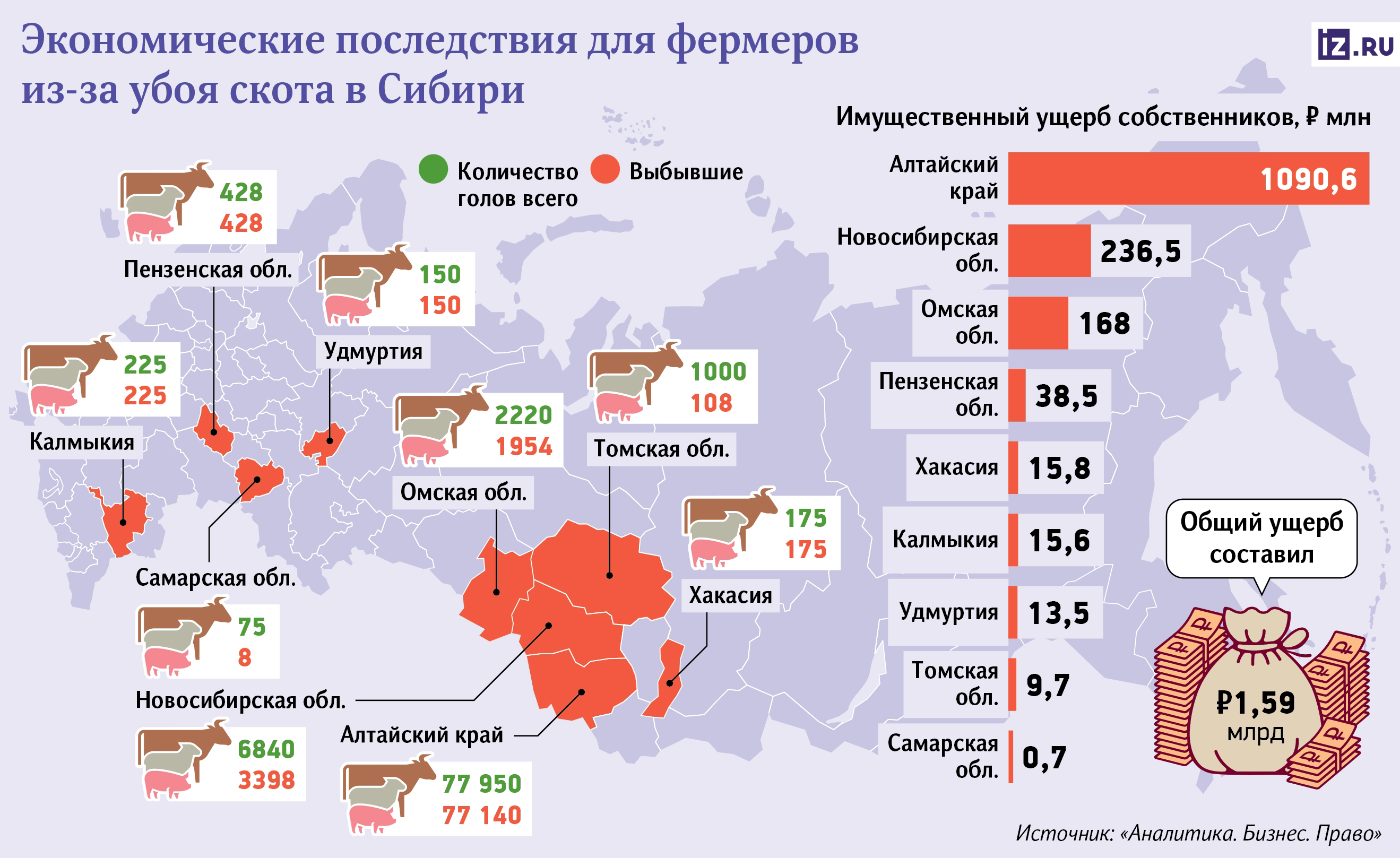
The direct property damage to the owners of the seized and destroyed animals exceeded 1.5 billion rubles, the Analytical center estimated to Izvestia.Business.The right." The uncovered losses of farmers and personal subsidiary farms amount to another 368.2 million. Among the causes were not only pasteurellosis, but also rabies, plague and other dangerous infections. Currently, animal cases have been identified in Novosibirsk, Omsk, Tomsk, Sverdlovsk, Samara and Penza regions, as well as in the Trans-Baikal Territory, Chuvashia, Yakutia and the Altai Republic. At the same time, a number of regions said they had already started paying compensation for seized livestock, but farmers note that the amount of payments is disproportionately small. How the situation will develop is in the Izvestia article.
What damage did the farmers suffer?
The number of animals affected by quarantine measures, seizure, destruction or other restrictive measures in the regions of Siberia in February-March 2026 ranged from 87.5 to 90.5 thousand, the Analytics center reported.Business.The right." Izvestia has reviewed the results of the study. They studied the situation in the Altai Territory, Novosibirsk, Omsk, Penza, Tomsk and Samara regions, as well as in Khakassia, Kalmykia and Udmurtia.
"The array under consideration combines cases of various diseases, primarily pasteurellosis, rabies, African swine fever and certain other infections," the experts said.
Since the end of 2025, a series of outbreaks of dangerous diseases of farm animals have occurred in some Russian regions, following which veterinary authorities began to impose quarantine restrictions, prohibit the movement of livestock and livestock products, and in some localities to make decisions on seizure and destruction. In particular, according to Izvestia, animal cases of pasteurellosis have already been identified in the Novosibirsk, Omsk, Tomsk, Sverdlovsk, Samara and Penza regions, as well as in the Trans-Baikal Territory, Chuvashia, Yakutia and the Altai Republic.
The situation in the Novosibirsk region caused the greatest resonance, where on March 17, on behalf of Deputy Prime Minister Dmitry Patrushev, a working group led by the head of the Rosselkhoznadzor, Sergei Dankvert, was sent. A day earlier, by decision of the local authorities, an emergency regime was officially introduced in the region due to outbreaks of pasteurellosis and rabies in livestock.

The Investigative Committee organized an investigation into possible violations by officials of the Ministry of Agriculture of the region after appeals from residents of the village of Kozikha in the Ordynsky district to the head of the Investigative Committee Alexander Bastrykin and President Vladimir Putin. Local residents reported that the administration does not provide documents confirming the validity of their actions.
"The direct property damage calculated based on the cost of the animals in the baseline scenario is 1.59 billion rubles," the analysts noted. — Additionally, the model records 368.2 million uncovered losses of farmers, which occur in excess of the cost of the head and reflect the restoration of the herd, quarantine costs and disruption of the production cycle. Direct property damage was calculated as multiplying the number of animals disposed by the estimated value of one head."

At the same time, the dropped supply of meat in retail equivalent corresponds to about 3.72 billion rubles. The consequences for dairy farming are also significant: assuming that 40% of retired cattle are productive cows, the potential loss of milk reaches 18 million liters in annual terms.
The situation in the Novosibirsk region regarding cattle pasteurellosis is currently under control. However, the measures taken by the regional authorities were insufficient, Sergei Dankvert, head of the Rosselkhoznadzor, told the media.
— We tried to understand why people had a misunderstanding. But we forget that the disease is mutating. Therefore, as a precaution, we are forced to act more actively now," explained the actions of the service staff on the ground.
According to him, the reason for the current situation of the spread of the disease could be abnormal weather conditions, temperature fluctuations and, as a result, the weakening of animals.
What kind of compensation is paid to victims
The Ministry of Agriculture stated that, along with measures to eliminate outbreaks and prevent the further spread of the disease, prompt compensation for damage to affected households remains one of the key tasks. So, currently about 200 million rubles are provided for these purposes.

"Due to the current epizootic situation, there are no risks for consumers. All products that arrive in stores undergo strict veterinary control," the report says.
The ministry noted that the situation, which is generally local in nature, will not have a significant impact on the development of animal husbandry in the country.
"Current production volumes, as well as systematic work to improve the efficiency and veterinary safety of enterprises, create the basis for maintaining the growth rate of the industry," the Ministry of Agriculture added.
On March 17, the press service of the government of the Novosibirsk Region reported that the owners of animals seized as part of anti-epizootic measures had received their first payments.
"At the moment, the veterinary department of the Novosibirsk region has received 21 applications for damages from the owners of the seized animals. As of today, payments have been made to 13 owners of the seized animals. The amount of compensation for the submitted documents amounted to up to 1 million rubles per applicant," the regional authorities clarified.

The local cabinet also noted that at an extraordinary meeting of the regional government, it was decided to allocate 110 million rubles to the veterinary department of the Novosibirsk region and 80 million to the Ministry of Labor and Social Development of the region for compensation and social payments to the owners of the seized animals.
In addition, they recalled that in addition to the existing payments for seized animals (more than 70 thousand rubles for an adult cow weighing 400 kg), a decision was approved to provide social assistance to citizens who find themselves in a difficult life situation due to partial loss of income due to the seizure of livestock. It will be paid monthly to the owner of the seized animals and his family members for nine months in the amount of the average per capita subsistence level established in the region. According to the authorities, for example, for a family of four during this period, the payment may amount to 668.1 thousand rubles.

"70 thousand for an adult cow? It's a penny! Considering that this cow was raised for more than one year, they did not plan to donate it for meat, this is just a mockery, not a payment! Until the new cows grow up, the family will completely go bankrupt and go around the world," local residents discuss the situation on forums.
"They announced a family of four, and even with conditions. What if the family consists of one person? Some grandmother kept a nursing cow, cared for her, loved her, what will she get?" — their interlocutors agree with them.
The People's Farmer Association stated that these payments are not enough to compensate for losses to agricultural producers.

— According to the law, the amount of compensation is set by the region, and if it has not done so, they are guided by the market value. In this case, the damage is calculated based on 175 rubles per 1 kg of live weight. With a conditional weight of 400 kg, the compensation amount will be 70 thousand rubles. In our opinion, this amount is clearly insufficient," Babken Ispirian, deputy chairman of the association's board, told Izvestia.
According to him, to compensate for the damage, the farm will need to purchase not only a cow, but also to compensate for the lost feed.
— The fact is that the feed stocks that were available in the farm affected by the epizootic cannot be used. The total damage to the farm often greatly exceeds 70 thousand rubles. In this regard, the amount of compensation should be increased," the industry representative explained.
He also noted that the regional authorities will provide additional support in the form of social assistance to affected farms.
— The problem here is that many people simply will not fall under this support. As a general rule, recipients of state social assistance can be low-income families who, for reasons beyond their control, have an average per capita income below the subsistence level per capita. In the Novosibirsk region, the minimum cost of living is set at 18.5 thousand rubles. Thus, with an income of, for example, 19 thousand per month, it will no longer be possible to apply for this type of state support," Babken Ispiryan emphasized.

According to him, the region also announced the allocation of subsidies for the purchase of young animals, but its size and conditions are still being clarified.
Why are fixed payments not enough
In such situations, transparency of decisions on the removal of animals, full-fledged documentary support and timely compensation for damage to owners are of key importance, said the director of the Analytica Research Center.Business.Pravo" by Venera Shaidullina.
— One payment for lost livestock is not enough: separate support measures are needed to restore farms, including the purchase of young animals, covering part of current costs and adaptation after the lifting of quarantine, — the expert emphasized.

It is equally important, according to her, to apply a differentiated approach depending on the specific disease and veterinary regulations, so that, where appropriate, use less destructive measures than mass destruction.
— In addition, to reduce social and economic losses, a unified register of quarantine, seizure, destruction and compensation cases is needed, which will ensure accurate accounting of the consequences and protection of the rights of animal owners, — said Venera Shaidullina.

However, with pasteurellosis and foot-and-mouth disease, the destruction of animals is not a mandatory method of combating the disease, Natalia Medvedeva, a veterinarian at the VetUnion veterinary clinic, told Izvestia.
"Upon confirmation of the diagnosis, animals and farms with confirmation of African swine fever must be destroyed," she said. — Animals with characteristic signs of rabies are slaughtered for subsequent diagnosis — the final diagnosis is made only posthumously after a brain examination. Livestock without clinical symptoms that are in contact with suspected rabies animals are vaccinated and quarantined for further observation. In case of foot-and-mouth disease, the slaughter of animals can be taken as a last resort.
According to her, instead of slaughter, it is possible to carry out other medical and sanitary measures, for example, isolation, the use of antibiotics, therapeutic serums. If the disease is curable (for example, pasteurellosis, foot-and-mouth disease) and is not highly contagious towards humans or other animals. But in controversial cases, as a rule, actions will be directed towards the maximum exclusion of further spread of infection.
To avoid outbreaks of dangerous infectious diseases in nurseries and farms, routine vaccination is necessary, quarantine is observed when new animals arrive, and the established disinfection schedule and zoo hygiene requirements are met, Natalia Medvedeva noted.
Переведено сервисом «Яндекс Переводчик»
