- Статьи
- Economy
- Access cattle: foci of pasteurellosis in animals have already been identified in 10 regions

Access cattle: foci of pasteurellosis in animals have already been identified in 10 regions

An epidemic of pasteurellosis, a dangerous disease for livestock, is gradually spreading in Russia. Foci of infection have already been identified in 10 regions, including Novosibirsk, Omsk, Tomsk, Sverdlovsk, Samara and Penza regions. For the first time in recent years, instead of treating sick animals, they began to destroy them. The People's Farmer Association is still assessing the situation as local. However, Izvestia's sources in the industry are confident that if the epidemic gets out of control, it could lead to business losses and losses. Against this background, Kazakhstan and Belarus have already imposed temporary restrictions on the supply of meat from the regions of the Russian Federation where the outbreak was detected. Izvestia investigated whether farmers would be able to receive compensation and why animals had previously been vaccinated against another disease.
Why can't the disease be stopped
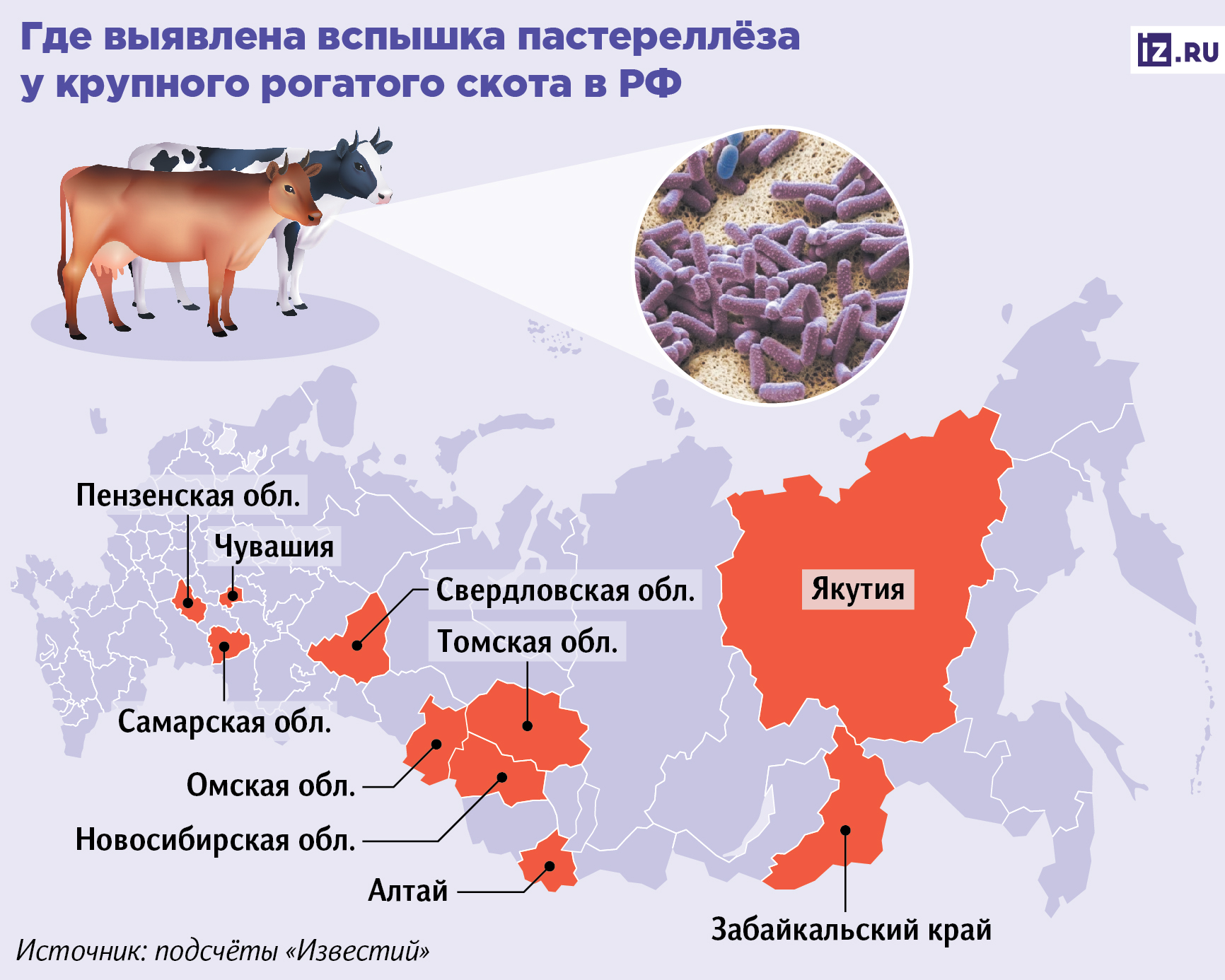
According to Izvestia, animal cases of pasteurellosis have already been identified in the Novosibirsk, Omsk, Tomsk, Sverdlovsk, Samara and Penza regions, as well as in the Trans-Baikal Territory, Chuvashia, Yakutia and the Altai Republic. The disease began to spread from the end of 2025 and, apparently, it has not yet been stopped even by removing and destroying livestock, which farmers and residents of these regions are massively talking about.
The situation in the Novosibirsk region caused the greatest resonance, where on March 17, on behalf of Deputy Prime Minister Dmitry Patrushev, a working group led by the head of the Rosselkhoznadzor, Sergei Dankvert, was sent. A day earlier, by decision of the local authorities, an emergency regime was officially introduced in the region due to outbreaks of pasteurellosis and rabies in livestock.
— All the requirements and measures for localization and relief of a particularly dangerous disease have been fulfilled as much as possible. And it really brings a lot of benefits. The first outbreaks have been localized," Andrei Shindelov, the Minister of Agriculture of the region, told the media, without going into details.
The Investigative Committee of Russia organized an investigation into possible violations by officials of the Ministry of Agriculture of the region after appeals from residents of the village of Kozikha in the Ordynsky district to the head of the Investigative Committee Alexander Bastrykin and President Vladimir Putin. Local residents reported that the administration did not provide documents confirming the connection between the quarantine and the subsequent seizure and destruction of their livestock.
"The scale of slaughter in the Ordynsky district of the region is significant, for example, in the Aquarius subsidiary farm, all the cattle of several hundred heads were burned," a resident of the village of Kirza, located in the area, told Izvestia.
Veterinarians come to farmers accompanied by police and euthanize cattle without providing any documents, confirmed Evgeny, a resident of the Kupinsky district of the Novosibirsk region.
— They say it's a particularly dangerous disease, but they don't explain what it is. This situation has been observed since March 6," the source said.
According to him, veterinarians arrived in the village of Novoklyuchi in Kupinsky district and, in the absence of the owner of the farm, they euthanized all the livestock — 200 cows. At the same time, no one weighed the animals, and farmers do not receive compensation, he added.
At the same time, earlier the authorities of the Novosibirsk region promised farmers compensation for the seized animals (70 thousand rubles for a cow weighing 400 kg), as well as providing social assistance to those who found themselves "in a difficult life situation" due to partial loss of income after the cattle were seized.
Pasteurellosis is an acute infectious disease characterized by fever, general intoxication, inflammation of the skin, subcutaneous tissue, damage to joints, bones, and internal organs. First of all, it affects animals — large and small cattle, pigs, rabbits, birds and wild mammals. However, it is possible to transmit the disease to humans through contact with infected animals or their biomaterials. Such cases are rare and are recorded mainly among veterinarians, farmers, and rural residents, whose work involves constant and close contact with domestic and farm animals. Eating raw or insufficiently heat-treated meat from animals with pasteurellosis is also dangerous for humans. However, products that have undergone industrial pasteurization or thorough heat treatment (cooking, frying) are safe. The ingestion of bacteria into the body can lead to inflammatory processes in the gastrointestinal tract, bronchitis, pneumonia and other complications. If there are open wounds or scratches, secondary infections may develop, including abscesses and sepsis.
Also, residents, in a conversation with Izvestia, noted that in March, for some reason, the animals began to be re-vaccinated against another more dangerous disease, foot—and-mouth disease, and they themselves were forbidden to leave the settlements.
— Schoolchildren living in the Ordynsky district canceled a trip to vocational guidance classes because "people are not allowed out because of quarantine," said a resident of Kirza. — When asked to take tests at their own expense, farmers receive refusals from laboratories if they find out that they are from the Ordynsky district.
Izvestia sent a request to the Ministry of Agriculture with a request to comment on the situation with the disease.
The Rosselkhoznadzor told Izvestia that the situation with pasteurellosis in the Novosibirsk region has been brought under control.
— The Rosselkhoznadzor provides the veterinary department of the Novosibirsk region with methodological support on the issue of preventing the spread and elimination of pasteurellosis, preventive vaccination of susceptible animals is carried out, as well as measures to curb the illegal transportation of animals that may be carriers of the pathogen. This situation is mainly regional in nature and is already stabilizing at the moment," the press service of the department noted.
They added that monitoring is currently underway, including online platforms and social networks, for the sale of animals and livestock products without documents, possible distribution routes are being suppressed, and the forecast for preventing further spread is positive.
The Federal State Budgetary Institution "Federal Center for Animal Health Protection", subordinate to the Rosselkhoznadzor, explains: in the winter of this year, outbreaks of animal pasteurellosis were recorded in a number of settlements in the Novosibirsk region. The reason for this was the abnormal frosts that came to Western Siberia in January.
According to the institution, pasteurellosis is a common animal disease, and infection of livestock most often occurs through feed, since the pathogen is contained in the soil and is quite resistant in the environment, including to low temperatures. In this case, such a massive disease was caused by a decrease in the immunity of animals against the background of stress caused by sudden temperature changes, they noted.
Which countries have stopped exporting from Russia due to the epizootic situation
The spread of infections in livestock in Russian regions is of great concern, a top manager of a large agricultural holding told Izvestia. If the situation worsens, he said, it could negatively affect exports of domestic livestock products and lead to "enormous losses" not only for farmers, but also for large agricultural producers, he said.
Kazakhstan has already imposed temporary restrictions on the import and transit through its territory of live farm animals, genetic material, meat and meat products, milk and dairy products, as well as other products that have not undergone heat treatment from the following regions of Russia: North Caucasus Federal District, Kalmykia, Astrakhan and Novosibirsk regions, Altai Territory, Altai Republic and Buryatia. And Belarus has imposed restrictions on the supply of livestock and livestock products from 21 regions of the Russian Federation. According to the documents, the reason is the deterioration of the epizootic situation and the risks of introducing dangerous animal diseases.
Izvestia sent inquiries to the Ministries of agriculture of these countries.
At the same time, the Rosselkhoznadzor called Kazakhstan's restrictions on the import and transit of live farm animals from some regions of the Russian Federation illegal. The ministry said that in accordance with the Treaty on the Eurasian Economic Union, veterinary and sanitary measures are applied on the basis of principles that have scientific justification, and only to the extent necessary to protect human life and health, animals and plants.
— If the disease is officially recognized, it is obvious that there will be problems with the deterioration of export supplies of livestock products. Kazakhstan and Belarus may not be the last countries to introduce them," Georgy Ostapkovich, research director at the HSE Center for Market Research, told Izvestia.
According to him, the question is how long this situation will last and how quickly the Ministry of Agriculture and the Rosselkhoznadzor will be able to resolve the situation. At the same time, he recalled that this had happened in other countries, for example, with the spread of avian influenza.
By the end of 2025, the volume of Russian exports of meat and meat products amounted to more than 911,000 tons. t, which is 10.6% more than a year earlier, follows from the data of the Rosselkhoznadzor information systems "VetIS" and "Argus-Phyto". Shipments of dairy products reached 191.9 thousand tons, and shipments of live animals increased 1.7 times to 694.2 thousand heads, according to the agency.
What measures are being taken and to what extent are they justified
So far, we assess the scale of the problem as local — there are indeed separate pockets in some regions, and, judging by official sources, the authorities are working on localization, the Narodny Farmer association told Izvestia.
At the same time, they noted that the situation faced by farmers in the Novosibirsk region requires prompt intervention and a fair solution.
— The precedent of cattle removal is always a huge blow to the economy of a peasant farm. We believe that the key issue of the need to destroy livestock should be addressed to the veterinary service of the region, which makes such a decision," the association believes.
They also noted that if the destruction has already occurred or is inevitable, then there should be fair compensation, which is prescribed in the Law on Veterinary Medicine (Law No. 4979-1 of 05/14/1993 (as amended on 12/29/2025) "On Veterinary Medicine"). People should not be left alone with this problem so that the affected farms have the means to recover, the association stressed.
— Livestock can be destroyed when there is a threat of an epidemic and especially dangerous infections common to humans and animals. At the same time, the practice of recent years implies the introduction of quarantine and therapeutic measures, since the destruction of all susceptible livestock causes great damage to agriculture," Mikhail Shelyakov, a veterinarian of the highest qualification category, told Izvestia.
The situation in the Novosibirsk region is complicated by the spread of rabies, said former Deputy Minister of Agriculture Leonid Kholod. According to him, this disease is transmitted to humans and turns out to be fatal — unlike pasteurellosis, rabies cannot be cured. The spread of these infections in the region is caused by the snowy winter, the expert believes. This situation has led to wild forest animals coming into contact with livestock more often and infecting them, he noted.
Pasteurellosis is a very serious disease that causes mass deaths of animals, says Andrey Kapustin, First Deputy Director of the All-Russian Scientific Research Institute of Experimental Veterinary Medicine named after K.I. Scriabin and Ya.R. Kovalenko of the Russian Academy of Sciences, Doctor of Biological Sciences, Professor. He noted that pasteurella is a highly virulent microorganism, some of its strains can cause the death of livestock in 12-24 hours. Therefore, the slaughter of infected animals is highly justified.
According to him, in such a situation, veterinary services act proactively. He is sure that it is better to eliminate a seemingly healthy animal now than to wait for an uncontrolled epizootic and an even greater death.
Переведено сервисом «Яндекс Переводчик»
