
Without steering wheel: car loans are unavailable for more than 60% of Russians

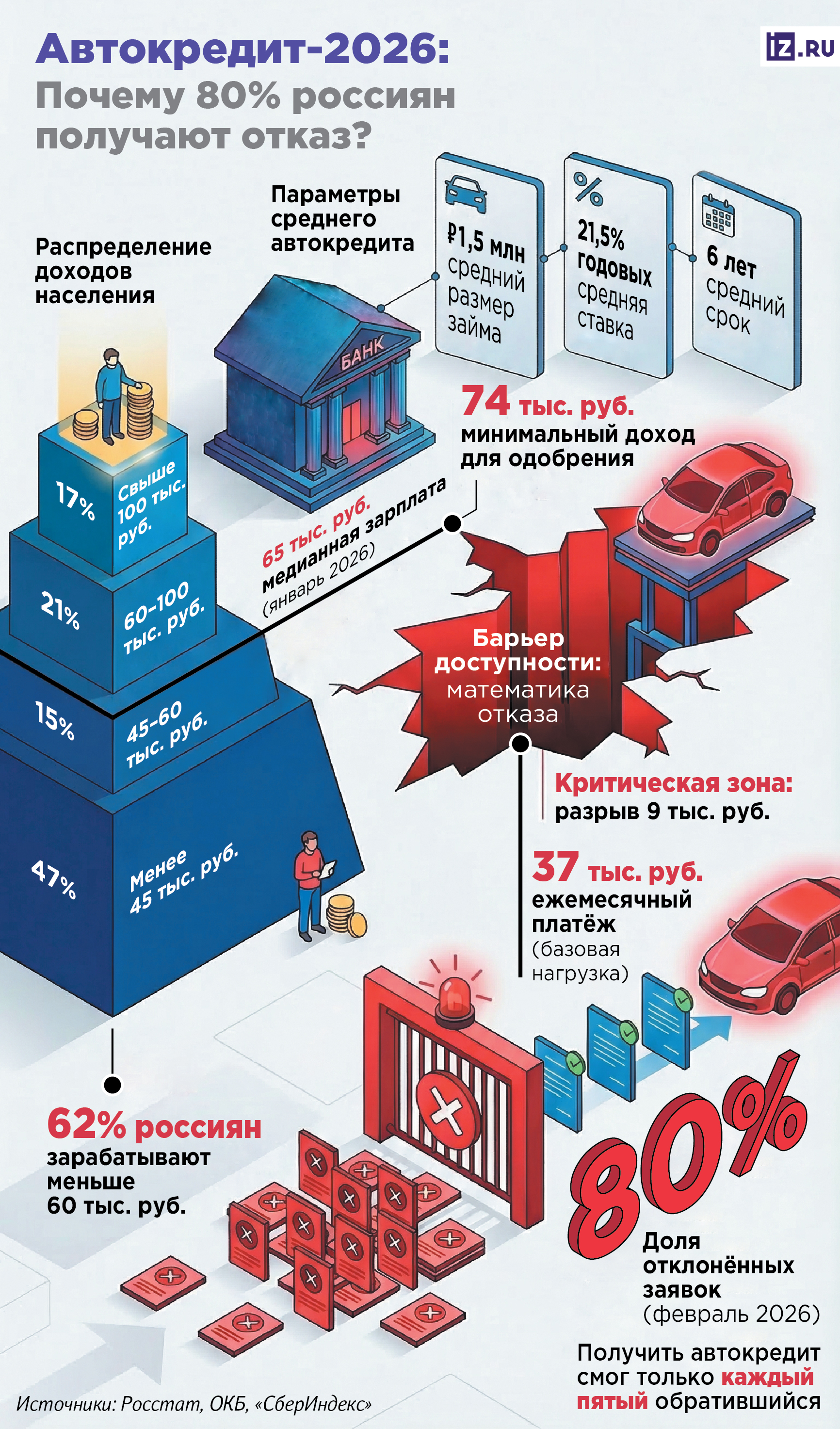
More than 60% of Russians will not be able to get a loan for a car, Izvestia found out. Currently, the borrower's earnings should be twice as high as the monthly payment (an average of 37 thousand rubles) so that the loan applicant can obtain approval for the application. According to Rosstat, there are only about 40% of such people in the country. In February, banks rejected 80% of car loan applications. What income is taken into account, how to get a loan for a car in the current conditions and how much this situation will affect the automotive industry in the country — in the Izvestia article.
How much do I have to earn to get a loan for a car
The average salary in Russia in 2025 was 98.2 thousand rubles. At the same time, only 17% of the population received income above 100 thousand, about one in five citizens could count on 60-100 thousand. At the same time, 62% of Russians received less than 60 thousand rubles, according to Rosstat data.
Currently, banks comply with the Central Bank's limits on granting loans to borrowers with high debt loads. In practice, strict restrictions are not applied only to those clients who spend less than half of their income on loan repayment.

Because of these requirements, banks often refuse to issue loans to customers — the share of rejected applications for car loans reached 80% in February, according to data from the National Bureau of Credit Histories (NBKI). In fact, only one out of five people can get such a loan now. At the same time, the situation was even worse in the last months of 2025: the approval rate remained at 15% or lower.
Since September 2025, the average check for car loans has exceeded 1.5 million rubles, according to data from the United Credit Bureau (OKB). In January, the average term for them was almost six years, and the rate was about 21.5% per annum. The monthly payment for such a loan is more than 37 thousand rubles.

To get approval for an average car loan, taking into account debt requirements, the borrower must earn at least 74 thousand rubles per month. Therefore, 62% of Russians (whose income is below 60 thousand) will not be able to apply for such a loan. The category with an income of 60-100 thousand rubles includes another 21.6% of employees, but even among them, not all meet the requirements for obtaining a car loan.

This conclusion is confirmed by more up-to-date statistics for January 2026: according to Sberindex, the median salary this month was slightly more than 65 thousand rubles. This means that half of Russians earn less than this amount — and, with a high probability, they will not be able to get a loan with a monthly payment of about 37 thousand rubles.
In such conditions, car loans become unavailable not because of banks' unwillingness to lend money, but because of high income and debt requirements, explained Magomed Gamzaev, Director of Financial Product Development at Compare.
Why does the failure rate for car loans reach 80%
The increase in loan refusals is related to the high debt burden of the population: almost one in three Russians already has at least one loan, said Anatoly Perfiliev, Director of Credit Institution Ratings at Expert RA agency. Against the background of rising prices and declining purchasing power, even a car is becoming a luxury item.
In addition, the stricter requirements for income verification had an impact, said Natalia Bogomolova, director of the NRA ratings of financial institutions. Banks are now required to verify them through official sources.

The high failure rate is a direct consequence of the tightening of the risk policy of financial institutions and regulation by the Central Bank, said Vladimir Chernov, analyst at Freedom Finance Global. After an active increase in lending in 2023-2024, delinquencies increased, especially for car loans with low down payments, so banks began to select borrowers more harshly.
Before the restrictions were introduced, the market was growing at the expense of customers with a high debt burden: more than half of the loans were given to those who had already spent more than 50% of their income on payments, said Alexey Ivanov, owner of the Alliance Trucks dealership network. After the requirements were tightened, the share of such risky loans decreased sharply to 13% by the end of 2025.

How does this affect the automotive industry
The situation is aggravated by rising car prices. The average cost of a new passenger car in 2025 reached 3.17 million rubles. Over the past three years, they have risen in price by an average of 60-80%, explained Vladimir Chernov. This is due to the weakening of the ruble in previous years, the departure of Western brands and the transition to expensive imports from China.
The growth of the recycling collection also had a strong impact: in October 2024, it was increased by 70-85%, and then began to be indexed annually, Alexey Ivanov noted. This is a mandatory payment when importing a car into the Russian Federation, which is included in its price. For cars in the middle segment, this added from 300 to 800 thousand rubles to the price. At the same time, recycling will continue to grow until 2030, which will further increase the cost of cars and loans.

The capabilities of the domestic automotive industry are not enough to cover domestic demand, explained economist Andrei Barkhota. The growth of scrap collection will inevitably accelerate prices: imported cars are becoming more expensive due to high margins, and demand for Russian models is growing.
However, high loan rates are holding back sales and hindering the expansion of market share, including for AvtoVAZ, the economist concluded. In the next 6-18 months, the market is likely to stagnate, and buyers will more often choose more affordable used cars.
Even with the easing of monetary policy, an increase in the availability of car loans should not be expected before 2027, Vladimir Chernov believes. At the same time, there will be no return to the conditions of 2021 and the beginning of 2022.
How to get approval for a car loan
Since January 2026, banks have taken into account only official income from the Federal Tax Service and the Social Fund — gray salaries are no longer taken into account, said Alexey Ivanov from Alliance Trucks.

First of all, they look at the confirmed income and credit history, Vladimir Chernov added. The self-employed can also get a loan if they have stable income and work experience of at least 6-12 months. The key factors for approval remain a low debt burden, stable income and a good credit history. Practice shows that several steps help to increase the likelihood of approval:
— applying to a salary bank that already has a history of transactions;
— increase the initial payment to 30-40%;
— lowering or closing credit card limits — banks consider them a potential debt burden, even if you don't use them;
— making a loan for a longer period (to reduce the payment);
— attracting a co-borrower with a steady income.

Preferential car loans remain a real tool for some customers, which allows them to get a discount of about 20% of the cost of the car, said Alexey Ivanov. However, the program applies only to a limited list of models and is valid for a car price of up to 2 million rubles.
In other cases, borrowers either have to make a significant down payment, choose a used car, or postpone the purchase until more favorable conditions. At the same time, according to Vasily Kutin, Ingo Bank's Director of analytics, in the baseline scenario, new cars could rise in price by 1.5-2.5 times by 2030 due to recycling.
Переведено сервисом «Яндекс Переводчик»
