- Статьи
- World
- Voltage regulator: Russia is ready to resolve the conflict between Afghanistan and Pakistan

Voltage regulator: Russia is ready to resolve the conflict between Afghanistan and Pakistan

Russia is concerned about the escalation of the conflict between Kabul and Islamabad, which could escalate into a full-scale war. This was stated to Izvestia by the President's special representative for Afghanistan, Zamir Kabulov. The CSTO is also monitoring the situation. The secretariat of the organization said that they expect the beginning of a meaningful dialogue between the countries, which will result in the settlement of disputed issues. The Afghan side claims that more than 400 people were killed in a recent Pakistani strike on a hospital. Moscow is ready to mediate, but only if both sides ask for help.
What is the reason for the escalation of the conflict between Afghanistan and Pakistan
The confrontation between Pakistan and Afghanistan has once again entered a hot phase. On March 16, the Afghan authorities announced that Pakistan had launched strikes on the country's territory, as a result of which a drug treatment hospital was hit. According to the Afghan Foreign Ministry, more than 400 people were killed and at least 265 more were injured.

Islamabad rejected these accusations, calling them false and misleading. The country's authorities claim that the strikes were carried out exclusively on military infrastructure and facilities associated with terrorist groups.

In the future, the conflict between the two countries may escalate even more, which is why Russia supports its settlement, Zamir Kabulov, the president's special representative for Afghanistan, told Izvestia. According to him, the outbreak of a full-scale war should not be ruled out, but the probability of this is low.
— Of course, Russia is concerned [about the escalation of the conflict between Afghanistan and Pakistan]. We would like to see an early end to mutual blows and a transition to detente in relations," he told Izvestia. — There is an escalation, it is episodic, it occurs for one reason or another, [the risks of] a full-scale war hypothetically, of course, remain, but it is unlikely [it is possible].
The CSTO is also expressing concern. The organization's secretariat stressed that any escalation of the situation in the region certainly poses a threat to security.

— The Collective Security Treaty Organization proceeds from the need to strengthen stability in the Eurasian space, and the CSTO Secretariat is closely monitoring events related to the escalation of the Afghan-Pakistani conflict. We look forward to the beginning of a meaningful dialogue between Kabul and Islamabad, which will result in the settlement of disputed issues, the CSTO secretariat told Izvestia.
Kabul has already threatened its neighbor with a retaliatory strike.
"Based on the decision of the leadership, a crushing response will be given to Pakistan in the near future," said Abdul Mateen Ghani, an official representative of the Afghan Interior Ministry.
Afghanistan's Acting Permanent Representative to the United Nations, Nasir Ahmad Faik, called for a transparent and independent investigation into the attack on the drug treatment hospital.
At the same time, Pakistani Information Minister Attaullah Tarar said that on the night of March 16, the country's Air Force carried out exclusively targeted airstrikes on the technical infrastructure and ammunition depots of the Taliban movement in Kabul. According to him, a little earlier — on March 15 — Afghanistan shelled Pakistani settlements, which killed four people and seriously injured a five-year-old child.

Russia maintains good relations with both countries, so Moscow will be ready to act as a mediator in the conflict if both sides turn to it for help, Kabulov said.
"We are trying to find a compromise solution that would allow us to stop the clashes and move on to diplomacy," he explained. — Russia will be ready to consider such an opportunity if both sides simultaneously request mediation. There is no such thing yet, so we are not going to impose ourselves.

Experts note that the escalation threatens major regional projects, including the Trans-Afghan Railway. Its implementation directly depends on the level of security and may take at least five years. Earlier, the Russian Foreign Ministry had already called on both sides to return to the negotiating table.
Is it worth waiting for a full-scale war in Central Asia
Pakistan regularly accuses Afghanistan of harboring militants involved in terrorist attacks on its territory. Another escalation began in late February, when Afghan forces launched an operation along the disputed border. Kabul said it was a response to Islamabad's actions.
We are talking, in particular, about the operations of the Pakistani army against the groups Tehreek-e Taliban Pakistan (recognized as terrorist and banned in Russia) and the Islamic State — Wilayat Khorasan (recognized as terrorist and banned in Russia), which, according to Islamabad, operate from the territory of Afghanistan. On February 27, fighting resumed again, after which Pakistan declared that the country was in a state of "open war" with the Taliban government in Afghanistan.

The conflict has led to a serious humanitarian crisis in both countries. The Office of the United Nations High Commissioner for Refugees reports that about 115,000 people have fled their homes in Afghanistan and about 3,000 in Pakistan. Residents of the border region told Reuters that mutual shelling often begins after sunset, when families gather for an evening meal during the holy month of Ramadan. Residential buildings come under fire, which is why locals are forced to leave them in a hurry. The CSTO reported that the member states are constantly analyzing and discussing the situation in the area of responsibility and adjacent regions.
— Exercises of the Collective Rapid Deployment Forces are regularly conducted in the Central Asian region of Collective Security. Tasks have been set and ongoing work is underway within the framework of a targeted interstate program to strengthen the Tajik-Afghan border, approved by the CSTO Collective Security Council in November 2024, the secretariat noted.

Both sides violated the truce signed in October 2025, and so far they see no reason to return to a peaceful settlement, Vladimir Sotnikov, an expert on South Asia, told Izvestia.
"This is not just some kind of limited conflict," the expert believes. — There are clashes all along the border. Of course, the Taliban will respond to Pakistan's attack, and the conflict will escalate.

However, the realities of this confrontation are such that it develops in the format of sporadic skirmishes and periodic bursts of escalation, orientalist Leonid Tsukanov noted in a conversation with Izvestia. Even though the scale of the clashes has increased significantly this year, they still remain within this framework. He added that both countries seek to avoid protracted hostilities, including for political and economic reasons.
Pakistan is confident that the terrorists in Afghanistan are actively supported by India. She, in turn, denies all charges. According to Sotnikov, New Delhi will not interfere in the conflict, and the United States, which is "bogged down" in Iran, will ignore it. Therefore, Russia can become the only international player-arbitrator. In any case, it is very difficult to establish lasting peace in the region.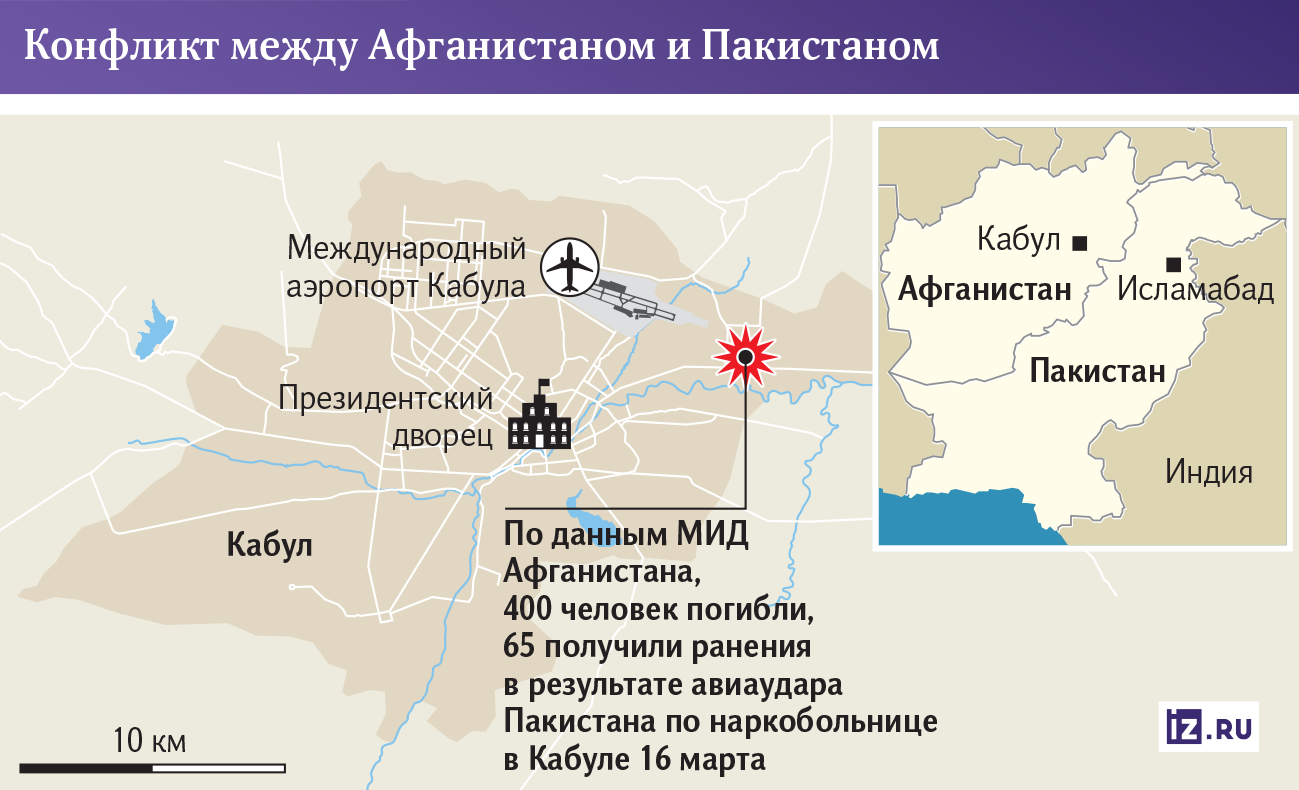
— In addition to disagreements on the position of the border, the parties actively use rhetoric about the terrorist threat and attempts to shake up the enemy from within, — Leonid Tsukanov believes.
The parties will be able to reach an agreement only when all the shelters of the Tehreek-e-Taliban Pakistan movement are eliminated in Kabul, which will suit Islamabad perfectly, Sotnikov concluded.
Переведено сервисом «Яндекс Переводчик»
