
Food or not: Rising fertilizer prices are leading to a global food crisis

The closure of the Strait of Hormuz has led to the stoppage of about 50% of global fertilizer exports, which could disrupt the sowing campaign and provoke a food crisis in Europe and Asia. Prices for nitrogen additives have increased by 30% since the outbreak of conflict in the Middle East. The Russian Federation, which accounts for about 20% of the global market for these products, may increase supplies abroad. How the war in the Persian Gulf is changing the situation in the petrochemical market and what impact Russian manufacturers can have on the industry — in the Izvestia article.
How the Gulf War affected the fertilizer market
Russia may increase the supply of fertilizers for export, according to analysts at Sovcombank, who have studied the consequences of Iran's closure of the Strait of Hormuz. First of all, the restrictions hit India. Supplies of liquefied natural gas (LNG) from Qatar, which serves as the main raw material for the production of nitrogen additives, have actually stopped. As a result, many carbamide production plants either completely suspended operations or significantly reduced their workload.

At the same time, India is in dire need of nitrogen fertilizers: domestic production is noticeably declining on the eve of the monsoon sowing season, which begins in June, experts say. The study also notes that the country's population of 1.4 billion people and the dependence of agriculture on fertilizers directly affects food security: there are significant risks of declining yields of rice, wheat and other basic crops, and as a result, rising food prices.
"In fact, one of the few quick and realistic options is to dramatically increase purchases of carbamide from Russia. 1-1.5 million tons per year (or twice as much) is quite possible, because our supplies do not affect the strait, contracts are already working, and logistics are reliable," the experts admitted.

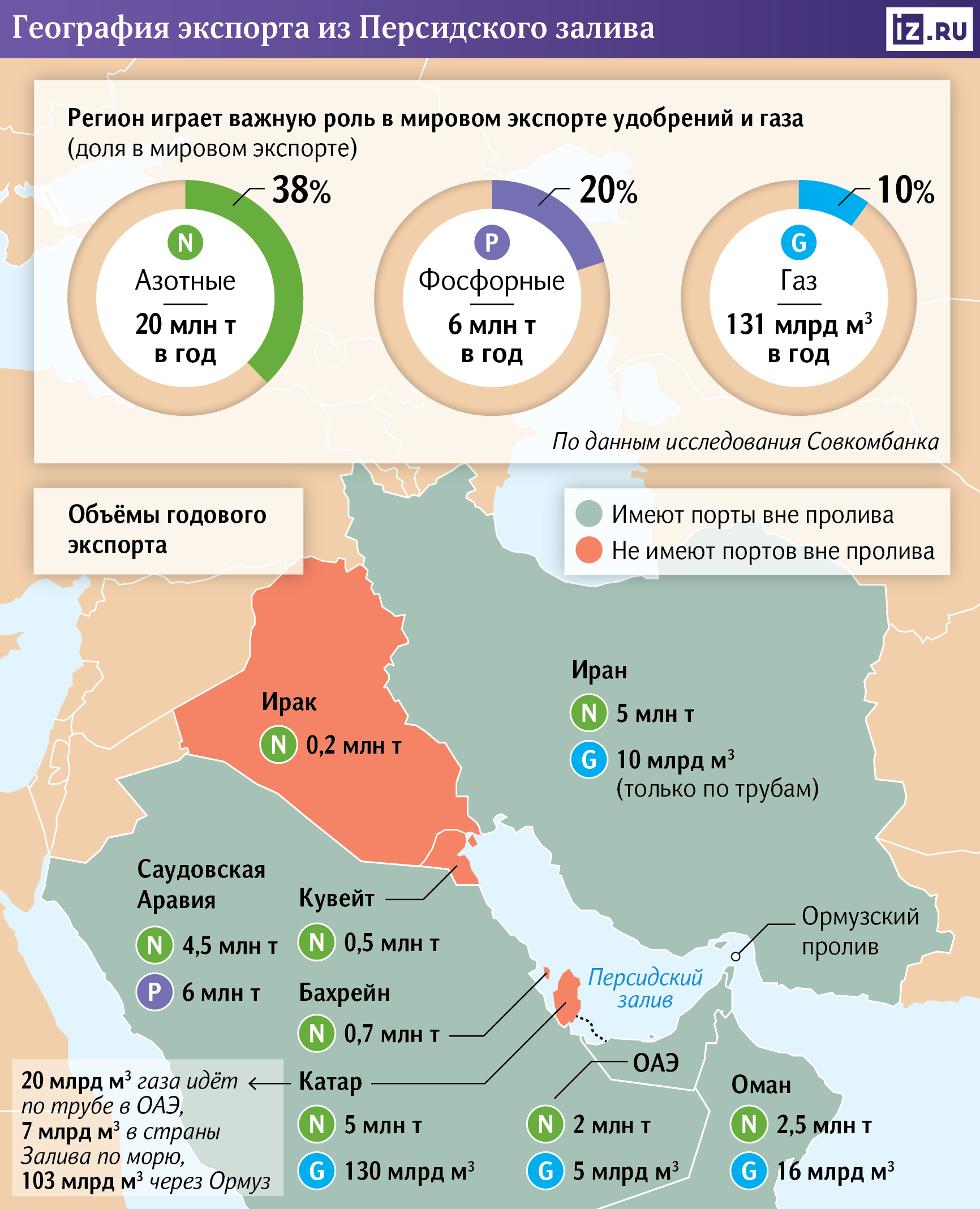
In their report "Fertilizer Market in March 2026," they analyze the situation in Europe, Brazil, and India, as well as shipments through the Strait of Hormuz. It remains a critically important transport corridor, through which more than half of the world's exports of key additives and raw materials pass.
— Under the current conditions, the fertilizer market is facing the threat of a sharp spike in prices and increased volatility. The segments of nitrogen and phosphorus additives look the most vulnerable. Logistical constraints directly affect the supply of carbamide (a key product of the nitrogen group), as well as reduce the availability of ammonia and sulfur, which are basic components in the production chain of phosphorous fertilizers. Given the high seasonality of demand, such a logistical shock can lead to higher costs for farmers and increase inflationary pressure on global food markets in the coming quarters," said Evgenia Popova, Project Manager at Implementa.

According to Valery Andrianov, associate professor at the Financial University under the Government of the Russian Federation, the cost of nitrogen fertilizers consists of 70-90% of the price of natural gas, therefore, due to the cessation of LNG supplies from Qatar and the rise in quotations for "blue fuel" carbamide and ammonia have already risen in price by 15-20%.
— This has made Russian products made from its own cheap gas very competitive and attractive to many importers. Brazil and India are the largest buyers of domestic nitrogen fertilizers, but many other countries, including the United States and EU states, also purchase them," the expert noted.

He stressed that the blocking of the Strait of Hormuz has led to the fact that about half of the European nitrogen fertilizer production facilities are either shut down or operating at minimum capacity. In particular, the Norwegian company Yara announced a 60% reduction in ammonia production at its European plants. And the German concern BASF has completely shut down one of the two ammonia synthesis plants at the giant chemical complex in Ludwigshafen.
Since Europe, along with China and Russia, was one of the three largest producers of nitrogen fertilizers, the shutdown of some capacities may lead to a shortage of supplies and a further increase in prices for these products, the expert noted.

— Thus, Russian companies can become the main beneficiaries of the crisis in the fertilizer market. It is expected that by the end of the year their net profit may increase by 25-40% compared to 2025," said Valery Andrianov.
According to Evgenia Popova, the prices of some basic nitrogen fertilizers have reached their highest levels since the beginning of 2023. So, for carbamide based on FOB ("loaded on a ship") Baltika, they reached the level of $500 per ton, which is about 30% more than the average level last year. A similar trend is demonstrated by ammonium nitrate, the price of which in the first half of March was 50% higher than last year's values.
At the same time, the escalation of the conflict in the Middle East affected the markets of phosphorous and potash fertilizers to a lesser extent due to the relatively small role of the region in their global supplies.
The world's reaction to the situation
Following the immediate crisis in the oil sector due to the closure of the Strait of Hormuz, the threat to food security is coming to the fore. Almost from the very beginning, the UN expressed concerns that the decline in commercial shipping through this strategically important logistics corridor directly affects access to energy, food and fertilizers in many countries. As the conflict drags on, its consequences become more serious.

Concerns have reached Europe: the head of the European Diplomacy, Kaya Kallas, said that blocking the supply of fertilizers could cause famine in African countries. In particular, after the first strikes on Iran, carbamide prices in North Africa increased by almost 20% in just 48 hours, according to data from Rabobank, one of the world's largest agricultural banks. Overall, more than 30% of the world's exports of nitrogen fertilizers, as well as their components such as sulfur, pass through the Strait of Hormuz.
"Any unilateral actions aimed at obstructing or denying transit to neutral vessels raise serious concerns in accordance with international law and may have serious consequences for international peace and security, as well as for the rights of millions of people around the world," the Office of the United Nations High Commissioner for Human Rights told Izvestia.
Due to the increased risks, Kaya Callas even discussed with UN Secretary General Antonio Guterres the possibilities of an initiative similar to the Black Sea initiative (which implied a cease-fire and the resumption of civilian navigation in the Black Sea). However, there are doubts about its effectiveness, given the position of Brussels. Russia is one of the largest importers of fertilizers, but their export is significantly complicated by disconnecting from SWIFT. However, in March 2025, the European Union rejected Moscow's demand to lift sanctions against Rosselkhoznadzor in order to return to the Black Sea Initiative, as a result of which it simply stalled. At the same time, the Food and Agriculture Organization of the United Nations (FAO) clarified to Izvestia that relevant discussions are underway and efforts are being made to find ways to resolve the crisis.

— Diplomatic efforts to de-escalate tensions and ensure freedom of navigation in the Strait of Hormuz are seen as the most effective way to stabilize global energy and food markets, along with coordinated political measures at the national and international levels. This indicates that both short— and medium-term strategies, including diplomatic engagement, are being considered to address disruptions, the FAO said.
However, even under the conditions of restrictions, Russia manages to provide food aid to countries in need. Since 2022, a large number of Russian fertilizers intended for this purpose have been stuck in European ports, mainly in the Baltic states, due to sanctions. Nevertheless, in 2023, it was possible to coordinate the shipment of Uralchem-Uralkali fertilizers to Kenya free of charge from Latvia.

The echoes of the Middle East conflict are also being felt overseas. Due to difficulties with the supply of fertilizers, farmers in the United States and Canada may face problems during the spring sowing season, writes Reuters. According to the agency, specialized shopping malls either remain without the necessary goods, or their prices have increased so much that they become inaccessible to many farmers.

For Russia, on the contrary, the situation does not look like a crisis — there is a mechanism for fixing fertilizer prices on the domestic market. Izvestia sent inquiries to the Ministry of Energy and large fertilizer companies.
Russia's role in the crisis
Dmitry Kasatkin, partner at Kasatkin Consulting, noted that about a third of global urea exports and 45% of sulfur supplies pass through the Strait of Hormuz. QatarEnergy has already stopped production of ammonia and urea, and urea prices have increased by more than 40%. The countries of South and Southeast Asia will be the most vulnerable, primarily India, Pakistan and Thailand, where supplies from the Persian Gulf region account for a quarter or more of fertilizer imports. Serious risks also arise for African countries, where dependence on this direction in some cases reaches 50%. The situation is aggravated by the fact that the interruptions coincided with the period of preparation for the spring sowing campaign, and there is practically no time to find alternative suppliers, the expert added.
"In the petrochemical industry, the main blow will be on methanol: the dropped volumes of Iran and Saudi Arabia create shortages for China and India and put pressure on the prices of plastics throughout the production chain," he said.

According to him, Russia benefits primarily by margin: the low cost of gas plus a 40% increase in prices result in a multiple increase in profits at the already planned volumes. Additionally, the traditional discount on domestic fertilizers is being reduced, because buyers are less picky in conditions of shortage.
However, in his opinion, it will not be possible to quickly increase physical volumes: production facilities are already loaded, and the logistics infrastructure in the eastern and southern directions (port transshipment and specialized fleet) remains a weak point. In addition, Russia itself is somewhat dependent on the import of sulfur, the supply of which from the Gulf is currently disrupted, which constrains the production of phosphorous fertilizers.

The conflict in the Middle East is more likely to lead to a more favorable price environment than to a sharp increase in physical exports from the Russian Federation, said Evgenia Popova from the company "Implementation".
— Russian fertilizer producers consistently demonstrate a high level of capacity utilization — by the end of 2025, it was estimated to be more than 85%. In this regard, the possibilities for a rapid increase in export supplies are limited. In the medium term, additional export growth is expected due to the introduction of new production facilities. Several projects are currently in high readiness, including Talitsky GOK and EuroChem North-West-2, which are scheduled to be launched in 2026-2027," Evgenia Popova emphasized.
The spike in fertilizer prices should not have a negative impact on domestic agriculture, Valery Andrianov noted. Priority is always given to the domestic market, that is, companies must first fully provide Russian farmers with crops at fixed prices, and only send the surplus for super-profitable exports, the expert concluded.
Переведено сервисом «Яндекс Переводчик»
