
Umbrella nonsense: what are France's nuclear ambitions in Eastern Europe leading to?

Paris has launched negotiations on a joint nuclear deterrent with almost a dozen European countries. In the eastern part of the region, France is particularly interested in Poland and Romania. Bucharest has so far rejected the prospects of the appearance of foreign nuclear forces on its territory, but Paris does not stop the pressure, the country's parliament said. The spread of weapons of mass destruction across the continent with the possible dispersion of control over them poses threats to Russia's security, Russian Ambassador to Bucharest Vladimir Lipaev told Izvestia. In response to the possible appearance of French warheads in the region, Moscow may strengthen the security of Crimea and increase the strike potential of the Black Sea Fleet, experts believe.
Which European countries are participating in France's nuclear initiative
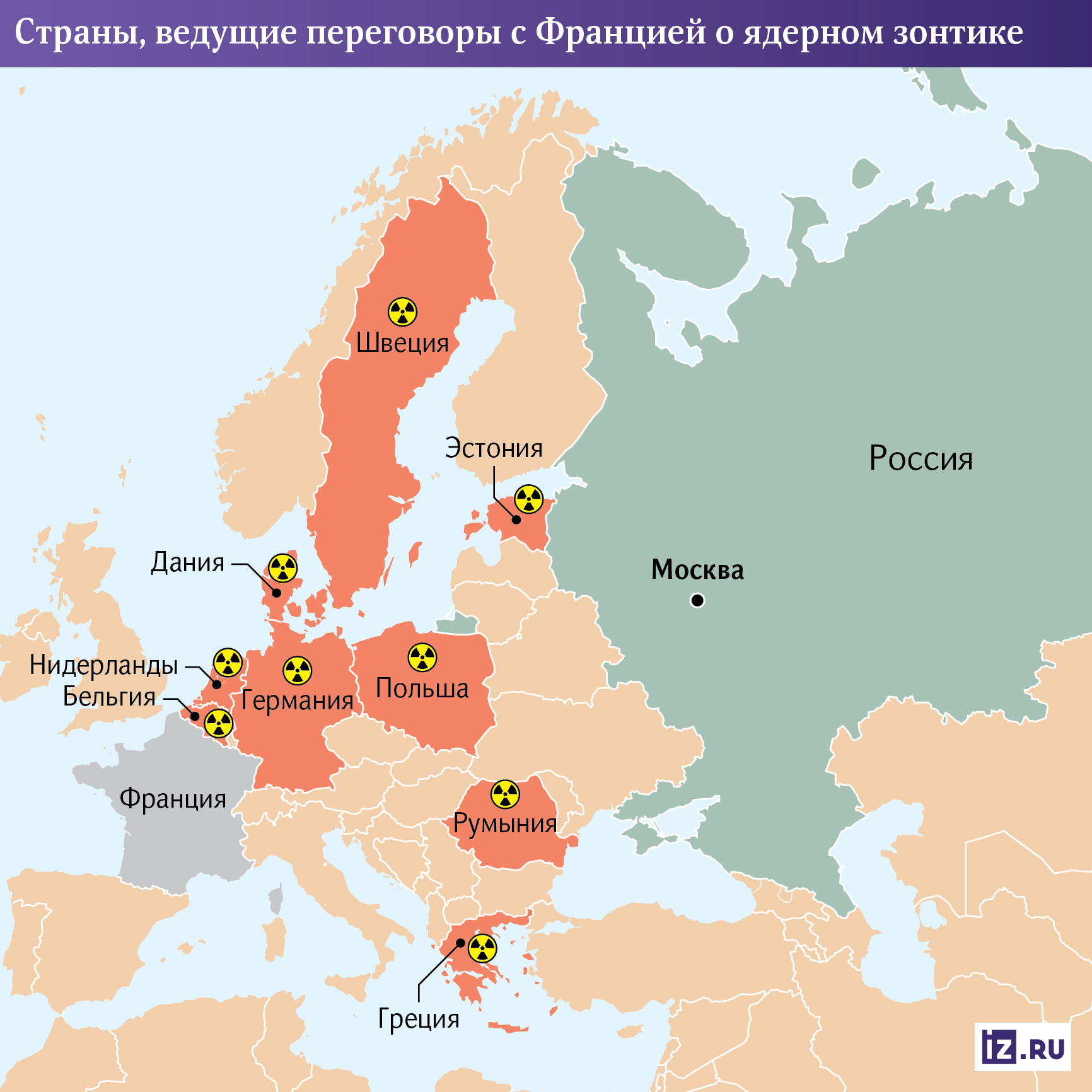
The French proposal for a "nuclear umbrella" over Europe is taking on concrete features. President Emmanuel Macron announced in early March that the United Kingdom, Belgium, Greece, Germany, Denmark, the Netherlands, Poland and Sweden had already officially joined the negotiations on a joint nuclear deterrent.

Paris offers its partners intelligence sharing, special communication channels, as well as the deployment of nuclear weapons carriers on their territory. France currently has two components of a nuclear triad of three: Rafale aircraft with ASMP-A missiles and nuclear submarines.
In Eastern Europe, Romania, Poland and Estonia responded to France's call for negotiations. Warsaw is openly talking about plans to obtain nuclear weapons, including with the help of Paris. Tallinn is also ready to discuss this issue with him.
Romanian President Nicusor Dan said that in the medium term, "there is no talk of nuclear components on Romanian territory." However, France continues to insist on deploying its nuclear weapons near the borders with Ukraine and Moldova, the leader of the opposition parliamentary party S.O.S. Romania, MEP Diana Shoshoake, told Izvestia.
"France demands that Romania adopt nuclear weapons to deploy them on the border with Ukraine and Moldova, they are directed against Russia," the politician stressed.

The Romanian president referred to the "nuclear umbrella" of NATO, which is represented by the United States, as an excuse for his refusal. Earlier, Bucharest allowed the United States to deploy fighter jets and up to 500 troops at the Mikhail Kogalniceanu airbase to support the operation against Iran. However, the role of the head of Romania is still limited, the executive power in the country is divided between the president and the government. The Cabinet expresses "openness to dialogue" with strategic partners, but emphasizes that any final decision should be made by the Supreme National Defense Council.
France has levers of pressure on Bucharest. Paris is the leader of the NATO combat group in Romania. A large contingent of French troops, including air defense and armored vehicles, has been deployed at the Chinku base. French businesses occupy dominant positions in Romania's strategic sectors, especially in energy and retail. Earlier, Telegram owner Pavel Durov hinted that the French special services contacted him on the eve of the Romanian presidential election in order to prevent the victory of the eurosceptic Calin Georgescu.

How will Russia react to the deployment of French nuclear forces
The spread of nuclear weapons with the possible dispersion of control over them poses threats not only to the security of Russia, but also to all states of the planet, Russian Ambassador to Romania Vladimir Lipaev told Izvestia.
— It is regrettable that there are politicians in the West who forget that an atomic bomb is not a toy, and owning such a weapon is, first of all, a huge responsibility to their people and humanity as a whole. Lightness, adventurism and a opportunistic approach to such serious issues are unacceptable," the diplomat said.

French Navy soldiers aboard a nuclear submarine
According to him, the issue of extending the French "nuclear umbrella" to Bucharest is not relevant, at least for now. Economically, the country is almost completely dependent on the European Union, which accounts for 72% of its trade, while in the defense sector it relies entirely on the United States as the leading force in the NATO bloc.
— How justified are the hopes for American support can be judged by the effectiveness and reliability of the military protection that the United States provided to its Middle Eastern allies in the Persian Gulf during the conflict they unleashed with Iran. Apparently, Romania is satisfied with this level of protection," the ambassador stressed.
The degree of threat to Russia will directly depend on the number of French nuclear-armed missiles and carriers that may appear there, as well as the general-purpose forces covering them. In general, this will contribute to the deterioration of the strategic balance in the conditionally "Black Sea" theater of mutual deterrence between Russia and NATO, Dmitry Stefanovich, a researcher at the IMEMO RAS Center for International Security, told Izvestia.

— After the completion of the CDF, serious measures will be required to restore and build up forces and assets on the Crimean Peninsula, primarily in terms of long-range missile weapons, the air force, and air defense and missile defense systems. The potential of the Black Sea Fleet, both strike and aerospace defense, should also be strengthened, the expert believes.
In which other countries could France have nuclear weapons?
Some countries in Western and Northern Europe are responding positively to Macron's initiative. Belgian Foreign Minister Maxime Prevost said that Brussels could provide its air bases for French aircraft capable of carrying nuclear weapons. Denmark does not rule out such a scenario, and Sweden may agree to deploy a nuclear arsenal on its territory during wartime, said Defense Minister Pal Jonson.

Berlin has so far refrained from commitments to deploy French carriers on its territory. However, the parties have already formed a high-level bilateral group on nuclear cooperation. As a first step, the German military will participate in the exercises of the French nuclear forces as early as 2026. The parties are also negotiating with the aerospace company ArianeGroup about the potential acquisition of a new ground-based ballistic missile.

The possibility of deploying French nuclear weapons on the territory of a European country will depend on two key factors. Firstly, it depends on the determination and interest of the partner, since the receiving side automatically assumes the risk of becoming a priority target for Russia in the event of a conflict. Secondly, how strategically necessary it is for Paris itself and what specific military and political goals it will serve, Tigran Meloyan, an analyst at the HSE Center for Mediterranean Studies, emphasized in an interview with Izvestia.
— However, the deployment of French nuclear warheads outside the jurisdiction of France is still extremely unlikely. This will require serious doctrinal changes and the building of an appropriate infrastructure," the expert noted.
According to Meloyan, the most likely scenario is the deployment of French Air Force aircraft capable of carrying nuclear weapons on the territory of the allies, which, in turn, will be presented as a temporary phenomenon associated with joint military exercises.
The strengthening of France's nuclear arsenal will affect the dialogue on nuclear arms control. The Strategic Offensive Arms Treaty (START Treaty) ended on February 5. According to Western media reports, Russia, the United States and China are in contact regarding the development of a new agreement. Moscow, as you know, insists on accounting for the nuclear arsenals of Great Britain and France. Paris' desire to extend its "nuclear umbrella" to Europe clearly will not help advance the negotiations.
Переведено сервисом «Яндекс Переводчик»
