
Debriefing: Iraq discusses closing skies to U.S. and Israeli aviation

Baghdad has prepared a bill to finance an air defense system to close the country's airspace to American and Israeli aircraft. This was reported to Izvestia by the Coordination Structure, the largest parliamentary coalition. The events of recent weeks have shown that Iraq's airspace remains virtually unprotected. Israeli fighter jets regularly use it to fly towards Iran, which is sharply criticized by some of the Iraqi political forces. At this time, regional threats are increasing — the Hezbollah movement was able to penetrate Israel's Iron Dome system, and the IDF is preparing for a land invasion of Lebanon.
In Iraq, they demand an end to the American military presence
Iraq is turning into one of the key arenas of confrontation between Iran on the one hand and the United States and Israel on the other. Since February 2026, after the start of massive strikes on Iranian territory, the skies over Iraq have become a zone of intense military activity. The geographical location of the republic makes its airspace a natural transit corridor for many operations: the shortest route from Israel to the western and central regions of Iran passes over Iraqi territory.

In this situation, the country's largest parliamentary coalition, the Coordination Structure, has prepared a bill on allocating funds for the development of the air defense system. As the coalition told Izvestia, the document provides for the financing of an air defense system designed to protect the skies of the republic and ensure its security. The initiative should allow Baghdad to strengthen control over its airspace and prevent unauthorized overflights by foreign aircraft.
— We have submitted a bill on financing the air defense system to protect the skies of Iraq. Every time we raised this issue in meetings with the heads of the security forces, they referred to the lack of funding. Today, many Iraqis feel humiliated when their skies remain open to American and Israeli aircraft, the Coordination Structure said.
The "coordination structure" dominates the political life of Iraq. The umbrella alliance includes most of the Shiite political forces (except for the movement of Muqtada al-Sadr). The key participants have close ties with Iran, which makes the coalition the main channel of Tehran's influence in Iraqi politics. After the November 2025 parliamentary elections, the "Coordination Structure" won the majority of seats. This gives her priority in nominating the Prime Minister and forming the Government.
The coalition believes that the continued US military presence in Iraq poses a direct threat to the country's security and stability and draws it into regional conflicts that do not meet national interests.
—The Iraqi government should take a resolute and clear position and seek the immediate cessation of the American military presence without delay," one of the deputies said.
Iraq has almost no active air defense. After the war and long-term restrictions on arms supplies, the country actually lost the means to protect its airspace. Even with the adoption of the law, the construction of a full-fledged system will take months. Until that happens, Baghdad will not be able to effectively restrict flights by American and Israeli aircraft.

One of the central streets of Baghdad in Iraq
The weakness of the republic's air defense system remains a long-standing problem, Iraqi military analyst Safaa al-Assam confirmed to Izvestia. According to him, Baghdad has already tried to purchase more modern detection and air defense systems, but such supplies usually require coordination with the United States.
"As a result, Iraq still has limited capabilities to detect modern aircraft and protect its airspace, which makes the issue of modernizing air defense one of the key issues for the country's national security," the expert said.
Russia can play a significant role here by offering increased military cooperation and access to modern air defense systems. Iraq is showing interest in Russian air defense systems, including the S-400, as reported by the country's ambassador to the Russian Federation, Haidar Mansour Hadi, back in 2019. The Russian Ambassador to Iraq, Elbrus Kutrashev, explained to Izvestia that the main obstacle to the purchase of such systems was the US position.

The Israeli army is preparing for a ground invasion of Lebanon
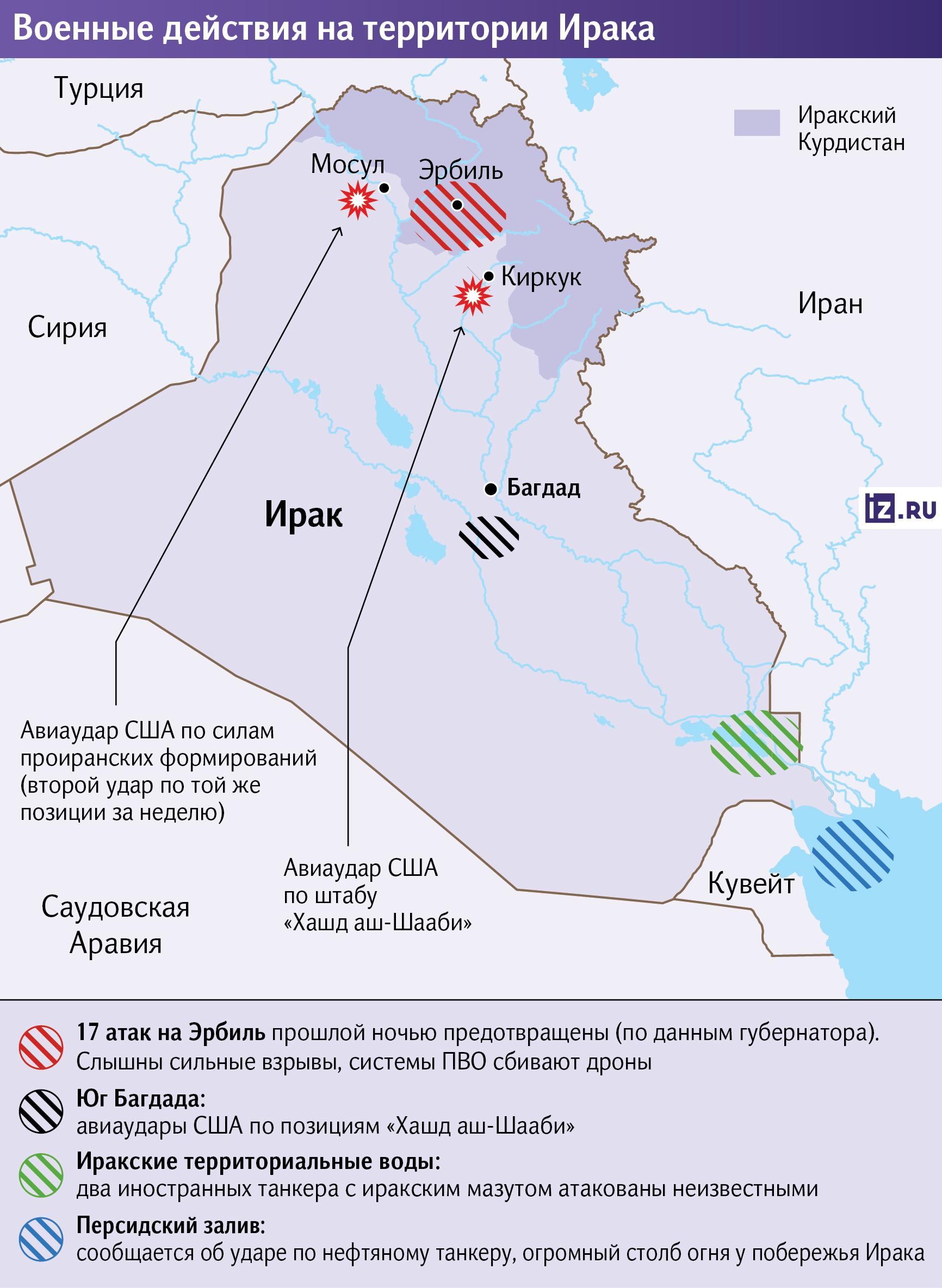
At the same time, military escalation around American facilities and pro-Iranian armed groups is intensifying in Iraq. Since the beginning of the war, major Iraqi Shiite armed groups — Kataib Hezbollah, Harakat al-Nujaba, Kataib Sayyid al-Shuhada and the Ansar Allah Faithful Movement have sided with Iran. These formations, with a long history of fighting and close ties to Tehran, began to carry out attacks on American facilities in Baghdad and Erbil, including bases, consulates and airports.

On March 6, Baghdad received a notification from the United States about the launch of attacks against groups that Washington blames for attacks on American bases in the south and north of the country. Within a few hours, about 14 air and drone strikes were carried out against Hashd al-Shaabi (a large pro-Iraqi militant group) north of Baghdad. At the same time, Iraqi air defense systems allegedly managed to shoot down one drone that tried to attack the Victoria base near Baghdad International Airport.
At the same time, new drone attacks are being recorded on targets associated with the United States. On March 11, a drone was intercepted near the American consulate in Erbil, where locals heard a series of explosions. Earlier, a UAV also attacked one of the key American diplomatic facilities in Iraq — according to the Washington Post, this could be a response by pro-Iranian groups to the war between the United States and Israel against Tehran.

On the same day, a drone strike in Iraqi Kurdistan killed a member of the Iranian Kurdish opposition party Komala, which blamed the Islamic Republic for the attack. Amid the escalation, the US Embassy in Baghdad warned of possible attacks on facilities visited by foreigners and urged American citizens to leave the country as soon as possible.
After the withdrawal of American troops from the Ain al-Asad base in January 2026, the number of US forces decreased to less than 1,100 people stationed in Baghdad and Erbil. The US military presence has become the lowest since 2014: the remaining contingent is limited to defensive functions, equipment and arsenal are not intended for offensive operations.

Meanwhile, the escalation continues in the region. So, on the eve of the Lebanese Shiite movement Hezbollah launched a massive strike on Israeli territory, piercing the Iron Dome missile defense system, the New York Post reports, citing sources in the Israeli army. According to the newspaper, about 100 rockets were fired from the territory of Lebanon, which overloaded the system so much that only half of them were intercepted. There is no exact information about the damage caused yet.
In response, the Israeli army began preparations for a ground operation in Lebanon. Defense Minister Yisrael Katz said that the military intends to expand operations in the republic, the Ynet portal reports.
Переведено сервисом «Яндекс Переводчик»
