- Статьи
- World
- This conflict will stretch: Iran's missile arsenal is capable of expanding the conflict

This conflict will stretch: Iran's missile arsenal is capable of expanding the conflict

Iran still has an arsenal of up to 2.5 thousand ballistic missiles of various ranges and continues to restore their production. Izvestia was informed about such assessments by the Israeli side by a source in the military structures of this country. The presence of such a large number of weapons can delay the operation against Tehran for a much longer period than its initiators expected. Despite the fact that the conflict between the United States, Israel and Iran has already turned from a local confrontation into a large-scale regional crisis in a matter of days. On March 3, the Jewish state expanded its geography — it announced the start of a ground operation in Lebanon and attacked more than 160 Hezbollah targets. Meanwhile, Donald Trump actually admitted the failure of the plan to rebuild Iran — according to him, people whom the United States saw as an alternative to the existing government died as a result of American attacks. But he still announced a "third wave" of strikes.
The death toll in Iran has exceeded 780 people.
March 3 was the next stage of a sharp escalation of the conflict in the Middle East. For the first time during the current confrontation, Israel simultaneously attacked targets in Tehran and Beirut, and also announced the start of a ground operation in southern Lebanon.

At the same time, Tel Aviv realizes that the war, which the country is already waging on two fronts, may drag on. An Israeli military source told Izvestia that Iran currently has an arsenal of up to 2.5 thousand ballistic missiles of various ranges. According to him, in recent months, Tehran has stepped up the restoration and expansion of missile production, despite sanctions and strikes on industrial infrastructure.
Iran's missile and overall military production facilities were severely damaged as a result of the 12-day war in June 2025. But according to Sarit Zehavi, a retired lieutenant colonel and president of the Israeli Alma Research Center, external assistance from China played a significant role in their subsequent recovery.
— We are talking, in particular, about the supply of specialized industrial equipment, including planetary mixers. Some of them were attacked and seized by the United States. But at the same time, it cannot be ruled out that a significant proportion of such supplies has reached Iran and continues to be used," Sarit Zehavi told Izvestia.

Mixers of this type play a key role in the production of solid fuels needed for long-range ballistic missiles, including those capable of hitting targets in Israel. This could allow Tehran to maintain and increase its production capabilities. Such assessments add a certain dissonance to the earlier statements by Washington and the Israeli leadership about the strong weakening of the Iranian military-industrial complex.

Meanwhile, due to the ongoing airstrikes, the humanitarian situation in Iran is rapidly deteriorating. According to the Iranian Red Crescent, the death toll from U.S. and Israeli strikes has exceeded 780 people. Hundreds of wounded are being admitted to hospitals. The Iranian authorities claim the destruction of civilian infrastructure, including residential areas and social institutions.
One of the most tragic episodes of the conflict was an airstrike on a girls' school in southern Iran on the first day of hostilities. According to the Iranian authorities, more than a hundred schoolgirls were killed, and the victims' funerals were held on March 3. Tehran blamed the United States and Israel for the attack. The Israeli side, commenting on reports of numerous civilian casualties, insists that as part of the operation, strikes are carried out exclusively against military infrastructure facilities.
Tehran, in turn, retaliates with strikes against military installations of the United States and its allies in the region. According to the American command, six US soldiers were killed and several others were injured as a result of the Iranian attacks. The strikes targeted bases in Bahrain, Jordan, Qatar, Kuwait, the United Arab Emirates and Saudi Arabia.

A separate episode was the drone attack on the US Embassy in Riyadh, which led to a fire and minor damage. The American diplomatic mission was temporarily closed, and US citizens were advised to take shelter and restrict movement.

According to the Axios portal, the UAE is considering the possibility of switching to "active defensive measures" in response to attacks on its territory. If earlier the Gulf countries were limited to the work of air defense, now Abu Dhabi is ready for tougher counteraction.
In turn, the Iranian Defense Ministry said that the capabilities of the Islamic Republic in the coming days will put the enemy in a dead end and force the United States and Israel to end the war. The ministry stressed the stability of the army vertical: each Iranian commander has three deputies. Tehran is confident that the death of even top generals will not lead to a vacuum in management — their places will be instantly occupied by trained personnel.
Initially, Tehran stated that it was striking exclusively at American bases, but very quickly the attacks went far beyond this framework — destruction of civilian infrastructure and damage to airports were recorded, said Roman Yanushevsky, editor-in-chief of the website of the 9th Israeli TV channel. This is exactly the development of events, the expert emphasized in an interview with Izvestia, which was feared in the Gulf countries.: they actually found themselves on the front line of the conflict, losing not only economic resources, but also security.
At the same time, according to him, it is easier for Iran to strike at these states than at Israel, due to geographical proximity and more vulnerable defense systems. Despite the active work of air defense and regular reports of interceptions of missiles and drones, the Gulf countries are still limited to defense and avoiding their own offensive actions.

Israel announces ground operation in Lebanon
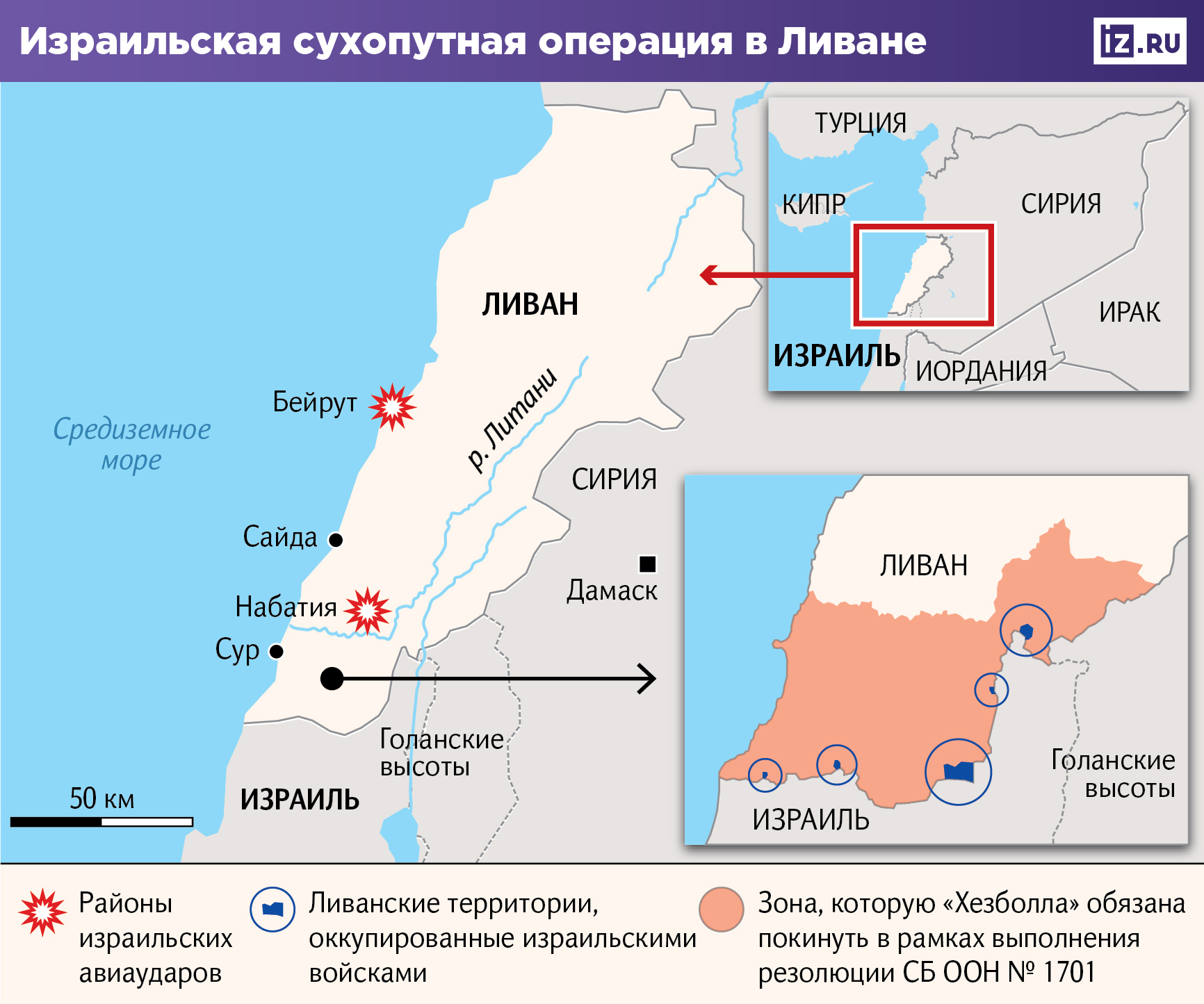
At the same time, tensions have sharply increased in the northern direction. Israel has deployed additional units to southern Lebanon, saying it is taking preventive measures to protect civilians and strategically important facilities. Israel claims that the deployment is defensive in nature, but in practice we are talking about the actual expansion of the previously occupied zone on Lebanese territory.

The Hezbollah movement claimed responsibility for launching drones and rockets at Israeli military targets, including bases in the north of the country and in the Golan Heights area. The Israeli side declares the successful interception of some targets and the absence of damage on its territory. In turn, the Israel Defense Forces (IDF) reported attacks on more than 160 Hezbollah targets in southern Lebanon.
It was precisely this scenario — the country's involvement in the war — that the Lebanese leadership feared. Against this background, the Government of the country announced a complete ban on any military actions by Hezbollah and called on the movement to abandon armed activity, limiting itself exclusively to political activities.
At the same time, the Lebanese army began evacuating its units from a number of border positions in the south of the country. According to local media, the troops were withdrawn from a number of settlements and advanced strongholds. Against this background, the Israeli army began advancing to the outskirts of several border settlements, and the air force launched a series of strikes on the southern regions of Lebanon.

The chief of the IDF General Staff, Lieutenant General Eyal Zamir, said that the army would not stop until the "complete disarmament" of Hezbollah units. In fact, this may mean that Israel intends to continue the cleansing of southern Lebanon until the military infrastructure of the Shiite movement is eliminated.
Witkoff's statements have raised questions in Moscow
Meanwhile, Cyprus was also hit: according to the British Defense Minister, Iran fired missiles towards the island where the British air base is located. Against this background, France announced its intention to deploy additional anti-missile and anti-drone systems in Cyprus. In Iran, meanwhile, attacks on strategic infrastructure continue, including the Natanz nuclear facility, where satellite images record new destruction inside the complex.

Richard Bensel, a professor at Cornell University, noted in an interview with Izvestia that the "America First" declaration, which the current US administration adheres to, initially called for minimizing external interventions, and many of Washington's steps in Latin America and the Middle East contradict this logic. All this reinforces fears that the conflict, which began as a limited confrontation, is rapidly escalating into a large-scale regional war in which diplomatic tools remain in the background.

A resonant statement was made from Washington. Donald Trump has actually acknowledged the absence of a "plan B" for Iran's political transformation. According to him, most of the people whom the United States considered an alternative to the current government probably died in the recent attacks. "We had a band in mind, and they died. And now we have another group. Maybe they're dead too... The third wave is underway," the American president stated.
The international community's special attention is focused on Tehran's nuclear dossier, which has actually become the reason for the current round of aggression. Special Envoy of the US President Steve Witkoff said on Fox News that the Iranian delegation at the talks that preceded the conflict confirmed the presence of 460 kg of uranium enriched to 60%. According to Washington, this is enough to create 11 nuclear warheads. At that time, the United States made it clear that they were ready to stop Iran by force if Tehran did not abandon uranium enrichment.

However, Moscow emphasizes that this interpretation of the causes of the conflict raises serious questions.
—Maybe Steven Witkoff made an unfortunate statement, but if that was the reason for the aggression, it raises many questions," Russian Foreign Minister Sergei Lavrov said.

Special Envoy of the President of the United States Stephen Witkoff
The Minister recalled that the right to enrich uranium for peaceful purposes applies to all parties to the Treaty on the Non-Proliferation of Nuclear Weapons without exception. According to Sergey Lavrov, the demand to make Iran the only country in the world deprived of this right is unrealistic, and forceful pressure will only stimulate the creation of nuclear weapons in the entire region.
Against the background of the escalation, the safety of the Bushehr NPP was under threat. The head of Rosatom, Alexei Likhachev, announced the suspension of work at the nuclear power plant. According to him, there is currently no communication with the leadership of the Iranian nuclear industry, and there is no understanding of the situation around the facilities yet. Likhachev stressed that the explosions were already being heard several kilometers from the nuclear power plant's physical protection line. Despite the fact that neighboring military facilities remain targets, Rosatom warns that the risks to the plant are growing in proportion to the escalation of the conflict.
Переведено сервисом «Яндекс Переводчик»
