
Rake-in: how the US attempts to change power in Iran ended

The US actions to change "undesirable" regimes are mired in cycles. In Iran, Americans have been interfering in political processes for half of the 20th century. After overthrowing democratically elected Prime Minister Mohammad Mosaddegh in 1953, they installed Shah Mohammad Reza Pahlavi in power. Then the Americans themselves greatly contributed to the creation of the Islamic Republic of Iran under the leadership of Khomeini, and now they are trying to destroy this system. And among the potential candidates is Pahlavi again, only now his son. At the same time, Boris Yefimov, the famous Izvestia cartoonist, noticed the peculiarities of US policy in Iran half a century ago.
How the US overthrew regimes in Iran
The actions of the United States to change "undesirable" regimes are bogged down in the cyclical nature of history. Another confirmation of this is the actions of the United States and Israel against Iran, which have already turned into a large—scale war and destabilization of the entire region. Back in 1980, the famous Izvestia cartoonist Boris Yefimov drew attention to the fact that US military adventures were always accompanied by arguments about "protecting human rights" and "easing tensions," but in the end they created a new, even more dangerous one. And the cartoon "The Pentagon's Risky swim in the Persian Gulf" clearly predicted what is happening in the Middle East.
Since the end of the second half of the 20th century, the United States and its allies have been intervening in Iran's politics with enviable frequency. Suffice it to recall Operation Ajax in 1953, led by the CIA and MI6, which led to the overthrow of the democratically elected Prime Minister of the country, Mohammed Mosaddegh.

— There is indeed a certain cyclical pattern — the United States sought to change the ruling regime in Iran whenever it intended to gain control over local resources or make the country dependent on Washington's position. This was especially true during the Cold War, when Iran, rich in oil resources, was an important "asset" in the global political game, orientalist Leonid Tsukanov told Izvestia.
In the mid-1970s, until the revolution, Iran was consistently among the top 4 leading global oil producers. And Mohammad Mosaddegh's decision in 1951 to nationalize the oil industry — the assets of the Anglo-Iranian company (now BP) — went against the economic interests of the Americans. And as history shows us, the United States does not neglect any means to protect them. It is no coincidence that Boris Yefimov portrayed Uncle Sam, "covering" the entire globe with American interests and at the same time "hedging" national missile power.
As a result, fearing the loss of Iran's powerful oil base, and with it, in the future, the entire region, the United States and Britain played a key role in overthrowing Mosaddegh.
— As a leftist figure, he could, under certain conditions, lean towards the Soviet Union. Moreover, during the Second World War, Northern Iran was under Soviet occupation.: There were many pro-Soviet politicians and opinion leaders there. The Eisenhower administration reacted painfully to this prospect, and it did not need a completely leftist government in Iran," Andrei Kortunov, an expert at the Valdai Club, told Izvestia.
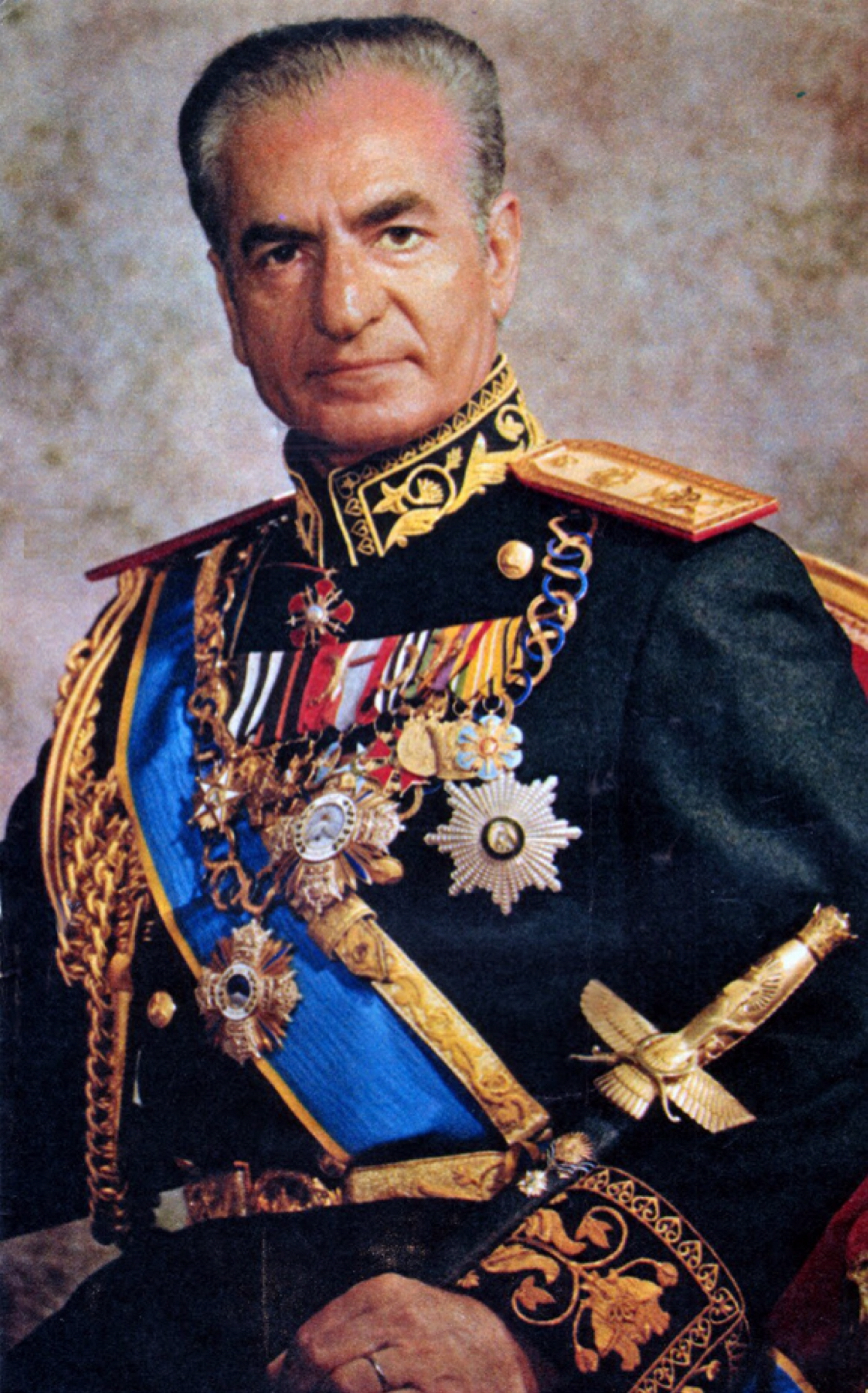
As a result, this strengthened the monarchical power in the country in the person of Shah Mohammad Reza Pahlavi, who began to position himself as an independent player and intended to make Iran almost a Middle Eastern superpower. However, at some point he became a "victim" of the American system.
The Jimmy Carter administration began to put pressure on the Shah, demanding more democracy and respect for human rights in the country. This gave the opposition room for maneuver and undermined the authority of the monarch, who was popularly considered an "American puppet."
In 1979, the Islamic Revolution took place, and Ayatollah Ruhollah Khomeini, who enjoyed broad popular support, came to power.
— I think it is also wrong to say that the Americans abandoned Shah Pahlavi to his fate. They simply did not believe that this regime could collapse so rapidly and so irreversibly. They clearly didn't calculate this," Andrei Kortunov believes.
In addition, the Afghan war broke out in 1978-1979. Probably, the United States simply did not have enough resources to work on several fronts at once, throwing all its forces into supporting Pahlavi.

However, there is another version. In 2016, the United States declassified documents confirming that representatives of the Carter administration held talks with Khomeini when he was in exile in France.
— Khomeini, wanting to return to power and fearing resistance from the military, turned to Carter, assuring him that the government would maintain friendly relations with the United States. Realizing that he was faced with a choice between an Islamic theocracy and the Communists, Carter chose the theocracy and secretly used US influence on the military to prevent them from blocking the Ayatollah's rise to power, Peter Kuznik, director of the Institute for Nuclear Research at the American University in Washington, professor of history, told Izvestia.

Everything new is well-forgotten old
Iran is far from the only country where U.S. support was determined by short—term interests. And against this background, the leaders who came with them soon began to take a different position.
— They supported Saddam Hussein in the 1980s mainly to defeat Iran. During the eight-year Iran-Iraq war, the United States formally remained neutral. But in fact, of course, they were on the side of Iraq, there were large supplies of weapons, there was an exchange of intelligence information. But Saddam Hussein was unable to win a decisive victory. And since he later invaded Kuwait, the Americans had already turned their backs on him. Hussein did not live up to the expectations that were placed on him," said Andrei Kortunov.

Iraqi-Iranian border: damaged tank on the side of the road
A number of Middle Eastern leaders wanted to pursue as sovereign a foreign and domestic policy as possible. And Americans do not perceive such leaders as at least some kind of equal partners, putting them in a dependent and humiliating position. The United States is actually pulling resources out of them in full, said Farhad Ibrahimov, an expert on Iran and the Middle East.
— The United States supported Saddam Hussein not because they wanted to bring peace to Iraq, but because they saw him as an instrument of their power. The same ex-Egyptian President Hosni Mubarak was their loyal ally to the last. They took him and overthrew him themselves," says the political scientist.
Therefore, the Americans were able to control their henchmen quite effectively only when, along with the regime change, the corresponding dependence of the state on the United States was created. It could have been an economic link, or a "force link" — the deployment of American bases, said Dmitry Novikov, head of the HSE Laboratory of Political Geography and Modern Geopolitics.

For this, the United States is now looking for Iran, in fact, a "new" Pahlavi. In the West, they really expect that the descendant of the last Shah of Iran, Prince Reza Pahlavi, will lead the country. Living in the United States "in exile," he declared his readiness to return to the Islamic Republic "at the earliest opportunity." Recently, Reza called on European leaders to support the US military operation in Iran, calling it a "humanitarian rescue mission that will save many lives."

However, the current attempt to "restore the monarchy" is based on nothing but the conviction of the United States and Israel in the correctness of this step, Tsukanov argues.
— The descendants of the Shah are unpopular in Iran and have no influence on the local population. Moreover, some minorities (even if they are unfriendly towards the Ayatollah regime) have a negative attitude towards the Pahlavi dynasty. For this reason, Reza Pahlavi's only chance to stay in power in the event of a hypothetical victory is to fully obey Western curators, the expert believes.

On the other hand, according to Tsukanov, excessive control is fraught with the emergence of new "popular authorities" who can quickly play the situation in their favor, despite Western support. Curiously, Pahlavi's candidacy does not seem to suit the United States anyway. At the very least, his political acumen is questionable — some Iranians accuse him of endangering people's lives amid the ongoing strikes, encouraging them to protest.
According to the British newspaper Telegraph, Washington is afraid of making Pahlavi another Ahmad Chalabi, "who was praised in Washington as a possible successor to Saddam Hussein, but whom the Iraqi people rejected after the invasion in 2003."
Переведено сервисом «Яндекс Переводчик»
