- Статьи
- Science and technology
- In one picture: "quantum antennas" made of atomic steam will catch the connection between underground and water

In one picture: "quantum antennas" made of atomic steam will catch the connection between underground and water

Russian scientists have proposed a concept for a new generation of radio communication devices that use atomic gas as an ultra-sensitive antenna. It consists of Rydberg atoms, which are highly susceptible to electromagnetic radiation. Such "quantum antennas" are capable of detecting even extremely weak signals, as well as so-called swirling radio waves that transmit more information than conventional ones. The development can form the basis of compact walkie—talkies, navigation and search devices designed to work in difficult conditions - under rubble, underground or at a considerable depth under water.
How atoms become hypersensitive
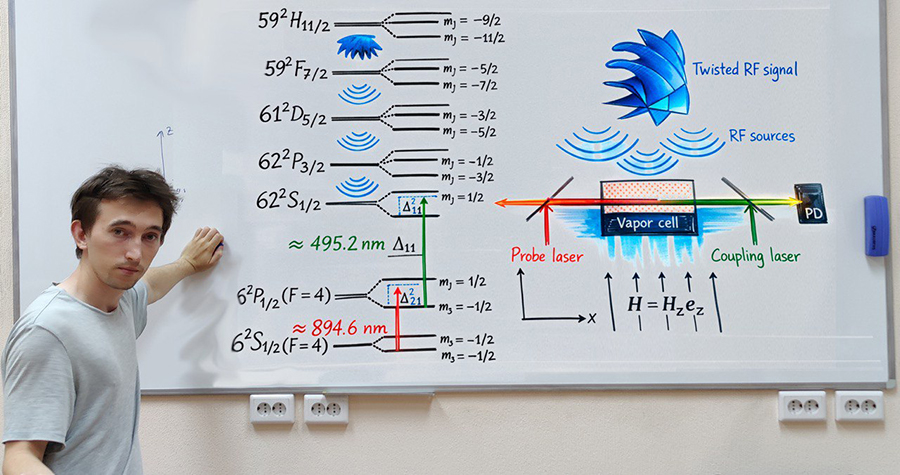
Physicists at Tomsk State University have developed a scheme for future radio receivers with a new way of detecting signals. So, as an ultra—sensitive antenna, scientists have proposed glass flasks with atomic vapor, a gas of individual highly excited atoms. According to the researchers, in the future, such devices will be able to detect even the weakest signals. Including in difficult conditions, such as deep underground or underwater. In the future, they can improve the reliability of communication for rescuers, miners, speleologists and submariners. The Ministry of Education and Science of the Russian Federation told Izvestia about this.

The new device is based on the so—called Rydberg atoms. They differ in that one of the electrons in them is in a very distant orbit — thousands of times further than in the normal state. This is achieved through exposure to a laser, the developers said. The result is "giant" atoms that become extremely susceptible to electromagnetic waves and respond to the weakest signals. Placed in a flask, they turn into ultra-sensitive radios.

— Such devices, among other things, allow you to capture swirling radio waves. They have an unusual "geometry" — their oscillation phase swirls around the direction of movement, forming a spiral. Due to the orbital angular momentum, swirling radio waves can carry more information, using it as an additional degree of freedom for encoding data," Petr Korolev, a research engineer at the Laboratory of Theoretical and Mathematical Physics and a junior researcher at the Laboratory for Data Analysis of High—energy Physics at the TSU Faculty of Physics, told Izvestia.
Swirled radio waves, the source explained, potentially allow for the transmission of several independent data streams on the same frequency. Similar principles are being considered in the world when developing new communication standards, including so-called 7G technologies that can replace modern systems. In addition, each new spin stage can be used as a separate channel, which will allow multiple channels to be placed on the same frequency.
Experts are also considering Rydberg atoms as sensors in devices for probing the subsurface, the scientist said. These devices will be able to "feel" underground objects at great depth with an accuracy of several centimeters. Such measurements, for example, are important for accurate assessment of mineral reserves or for the search of archaeological sites.
So far, the lack of compact and universal detectors has hindered the development of these ideas, said Peter Korolev. The "antenna" with atomic steam itself is a cube several centimeters in size, but laser installations take up a lot of space. Therefore, developments exist only in the form of laboratory versions. However, the proposed schemes may help to make a breakthrough.
"In recent years, Rydberg atoms have been used to develop prototypes of quantum radio receivers," explained Vladislav Ryakin, co—author of the study. — In a typical scheme, they are placed in glass cells and illuminated with lasers. A swirling wave excites special quantum states in atoms that can be detected. For example, by measuring the loss of light as it passes through a cell, you can restore the parameters of the radio signal.

According to him, theoretically, the transmission of several independent data streams on a single carrier frequency will help solve the problem of air congestion and frequency allocation. In addition, the special geometry of swirling waves complicates the encoding of signals, which makes it more difficult to intercept information.
How to improve communication underground and underwater
— The research is a fusion of quantum physics and classical radio engineering of a new level. During the work on the proposed scheme, two possible types of devices were presented. Further work in this direction will contribute to the creation of compact sensors for analyzing complex radio signals and new communication systems," says Peter Kazinsky, one of the authors of the development, professor of the Department of Quantum Field Theory at the TSU Faculty of Physics.
For example, the increased data transmission density will allow for more precise control of robotics in mines or underwater and receive more telemetry from them, he said.

— The use of Rydberg atoms for radio wave detectors is a well—developed field, and commercial prototypes have already been created. Similar developments are also underway in Russia. In addition, Rydberg atoms are used for qubits in atomic quantum computers at Moscow State University. The detection of waves with an orbital moment by atomic ensembles has also been developed," Alexey Akimov, scientific director of the Russian Quantum Center, told Izvestia.
The Tomsk colleagues brought together the available knowledge and, on this basis, proposed a schematic diagram of the detectors. The idea is interesting, but it's too early to talk about specific products, he explained.

— Now the orbital moment of light is a sphere of interest for scientists. But practical tasks for them may also arise. For example, in optics, such beams are used for ultra-sensitive interferometers and for obtaining ultra-high-resolution images. Something similar can be done in the microwave range. Nevertheless, mass—produced products are still far away, and a lot of effort is needed to develop the idea into real solutions," he added.
Developments in the field of underwater communications remain in demand. However, the use of electromagnetic waves in the usual radio or optical communication ranges faces a physical limitation: in salt water, they almost do not spread over significant distances, Dmitry Ilyinsky, senior researcher at the Laboratory of Underwater Research and Testing Technology at the P.P. Shirshov Institute of Oceanology of the Russian Academy of Sciences, told Izvestia.

Therefore, according to him, any proposals to apply "new electromagnetic effects" require detailed verification in real experiments. Today, the only reliable and physically sound method of underwater communication is sonar, the expert emphasized.
— Physicists have proposed a theory that makes it possible to describe the properties of two swirling radio wave detector circuits based on Rydberg atoms. The work presents a synthesis of optical and radio frequency methods. This combination is fraught with difficulties related to the difference in the energies of quantum structures, which requires different measurement techniques," explained Maxim Smirnov, an employee of the Kazan Quantum Center, associate professor at the Kazan National Research Technical University named after A.N. Tupolev — KAI.
Nevertheless, the theory is interesting not only from the point of view of detecting radio signals of complex structure, but also as an example of new methods of controlling atomic systems using structured radio waves, he added.
Переведено сервисом «Яндекс Переводчик»
