- Статьи
- Science and technology
- Nourish clothes: smart fabric will clean itself of dirt and repel bacteria.

Nourish clothes: smart fabric will clean itself of dirt and repel bacteria.

Russian scientists have developed a smart fabric capable of destroying pathogenic bacteria and self-cleaning from pollution when exposed to sunlight. For the first time, researchers have managed to combine antibacterial properties, ultra-high water repellency and biocompatibility in cotton material. As experts told Izvestia, in the future, the development can reduce the risks of the spread of nosocomial infections and be used to create new—generation clothing, from sports and children's clothing to special uniforms for health workers.
3-in-1 Smart fabric
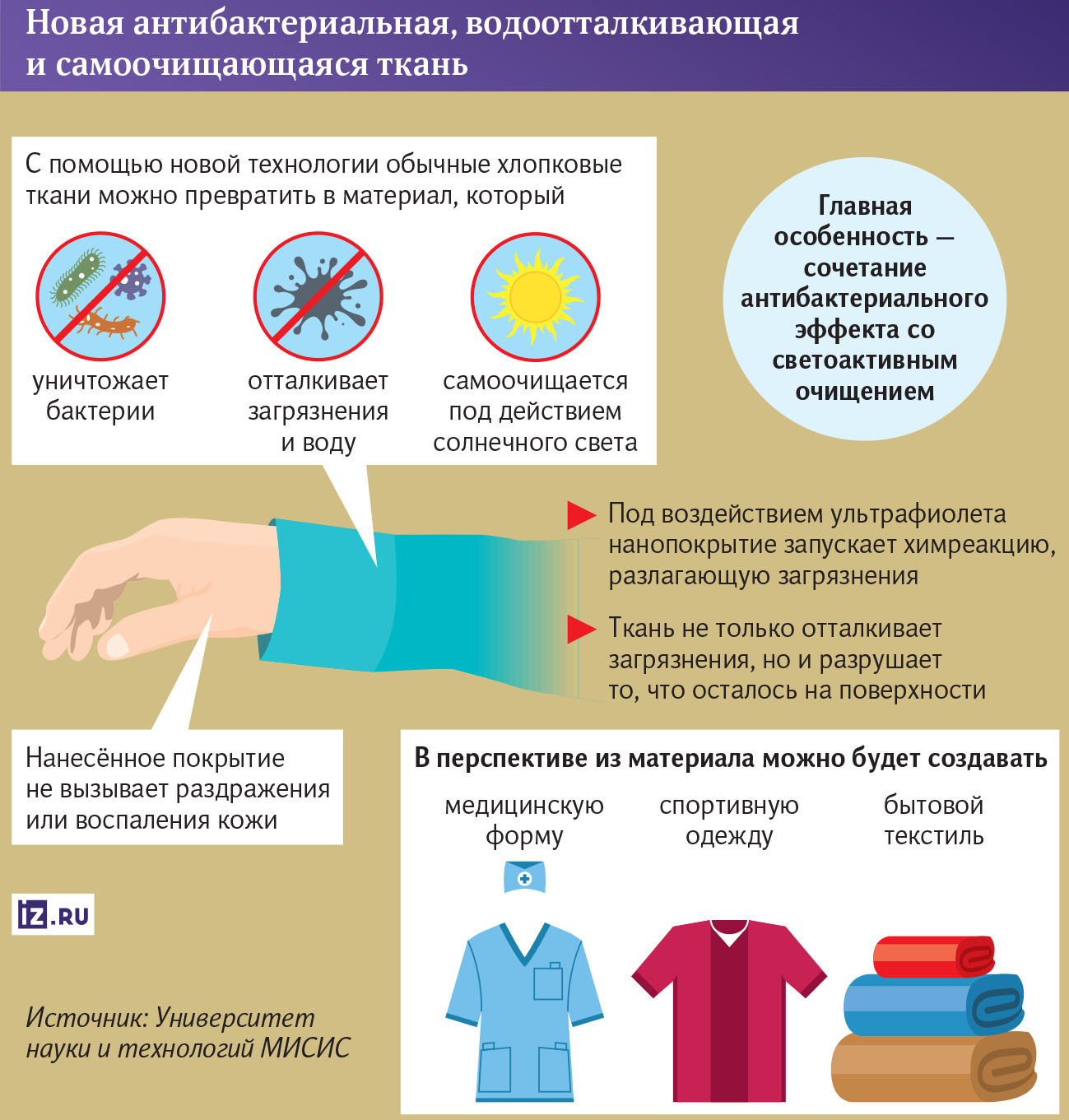
With the help of a new technology proposed by NUST MISIS researchers, ordinary cotton fabrics can be turned into a material that destroys bacteria, repels pollution and self-cleanses under the influence of sunlight. The applied coating has shown high effectiveness against dangerous bacterial strains and is completely biocompatible and does not cause skin irritation or inflammation. In the future, it will be possible to create medical uniforms, sportswear and household textiles from the material, the developers told Izvestia.

Previously, scientists were able to impart either antibacterial or water-repellent properties to tissues. Until now, it has not been possible to combine these characteristics in one material, ensure their long-term stability and at the same time maintain complete safety for humans. According to the NUST MISIS researchers, this is the first time they have managed to solve this problem.

This result was achieved by including hybrid nanoparticles based on boron nitride and zinc oxide in the fabric, the scientists said. In order for the nanoparticles to be better distributed over the surface of the tissue fibers and bind tightly to it, they were pretreated with a compound of diethylenetriamine (DETA), so that amino groups were formed on the surface of the particles. Due to this, they were able to form hydrogen bonds with cellulose, the main component of cotton, thus ensuring the stability of the obtained materials.

— Nanotextile materials are widespread, however, their main problem remains the loss of functionality during use. Previously, we developed a technology using DEET, which allowed us to keep more than 50% of the particles on the surface even after 40 washes. Nevertheless, the fabric still lost its desired characteristics, since detergents contain a large amount of surfactants that envelop the particles, thereby preventing them from performing their functions," said Elizaveta Permyakova, a junior researcher at the Inorganic Nanomaterials Research Center at NUST MISIS.

The purpose of this work was to obtain materials that, having antibacterial activity and hydrophobicity, are able to be cleaned of pollutants in an alternative way, in this case by sunlight, she noted.
What have the smart fabric tests shown?
Tests have confirmed the high water and dirt repellent properties of the new coating. The angle of contact with water reaches 145 degrees — moisture is not absorbed into the fabric, but collects in droplets and rolls off the surface, carrying with it dust and dirt particles. After a day in the liquid, the material retains up to 92.6% of the protective layer, while unmodified fabric loses more than a third of the coating.
— The main feature is the combination of antibacterial effect with light—active cleansing. Under the influence of ultraviolet radiation, zinc oxide nanocoating triggers a chemical reaction that decomposes organic pollutants: components of sweat, food stains or beverages. Thus, the fabric not only repels impurities, but also destroys those that remain on the surface," said Dmitry Shtansky, Director of the Inorganic Nanomaterials Research Center at NUST MISIS.

This technology really stands out even against the background of active global research in this field, the president of the Interregional Association of Entrepreneurs and Light Industry Enterprises Moda told Izvestia. Technologies. Retail", NTI WearNet market expert Alyona Rusakova.
— Smart clothes are a new trend. And here we see not just one function, but three in one: antibacterial, water-repellent and self-cleaning in one material. It is extremely difficult to achieve a combination of hydrophobicity, photocatalysis and biocompatibility in one study, and our scientists have succeeded. It is very important that specialists have solved the problem of coating stability, the material will not lose its properties after the first washes, which is considered one of the consumer limitations of such developments in the world," the expert noted.

First of all, the development will find application in medical clothing and textiles, where hygiene and reducing microbial load are critically important, says Maria Ashikhmina, senior lecturer at the ITMO University Research Center for Infochemistry. According to her, the material is promising for sportswear — to combat odors and traces of sweat, as well as for uniforms and special equipment used in conditions of increased pollution. In addition, the coating can be used in children's clothing and goods, where the confirmed absence of harmful effects and hypoallergenic are especially important.

— Zinc oxide is known for its biocompatibility and antimicrobial properties. This opens up opportunities for creating bandages with antibacterial and self-disinfecting effects, as well as textile coverings for the hospital environment. Such technologies can help reduce the risk of nosocomial infections, especially given the growing antibiotic resistance," the specialist emphasized.

However, laboratory research is one thing, and mass production of materials using this technology is quite another, noted Alyona Rusakova. According to her, a well-established technology transfer system, specialized equipment and trained personnel are needed for the large-scale production of such materials.
The work was supported by a grant from the Russian Science Foundation, as well as within the framework of the NUST MISIS strategic technology project "Biomedical Engineering and Biomaterials" under the program of the Russian Ministry of Education and Science "Priority 2030". The scientists published detailed results in the scientific journal Applied Surface Science.
Переведено сервисом «Яндекс Переводчик»
