
Not upset: top developers rent every eighth meter of housing with a delay.

As of February this year, every eighth square meter of housing, which is being built by the five largest developers in the country, is being built in violation of schedules, Izvestia found out. This is four times more than at the beginning of 2025. Of the large companies, the projects of the Aeroplane and Etalon groups are most often delayed — they have violated deadlines for almost every fourth meter. PEAK and "Exactly" have a delay rate below 10%, but considering the volume of construction, this is also significant. What to expect for shareholders and when the situation can return to normal is in the Izvestia article.
Which developers rent housing late
By February 2026, the share of projects that are being commissioned with a delay among the top 5 developers reached 12.7%, which is more than 1.95 million square meters, according to the data from the Unified Resource of Developers (ERZ).
In February 2025, this figure was only 3.2% (503.8 thousand square meters out of 15.7 million under construction). Thus, the share of problematic construction among market leaders has almost quadrupled in a year.

Among the top 5 companies in terms of construction volume, the Airplane group most often violates deadlines. Of the 4.71 million square meters that the organization is currently building, the schedules are shifted by almost 1.22 million "squares" — this is 26% of the portfolio, according to the data in the ERZ. For comparison: in February last year, according to the resource, the "Plane" had only 6.8% of projects with transfers.
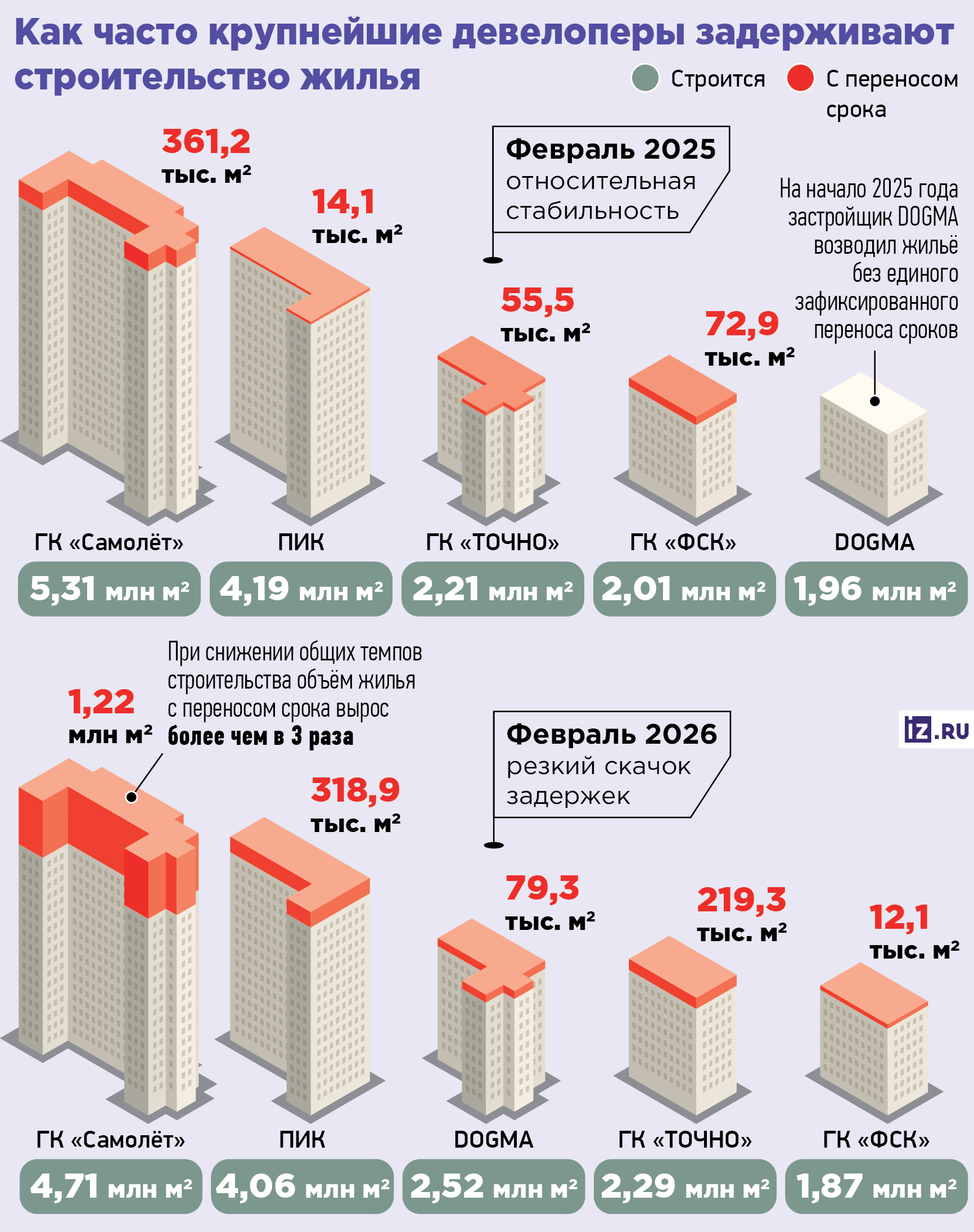
This is followed by GC Exactly: 9.5% of housing under construction (219.3 thousand square meters out of 2.3 million) was affected by postponements. Moreover, the indicator has also jumped almost fourfold over the year. PEAK delays occur in 7.8% of housing (almost 319 thousand square meters out of 4.07 million). FGC Group of Companies closes the top five (6.5% of transfers) and Dogma (3.1%).

This is not a disaster yet, but it is already a noticeable stress signal, says Vladimir Chernov, analyst at Freedom Finance Global. According to him, for a market where projects are under bank control, an acceptable proportion of facilities with modified schedules is usually kept within a few percent.
Among the top 20 developers in the country, there are other companies that often violate construction deadlines. The Etalon group's share of "problem meters" reaches almost 23%. Strana Development has 13.5%, and A101 has 12.5%.

Some players with smaller construction volumes miss deadlines even more often. For example, the Squadra group of companies in Primorsky Krai has disrupted schedules for half of the meters under construction. MSK from the Rostov Region has almost 45% each, and Metrix Development from the Krasnodar Territory has 41% each. And at St. Petersburg's Seven Suns Development and Moscow's UEZ, every meter under construction is completely late. Izvestia sent a request to all the listed companies.
What proportion of delayed facilities is critical for the company
A quarter or more of an individual player's portfolio with transfers is no longer a "background", but a signal of risk concentration, said Konstantin Konov, founder of the real estate consulting company Youkon. This means an increased sensitivity of the business to the key rate, sales and construction rates, he explained.
In other words, with a high proportion of problematic facilities, any external shock — whether it is another tightening of monetary policy (an increase in the cost of project financing), a drop in demand from customers or disruptions from contractors - can dramatically worsen the company's financial situation and lead to cash gaps. This is especially sensitive for the industry if major players from the top 20 start having problems.
For a developer whose debt coverage (the ratio of funds in escrow accounts to the loan amount) may be less than 70%, the current level of the key interest rate creates serious risks, warns Konstantin Konov. In this case, the money of shareholders in the accounts turns out to be insufficient to fully meet obligations to banks, and expensive project financing eats up margins.

Izvestia appealed to the Ministry of Construction of the Russian Federation with a request to assess the postponement situation among the largest developers and comment on possible measures to support the industry.
In mid-January, Aeroplane asked the government for support. They requested a preferential loan of 50 billion rubles for a period of up to three years in order to "eliminate non-fulfillment of obligations to shareholders and investors."

Nina Golubnichaya, Financial director of Aeroplane, explained during a conference call with investors that this was not about a "financial hole", but about subsidizing interest rates on loans, and assured that the company had not asked for money to close cash gaps.
Why developers don't meet deadlines
According to experts interviewed by Izvestia, there are many reasons for disrupting schedules. Irina Pashkovskaya, head of the Analysis Center at the federal company Etagi, identifies systemic factors: unstable prices for building materials, high cost of loans (borrowing has more than doubled in price in recent years) and an acute shortage of personnel.

The high cost of borrowed funds directly affects the pace, Irina Pashkovskaya explained. Developers have to work hard with the cost, limiting the number of contractors and reducing the wage fund allocated for processing. Any savings leads to longer deadlines, she added.
The increase in the share of problem properties among the top 5 developers to 12.7% is a consequence of tight monetary policy and cooling demand after the curtailment of mass preferential mortgages in 2025, said Valery Tumin, director of markets in Russia and the CIS at Fam Properties.
Until December 31, there was a moratorium on charging penalties to developers for failure to meet deadlines, said Flip CEO Evgeny Shavnev. Developers could take their time, work in a calm mode, without fear of massive claims from shareholders, and this eventually affected the growth of the indicator, he stated.

With the advent of 2026, the situation has changed dramatically. The moratorium on fines for developers has ended, and now every day of delay is converted into money for the buyer, explained Nikita Chaplin, a member of the State Duma Committee on Budget and Taxes. The main tool for protecting shareholders is a penalty in the amount of 1/150 of the Central Bank's key rate from the contract price for each day of delay in the transfer of the apartment. If the developer does not voluntarily satisfy the reasonable demands, the court will impose an additional fine from him — 5% of the amount awarded.
The fact of delay should be recorded in writing — send a claim, and only then go to court, Konstantin Konov noted. With a significant delay of more than two months, the shareholder has the option to terminate the equity agreement, on the basis of which citizens invest money in housing under construction, unilaterally and demand a refund with interest, the expert added.

It will not be possible to collect a penalty for the period of the moratorium — from March 22, 2024 to December 31, 2025, analysts warn. These days are excluded from the calculation by law.
How will housing prices change in 2026
If there are more projects with transfers, the actual supply of ready-made housing may decrease. In some locations, this can affect prices, explained Vladimir Chernov. But at the same time, an increase in the number of delays means weak sales and the need to stimulate demand with discounts and installments. At the statistical level, it turns out to be stabilization rather than linear growth, the expert added.

According to Yevgeny Shavnev's forecasts, in 2026 the price growth for primary housing will not exceed 6%, and in the secondary market everything will depend on demand.
If the share of construction projects with modified schedules increases to 15-20% among major players, the market will consolidate, Konstantin Konov predicts. Strong companies will absorb weak ones, and some projects will be restructured.
According to Alexey Golovinov, Chief analyst at Vector Capital IC, the share of objects with postponed dates in the market as a whole is already significant. This increases the likelihood of point bankruptcies among weak participants. At the same time, the money of shareholders is protected in escrow accounts. They are stored in banks until the construction is completed and become available to the developer only after the property is put into operation. By the end of 2025, according to the Central Bank, there were almost 7.4 trillion rubles in escrow accounts.
Переведено сервисом «Яндекс Переводчик»
