Wheat in hand: Russia has become a key grain supplier for Sudan


Sudan, which is mired in a civil war, is counting on Russia's support. Moscow has already become an important supplier of grain to the country, its Ambassador Mohammed Sirraj told Izvestia. Russia has more than doubled its exports of grain and agricultural products. Economic cooperation is unfolding against the backdrop of a serious military escalation, fierce fighting in Darfur and Kordofan, as well as a rapidly deteriorating humanitarian situation, primarily in the field of education, where millions of children are deprived of the opportunity to study.
Increased supply of agricultural products to Sudan
Exports of Russian agricultural and food products to Sudan increased 2.3 times in 2025 and reached $410 million. According to the federal center Agroexport, the volume of supplies amounted to 1.7 million tons, and the key item was wheat, which accounted for more than $408 million in revenue. Flour, yeast and fertilizers were also supplied to Sudan.
As the Sudanese Ambassador Mohammed Sirraj told Izvestia, Russia's role as a food supplier for the country was significant even before the outbreak of war in April 2023.
"The growth of Russian agricultural exports, in particular, fits into the context of the expansion and development of Russian-African relations," he said.
According to him, Sudan traditionally imports wheat, flour and fertilizers from Russia, and the increase in volumes was a direct result of the progressive development of bilateral ties. Last year, a meeting of the joint intergovernmental commission at the ministerial level was held, where its participants developed a clear framework for the development of economic and trade cooperation, the diplomat recalled.
Earlier, Russian Minister of Natural Resources Alexander Kozlov also pointed to a noticeable increase in trade turnover between the two countries, primarily due to an increase in supplies of Russian agricultural products to Sudan. Food cooperation with the Russian Federation is becoming particularly important against the background of war and supply disruptions from other countries.
According to orientalist Leonid Tsukanov, against the background of the ongoing armed clashes in the republic, any stable format of agreements on food supplies helps to stabilize the internal situation, especially when it comes to essential goods.
— Taking into account the fact that Russia is increasing its activity in Africa, the rapprochement with Sudan in terms of grain and fertilizer supplies creates a good foundation for further expansion of trade and economic relations with the region. Moreover, there is a consistently high demand for Russian goods in this category," he told Izvestia.
Sudan rejects the participation of the Security Council in the political process
The civil conflict in Sudan has not been resolved yet. At the end of October 2025, the Rapid Reaction Force (RDF) announced the capture of the army headquarters in El Fasher, a key base in Northern Darfur. The Sudanese authorities reported more than 2.3 thousand dead during the assault, and local doctors recorded attacks on hospitals and murders of patients.
In recent months, the epicenter of the fighting has been the Kordofan region, where the RDB deployed its main forces after gaining control of Darfur. In early December, the parties fought fierce battles, accompanied by accusations of attacks on civilian targets and civilian casualties.
After the overthrow of President Omar al-Bashir in 2019, the country began the process of restructuring the security system. Under Bashir, the army commander and the head of the Security Council reported directly to him, but after the coup, the transitional authorities initiated a reform involving the inclusion of Rapid Reaction Forces in the national armed forces. The intention of the cabinet of Abdel Fattah al-Burhan to fully integrate the SBR provoked resistance from the SBR, which in April 2023 resulted in large-scale clashes with regular troops.
Human rights organizations reported the deaths of dozens of people, including students, as a result of strikes on civilian infrastructure. Amnesty International accused the SBR of war crimes, in particular, during the attack on the Zamzam refugee camp in Northern Darfur, from where hundreds of thousands of people were forced to flee. Against this background, the Sudanese authorities continue to rule out the possibility of political compromises with the Security Council.
Mohammed Sirraj stressed that their participation in the future political process is excluded.
"It is absolutely unacceptable for this group to play any role in the future political or economic structure of Sudan after the crimes and atrocities that the whole world has seen," the ambassador said.
Khartoum insists that power in the country must fully return to the hands of the state, and any attempts to recognize the rebels as legitimate are unacceptable.
"The Government of Sudan is interested in achieving peace and ending the systematic destruction of infrastructure and attacks on civilians by the Rapid Reaction Forces and their patrons," he said.
Sudan's peace initiative, presented at the UN Security Council in December, provides for a phased end to the conflict, Mohammed Sirraj added.
"The initiative is based on the withdrawal of the group from the occupied territories, their disarmament and placement in special camps, as well as on resolving refugee issues, reparations, bringing perpetrators to justice and public reconciliation," the diplomat explained.

Millions of children have been unable to go to school for two years
One of the most severe consequences of the war was a large-scale humanitarian crisis. According to international organizations, famine, the most acute form of the food crisis, has been officially recorded in several regions of Sudan. In Northern Darfur, certain territories have entered the fifth, catastrophic phase according to the IPC international classification. Millions of people are at risk of experiencing acute malnutrition throughout the year.
The situation is particularly difficult in the field of education. Save the Children, a non—governmental organization, reports that millions of Sudanese children have missed almost 500 school days since the start of the war, one of the longest school closures in the world, exceeding even pandemic restrictions. More than 8 million children, almost half of the country's schoolchildren, were actually deprived of the opportunity to study.
"The educational process in Sudan has suffered as a result of the aggressive war waged by the Rapid Reaction Forces against civilians and civilian infrastructure, including schools and educational institutions," said Mohammed Sirraj.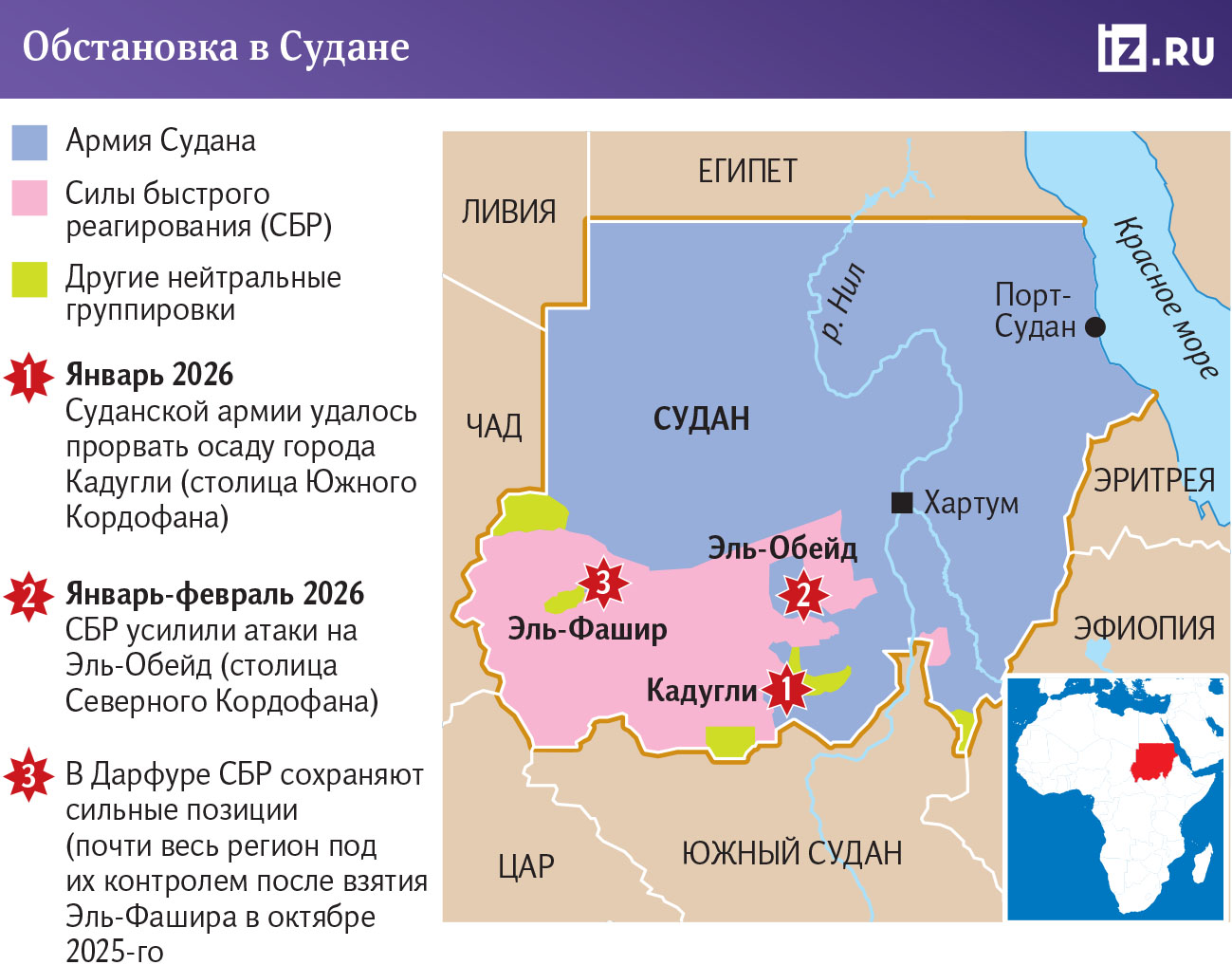
According to the ambassador, hundreds of schools were destroyed, and the massive displacement of the population and the loss of jobs by thousands of teachers virtually paralyzed the educational system. "This adds to the list of crimes recorded in the dossier of this group," the diplomat added.
At the same time, he noted, the situation is gradually improving in the areas liberated from SBP control. After the return of government institutions to Khartoum, schools reopened and students returned to their desks. A similar process is underway in other regions, with the exception of Darfur and parts of Kordofan, the ambassador said. The goal of the authorities is to restore security throughout the country.
"The Sudanese army intends to liberate every piece of national land in order to normalize life and return children to full—fledged education," concluded Mohammed Sirraj.
In these circumstances, cooperation with the Sudanese authorities on the project to create a logistics center for the Russian Navy on the Red Sea coast remains an important area for Moscow. The Russian side is confident that its implementation will be able to strengthen regional stability and create additional conditions for economic development. Earlier, former Sudanese Foreign Minister Ali Yousef Sharif pointed out that Moscow and Khartoum had reached a full understanding on this issue.
Переведено сервисом «Яндекс Переводчик»
